Renovate basement ceiling yourself – safely replace steel beams
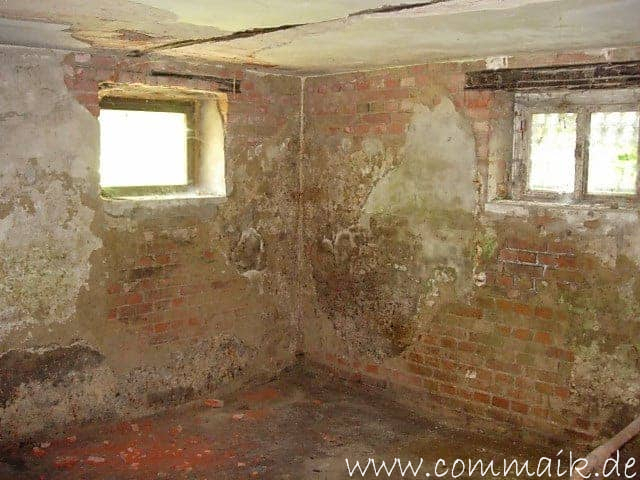
Our art nouveau villa was built in 1900 and has a full basement. However, there is another, previously unrenovated cellar beneath the basement. This was used in the past as a vegetable cellar and air raid shelter. The climate is therefore cool and humid.
Over the years, leaking pipes on the outside have led to major water damage in this area. For years, rainwater from a roof area of more than 100 square meters ran directly into the masonry.
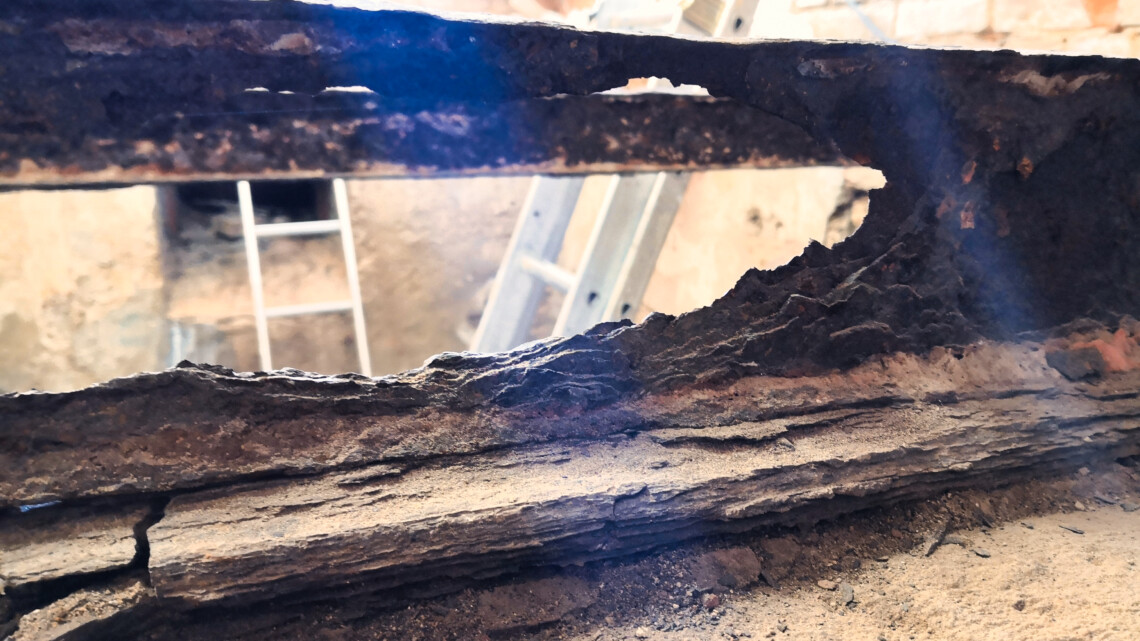
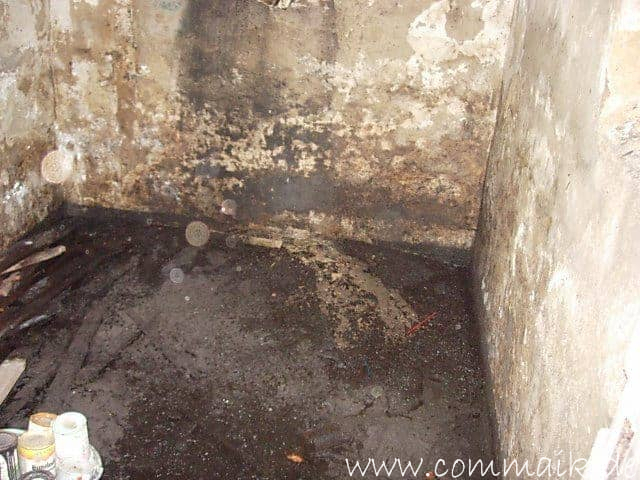
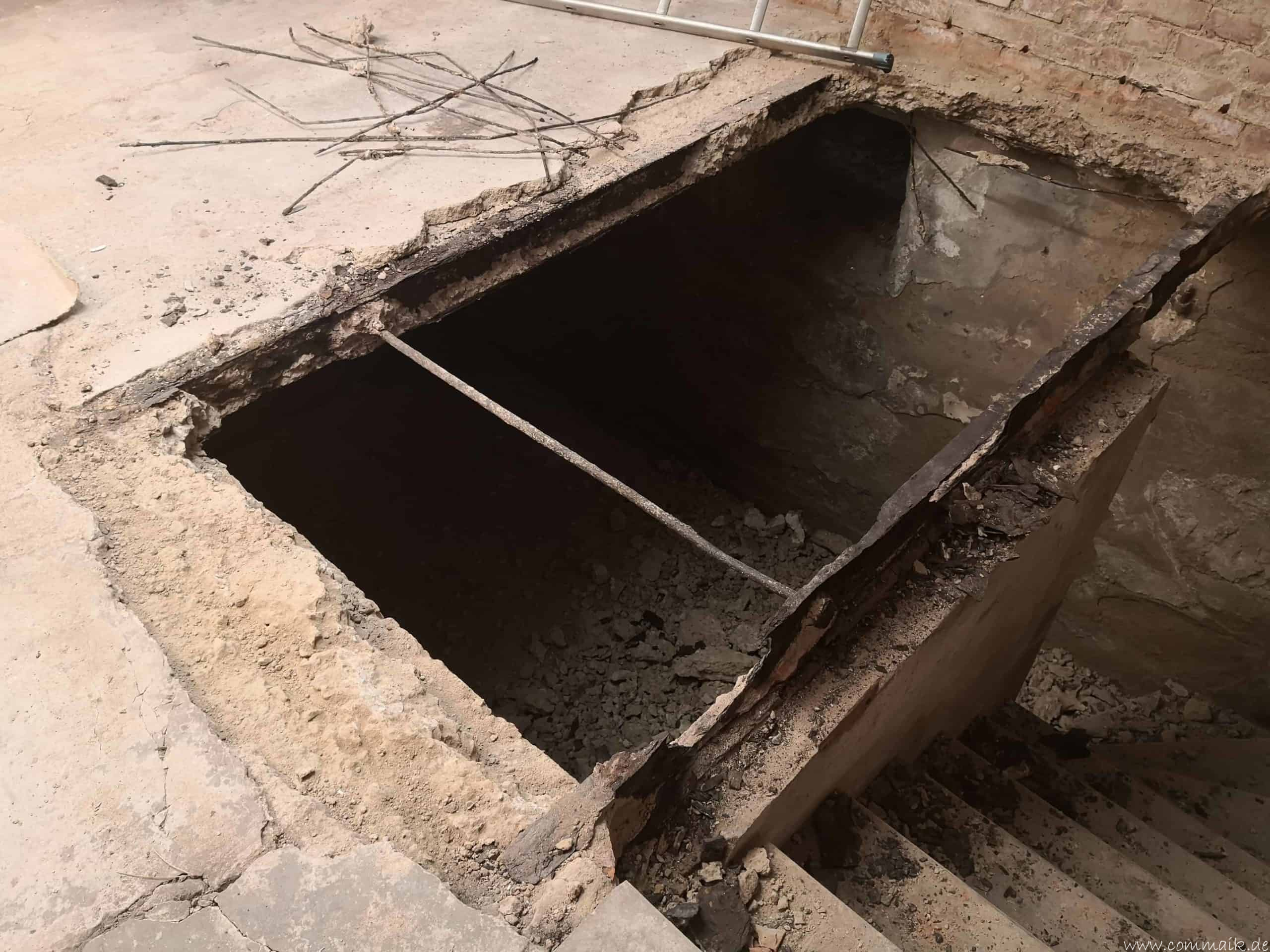
This, of course, had a considerable impact on the building fabric. The steel beams in the basement ceiling are badly rusted and the floor is blown up.
Drying basement – false ceiling must be renovated
In order to make the room usable in the future, the entire area had to be drained. I had already repaired the downpipes and uncovered the walls of the upper cellar on the outside. In addition, the entire plinth area was drained with a drainage system.
As the lower cellar extends to a depth of six meters below ground, it was not possible for me to expose the plinth in this area from the outside. The risk of the foundation walls collapsing was simply too great.
So I had to work from the inside. I have described my experiences with the installation of a retrofitted horizontal barrier and the creation of a pump sump in the article Draining the basement – 1 year later.
The basement ceiling with its rusted steel beams also required renovation. To do this, the old basement ceiling had to be removed and completely rebuilt. This all had to be done laboriously by hand, as there was no access for heavy equipment.
The intermediate ceiling between the steel girders was filled with concrete screed. Reinforcement provided additional stability. After all, this cellar had also served as an air raid shelter during the war.
The demolition was therefore very laborious.





- POWER: Mit einer Schlagkraft von 50 Joule, 2000 Schlägen in einer Minute und der Leistung von 1600W ist die Maschine ein wahres Powergerät und garantiert einen zuverlässigen Einsatz
- Praktisch: die Meißel / das Werkzeug kann einfach und schnell gewechselt werden so haben Sie mehr Zeit für Ihre Abbrucharbeiten.
- Komfort: durch den D-Handgriff mit Dämpfung der Vibration (soft-grip) können sie auch über einen längeren Zeitraum ermüdungsarm arbeiten.
- Kompakt: die schlanke Bauweise ermöglicht das Arbeiten auch in schwer zugänglichen Bereichen. Frequenz: 50 Hz
- Lieferumfang ab 1600: der Hammer wird zusammen mit einem stabilen Meißel Set (1x spitz, 1x flach) in einem robusten Koffer aus Metall geliefert (Farbe des Metallkoffer blau)
Why does our house have a 2nd basement?
Old houses often have an interesting architectural feature: for example, an additional cellar beneath the actual cellar.
These additional basements, such as the one under our house, which is about 15 square meters in size and is almost 6 meters below ground level, were built for several reasons.
Originally, they were used to create a constantly cool environment for storing food, especially vegetables. The constantly cool climate, which prevails in both summer and winter, is ideal for storing and preserving food.
The depth of these cellars naturally ensures a constant temperature and high humidity. These conditions are ideal for keeping food such as potatoes, apples and pickled vegetables fresh for longer periods of time.
However, when storing food, care must be taken to ensure that it is well ventilated to prevent mold growth. Food should be stored in containers or on shelves that allow air to circulate.
In addition to the advantages, such as natural cooling and suitability for food storage, these cellars also have disadvantages. The high humidity can lead to moisture problems, which can affect not only the storage conditions but also the fabric of the building.
The moisture can promote the formation of mold and damage wood and other materials.
To reduce the disadvantages, it is important to take measures to control moisture. This includes good ventilation to keep the humidity low.
In some cases, it may also be necessary to add insulation to the walls or install drainage or a dehumidifier to effectively manage moisture.
Video: Replacing and renovating basement ceilings
I recorded the demolition and dismantling of the old steel girder ceiling in the basement in a short and informative video and published it on my YouTube channel.
You can find my videos about drying and finishing the basement in my playlist Drying Basements.
If you want to see more of me and my projects, feel free to check out my YouTube channel.
Zuletzt aktualisiert am 12. April 2026 um 10:33 . Ich weise darauf hin, dass sich hier angezeigte Preise inzwischen geändert haben können. Alle Angaben ohne Gewähr. (*) Bei den verwendeten Produktlinks handelt es sich um Affiliate Links. Ich bin nicht der Verkäufer des Produktes. Als Amazon-Partner verdiene ich an qualifizierten Verkäufen. Dein Preis ändert sich jedoch nicht.


Demolish basement ceiling – air tools help
In addition to the hammer and chisel, I used my tried-and-tested pneumatic tools. After the first segment was completed, however, the first pneumatic chisel was destroyed. The concrete was simply too hard.
To continue the work, I ordered a new chisel and the next day I was able to continue the demolition.
I loosened the concrete very finely with the pneumatic chisel. However, the basement ceiling was still very stable and load-bearing due to the reinforcement. I then worked on the area with the large 5 kg sledgehammer.
Thanks to the previous loosening, I was now able to break up larger pieces of the ceiling and gradually remove them.
Nevertheless, it took over three days to remove the 15 square meter false ceiling.
I proceeded as follows:
- Preparation of the work area: I carefully secured the area and provided all the necessary tools.
- Working on the first segment with the pneumatic chisel: The concrete was loosened piece by piece.
- Using the sledgehammer: Once the concrete was sufficiently loosened, I was able to remove larger pieces.
- Removal of the concrete pieces: The larger pieces were gradually removed.
- nishing the work: After three days, the ceiling was completely removed.
In the end, I still managed it and can now start installing the new basement ceiling.



- Doppelzylinder sorgt für die kraftvolle Ansaugleistung von 412 l/min
- Maximaler Arbeitsdruck von 10 bar
- Leistungsstarker 3,0 PS Motor
- Kesselvolumen von 50 L
- Druckminderer für die optimale Regelung des Arbeitsdruckes
- Anschluss an gewöhnlichen 230 V Stromzugang
- 2 Schnellanschlusskupplungen für einen schnellen Werkzeugwechsel
- Vibrationsgedämpfte Standfüße aus Gummi für rutschfestes Abstellen
- Fahrvorrichtung für einen einfachen Transport
- Bitte beachten Sie: Die Abbildung zeigt einen Druckminderer und weicht vom tatsächlichen Produkt ab. Die korrekte maximale Luftleistung beträgt 412 l/min. Auf dem Artikel selbst und in der Bedienungsanleitung ist fälschlicherweise 371 l/min angegeben.
Summary and conclusion
In our Art Nouveau villa from 1900, which has a full cellar, there is another cellar of around 15 square meters below the main cellar, which extends six meters underground.
In the past, it served as a vegetable cellar and air raid shelter and is characterized by its cool, damp climate.
However, long-term exposure to moisture caused by leaking pipes has led to considerable water damage to the building fabric, particularly to the steel beams of the basement ceiling.
To make the room usable again, it was necessary to dry out the entire area, which I achieved by repairing the downpipes and exposing the outer walls.
As the cellar is very deep, the base could only be uncovered from the inside.
The severely damaged basement ceiling had to be painstakingly demolished and rebuilt by hand without heavy equipment.
FAQ on renovating the old cellar
1 Why do some old houses have a second cellar?
A second cellar, like the one under our Art Nouveau villa, was originally built to create a constantly cool environment for storing food. The low location ensures stable temperatures and high humidity, ideal for preserving provisions.
2. what damage was caused by the damp in the lower cellar?
For years, water from leaking rainwater downpipes ran into the brickwork, causing rust on the steel beams of the basement ceiling and damage to the concrete floor. This moisture has significantly impaired the fabric of the building.
3. how was the cellar drained?
To drain the building, the downpipes were repaired, the walls in the upper area were exposed and a drainage system was installed in the plinth area. As it was not possible to expose the plinth in the lower cellar, it was drained from the inside.
4 Why did the basement ceiling have to be demolished by hand?
Access for heavy machinery was not possible due to the cellar’s location six meters below ground. The demolition therefore had to be carried out by hand using pneumatic tools and a sledgehammer.
5. how was the basement ceiling renovated?
The old ceiling was demolished, the damaged steel girders removed and the concrete ceiling replaced. New reinforcement was installed to increase stability.
6. what measures have been taken to prevent future moisture damage?
In addition to repairing the rainwater downpipes, drainage pipes were installed and a subsequent horizontal barrier was fitted to prevent the ingress of moisture.
7 Why was the cellar used as an air raid shelter?
During the Second World War, many cellars, especially low-lying ones like this one, offered protection from air raids. The solid construction and stable basement ceiling made it a suitable shelter.
8. which tools were used to demolish the cellar ceiling?
In addition to a pneumatic chisel, which was used to loosen the concrete, a sledgehammer was also used to remove the loosened concrete parts.
9. how long did the demolition of the basement ceiling take?
The demolition of the approximately 15 square meter ceiling took a total of three days. The work was carried out painstakingly by hand.
10. how will the renovated cellar be used in the future?
After the renovation, the cellar is to be used as a storage room, with long-term use as a hobby room or wine cellar also being considered.
Dieser Beitrag ist auch verfügbar auf:
 English
  Deutsch


Ähnliche Beiträge
Build your own garden kitchen – brick and glue walls with aerated concrete
Build your own carport – secure slope with shuttering blocks