ECOVACS GOAT O1200 LiDAR PRO Review: Perfect Edge Mowing Without Any Touch-Ups?
Lawn edges are among the biggest weak spots for many robotic mowers. The open lawn area is mowed neatly, but a narrow strip often remains unmowed along walls, hedges, or barriers that the mower cannot cross. That’s exactly where the ECOVACS GOAT O1200 LiDAR PRO comes in, with its side-extending TruEdge Trimmer.
I tested the robotic lawn mower on three separate lawns, evaluating features such as automatic mapping, navigation, app control, the mowing pattern, and edge cutting. I was particularly interested in whether the built-in trimmer could actually reduce the need for regular touch-ups with a handheld trimmer.
The first impression in the ECOVACS GOAT O1200 LiDAR PRO review was extremely positive. The automatic mapping worked accurately; the robot mowed its areas in orderly patterns, and the trimmer even removed grass along my hedge. As my long-term test continued, however, a defect developed in the trimmer unit. This point is also part of my experience with the ECOVACS GOAT O1200 LiDAR PRO and, as such, plays a significant role in my conclusion.
ECOVACS GOAT O1200 LiDAR PRO Review: My Testing Framework
My test environment consisted of three separate lawns. There are paved paths between the individual zones, which the robot had to navigate on its own. On top of that, there were hedges, straight lawn edges, WPC boards used as edging, tight inside corners, and several flat covers for the valve boxes of my automatic lawn sprinkler system.
While testing the O1200 LiDAR PRO, I tried out the following features myself:
- Installation and Connection of the Charging Station
- Integration with the ECOVACS HOME app
- Installing a Firmware Update
- Automatic mapping of three lawns
- Manual configuration of connection paths
- Mowing by zone
- Electric cutting height adjustment
- Navigating along hedges and fixed boundaries
- Edge Trimming with the TruEdge Trimmer
- Crossing over flat valve box and irrigation covers
- Behavior at 90-degree inside corners
- Manual and automatic trimming modes
- Removal, Cleaning, and Reinstallation of the Trimmer Coil
I have not tested the manufacturer’s stated maximum coverage of 1,200 m² on a contiguous area of that size. Nor were the maximum climbing ability and the ability to recognize 200 different types of objects part of a standardized in-house test.


At a Glance: Strengths and Weaknesses of the GOAT O1200 LiDAR PRO
Strengths
- Automatic mapping without boundary wires or an RTK antenna
- Precise navigation across my three lawns
- Neat and orderly mowing patterns
- Electric cutting height adjustment via app
- Very quiet normal mowing operation
- Effective trimming of hedges and straight borders
- significantly less manual rework on suitable lawn edges
- Compact design for formal gardens
- The charging station can also be placed on a paved surface
- In my test, flat irrigation covers were driven over
Weaknesses
- The TruEdge trimmer is noticeably loud when in use
- Thread can damage delicate edging
- Grass clippings in tight 90-degree interior corners
- Trimmer line and brush are wear parts
- The trimmer unit stopped working after about two months
- The first repair under warranty demonstrably did not fix the problem
- No AWD for particularly challenging terrain
- The exact lifespan of the optimized trimmer unit remains unknown

- 【Intelligente Navigation für sichereres Mähen 】Das bahnbrechende Dual-LiDAR-Navigationssystem HoloScope 360 verfügt über ein 360°-LiDAR-Modul sowie eine KI-Kamera, um automatisch eine detaillierte 3D-Karte deines Rasens zu erstellen und eine präzise Navigation mit einer Genauigkeit von 2 cm zu gewährleisten – auch bei Nacht. Unabhängig von der Beschaffenheit deines Rasens gewährleistet er jedes Mal ein gleichmäßiges und präzises Mähen.
- 【Freihändiges Mähen】Der GOAT O1200 LiDAR PRO erkennt und speichert automatisch alle Arten von Begrenzungen, sodass keine zusätzliche Einrichtung von Begrenzungen oder RTK-Referenzstationen erforderlich ist. Er bietet eine um 150 % höhere Schnittleistung für professionell gleichmäßige Ergebnisse, und die App Steuerung ermöglicht manuelles Mähen oder die Fernüberwachung des Rasens.
- 【KI-gestütztes, vollautomatisches Kantentrimmen 】Der GOAT O1200 LiDAR PRO mit TruEdge Trimmer passt sich mühelos an alle Gartenformen an und bearbeitet gerade Kanten, Kurven und Ecken mit Präzision. Er erkennt automatisch über 200 Arten von Hindernissen, darunter Igel, und trimmt dicht um statische Objekte wie Baumstümpfe herum, während er sofort anhält, wenn er sich bewegende Hindernisse erkennt, um die Sicherheit von Menschen und Haustieren zu gewährleisten.
- 【Individuell anpassbares Mäherlebnis】Passe die Schnitthöhe in 1-cm-Schritten von 3 bis 8 cm an verschiedene Grasarten an, um deinen Rasen gesund zu halten und sein Wachstum zu fördern. Ein benutzerfreundlicher Karteneditor ermöglicht es dir, Bereiche nach deinen persönlichen Präferenzen hinzuzufügen, zusammenzuführen, zu teilen und zu löschen. Außerdem kannst du die Mähzeiten und -häufigkeit für bestimmte Bereiche so planen, dass sie deinem persönlichen Zeitplan und deinen Bedürfnissen entsprechen.
- 【Hervorragende Steigfähigkeit und Hindernisüberwindung】Bewältigt anspruchsvolles Gelände mit einer Neigung von 45 % und einer Hindernisüberwindung von 3 cm. Das besonders schmale Design in Kombination mit intelligenter Kantenerkennung ermöglicht eine mühelose Navigation auf Pfaden mit einer Breite von nur 0,8 m – ohne manuelles Eingreifen.
- 【Optimierte Pfadplanung für maximale Leistung】 Der GOAT O1200 LiDAR PRO, unterstützt durch Deep Learning und fortschrittliche Algorithmen zur Pfadplanung, unterscheidet in Echtzeit intelligent zwischen Grasflächen und anderen Bereichen. Er erstellt automatisch die effizientesten Mährouten, selbst auf Kurven, Hängen oder schmalen Wegen, reduziert dabei ungemähtes Gras und hält einen sicheren Abstand zu Hindernissen ein.
- 【Mehr Ersatzteile für verbesserte Haltbarkeit】 Die GOAT O1200 LiDAR PRO Care Kit-Version enthält zusätzlich 24 Klingen, Trimmerfaden (4) + Schrauben (4), Trimmerfadenabdeckung (1) + Schraube (1) für eine verbesserte Leistung. Genieße ein gleichmäßiges und langlebiges Mäherlebnis mit minimalem Aufwand.
Package Contents and Features of the ECOVACS GOAT O1200 LiDAR PRO
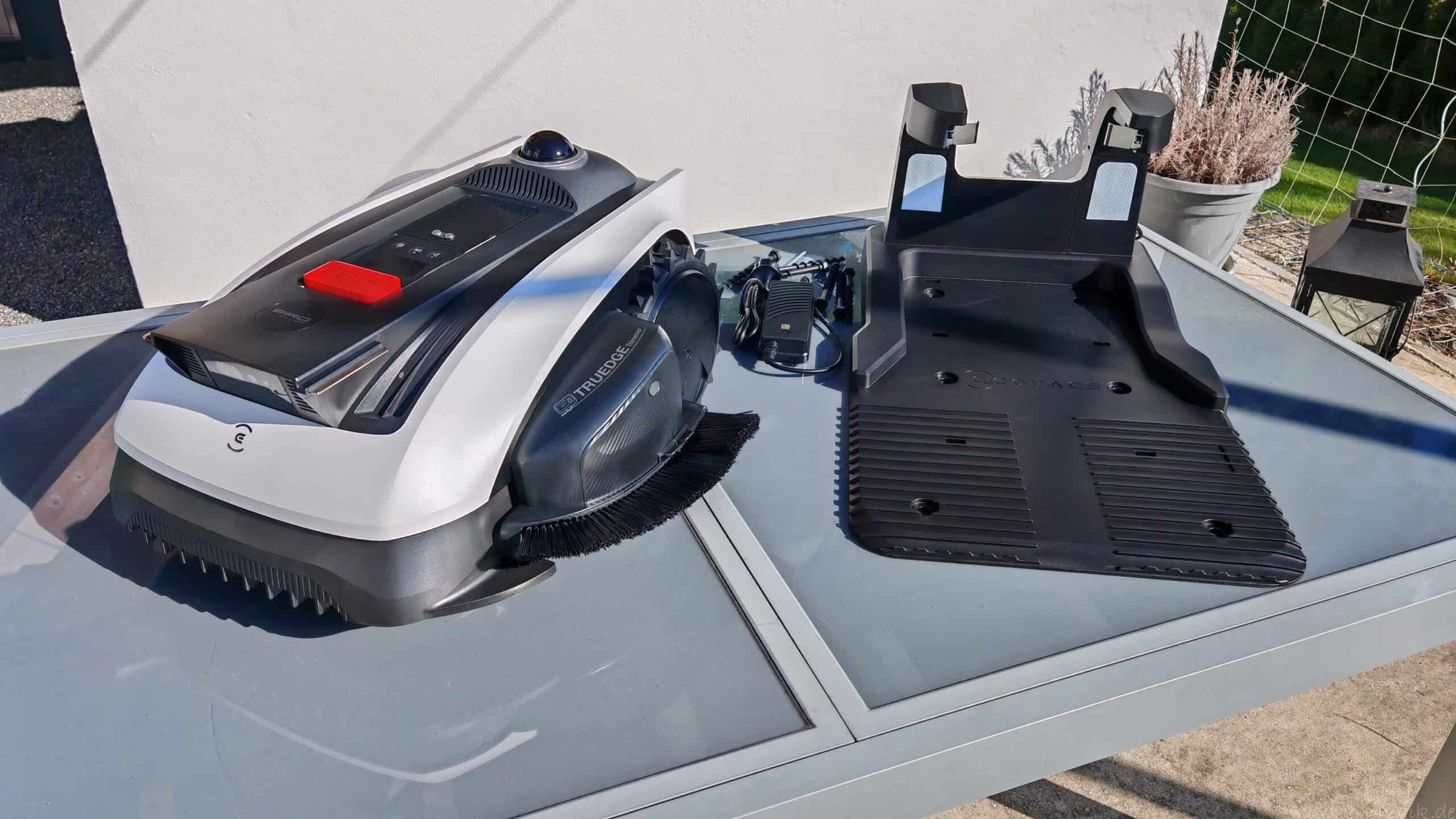
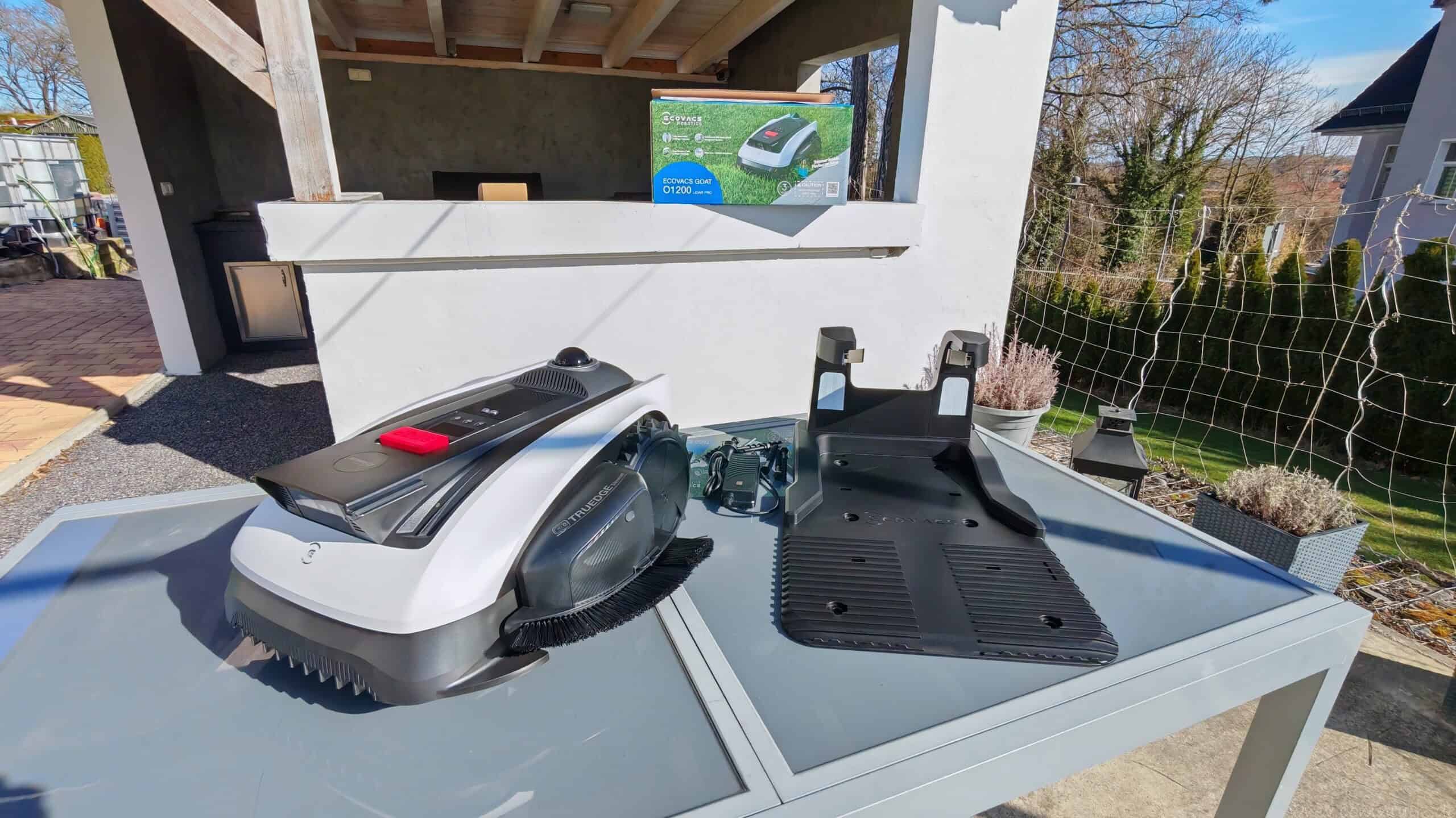
In addition to the robot mower, which is ready for use, the package includes all the components needed to set up the charging station, as well as replacement blades and printed documentation. A boundary wire or an RTK reference station is not required.
| Component | Quantity | Technical Specifications and Details |
|---|---|---|
| ECOVACS GOAT O1200 LiDAR PRO | 1 | Robotic lawn mower for areas up to 1,200 m²; 22 cm cutting width; electric cutting height from 30 to 80 mm; 5,200-mAh lithium-ion battery; Dual LiDAR navigation; IPX6; Weight: approx. 13 kg |
| Pre-assembled blades | 3 | Three flexibly mounted blades on the central mower, each with a mounting screw |
| Protective cover for the LiDAR sensor | 1 | Transparent cover to protect optical or laser-based sensors |
| TruEdge Trimming Module | 1 | Side-extending string trimmer for lawn edges; automatically stops when it detects a person or when the safety shut-off is activated |
| Trimmer line | 1 | Replaceable wear part for the trim module |
| Trimmer Brush | 1 set | A brush assembly consisting of two brush elements for protection and/or guidance along the edge |
| Charging station | 1 | Dimensions according to the manufacturer: 706 × 430 × 285 mm; weight approx. 2.9 kg; IPX6; with charging contacts and a permanently attached power cord |
| Charging station power cord | 1 | Permanently connected to the charging station; cable length: 10 m, according to the manufacturer’s current specifications |
| Power supply unit | 1 | 3-A AC adapter for powering the charging station |
| Earth Anchor | 6 | Mounting nails for securing the charging station to a suitable surface |
| Allen wrench | 1 | Tool for assembling or securing the charging station |
| Spare blades | 9 | Nine replacement blades, including nine matching mounting screws |
| Operating instructions | 1 | Printed manual containing operating, maintenance, and safety instructions |
| Quick Start Guide | 1 | Quick Guide to Setup, App Connection, and Initial Setup |
This means there are a total of twelve mower blades in the box: three blades are already mounted on the mower, and nine additional blades are included as spares. The corresponding screws are also included.
According to the manufacturer, the robot itself measures approximately 600 × 479 × 304 mm, although this measurement does not include the side trimmer brush. Including the charging station and packaging, the gross weight of the package is approximately 21.94 kg.
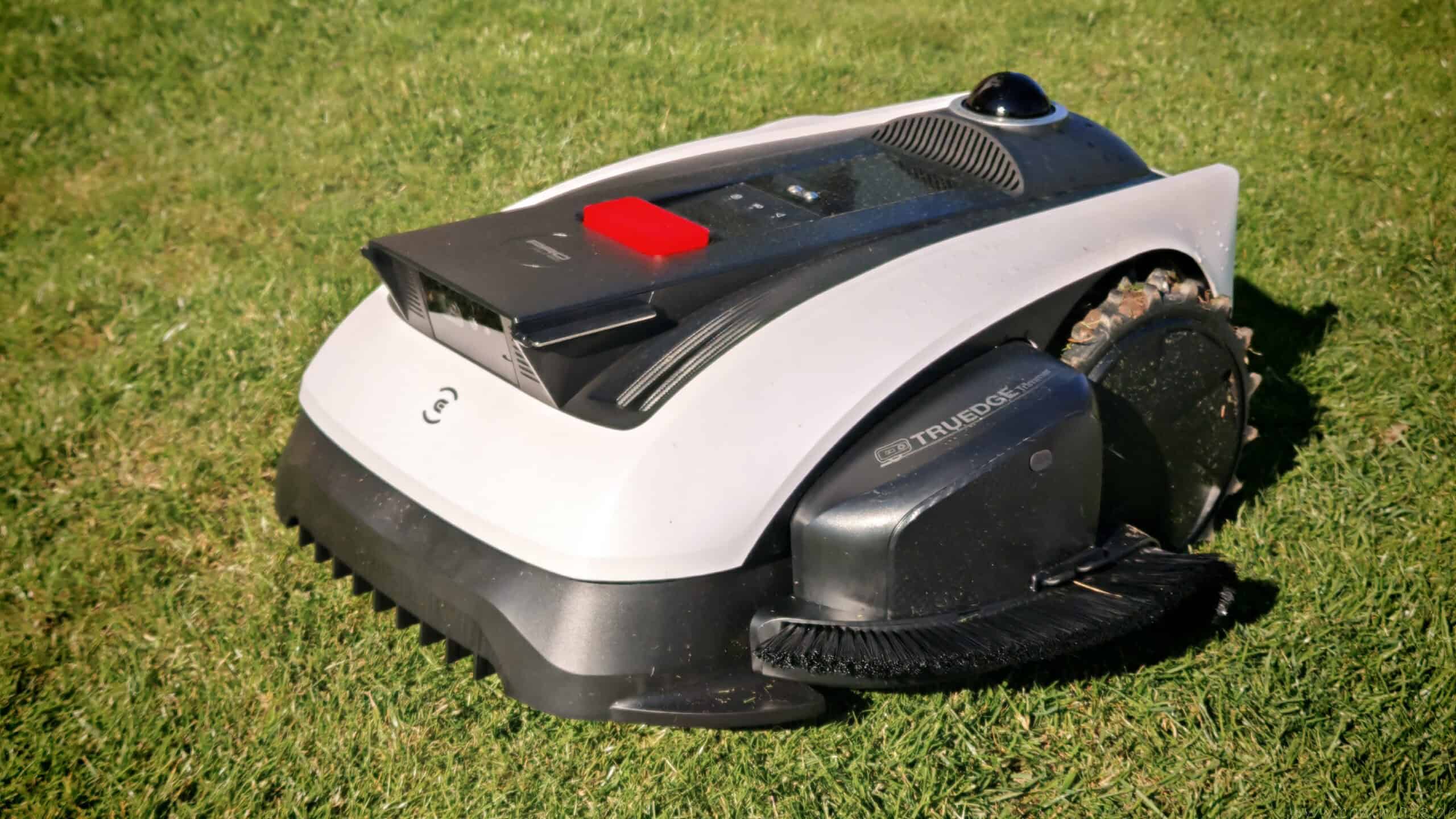
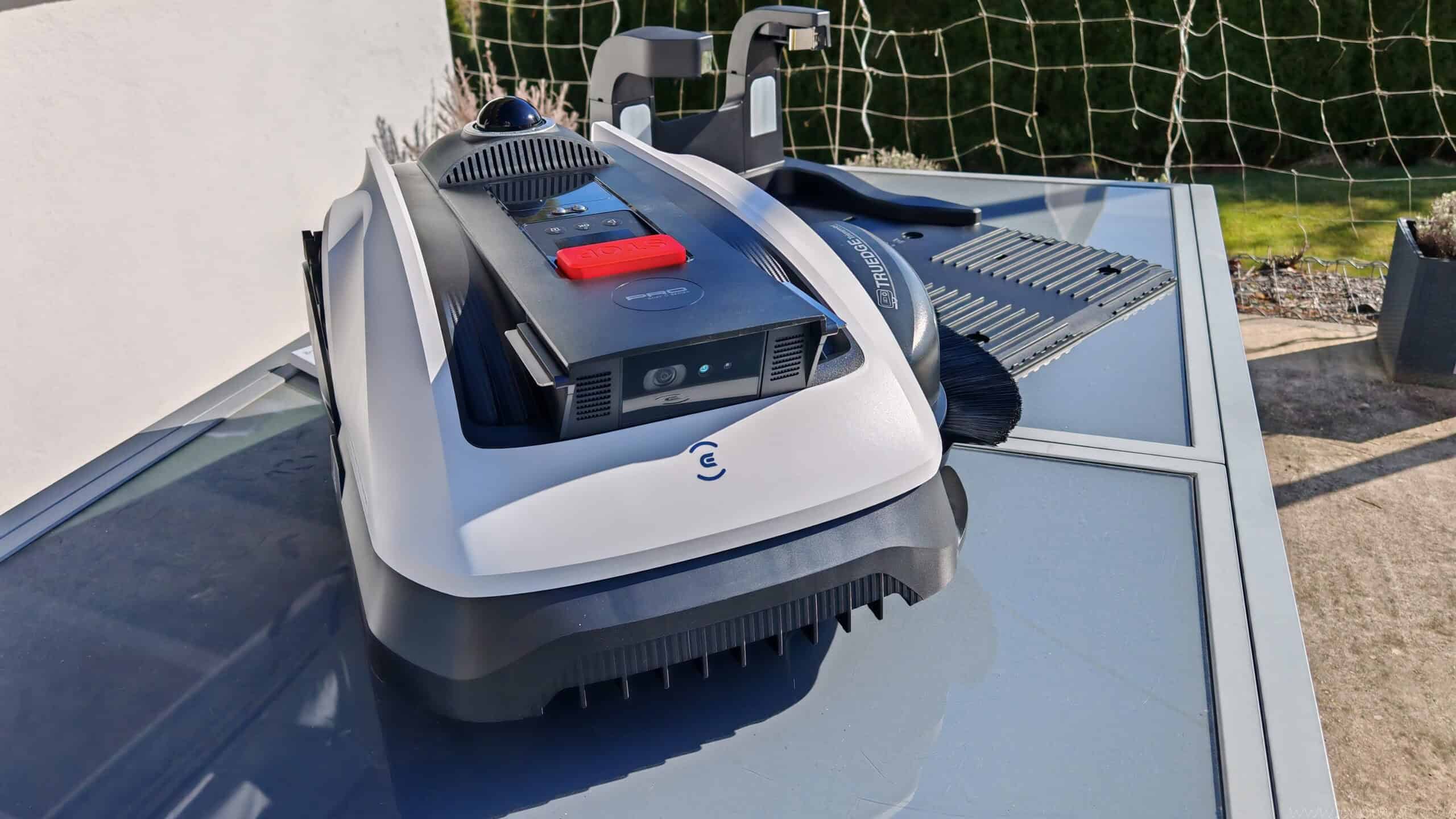
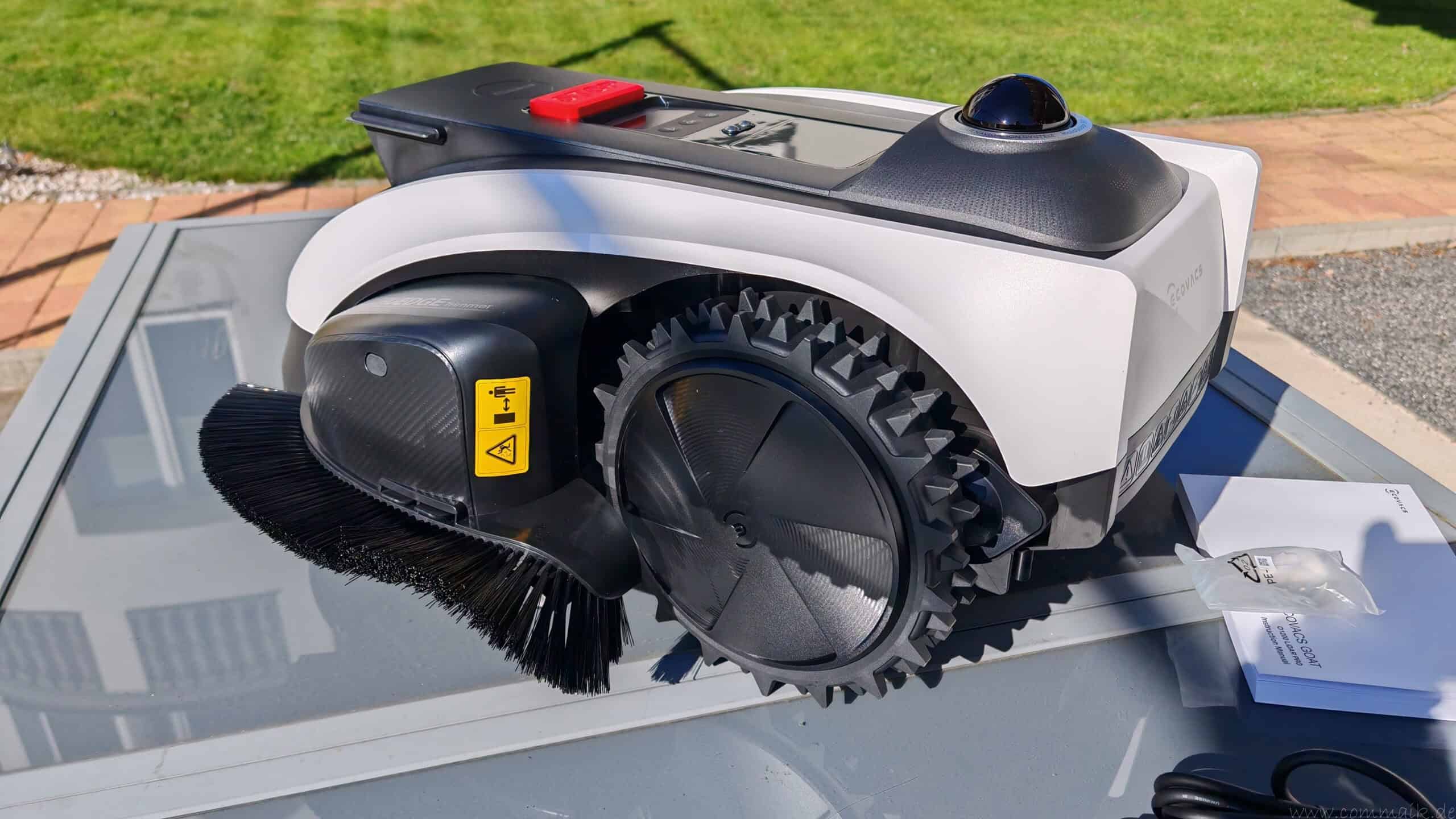
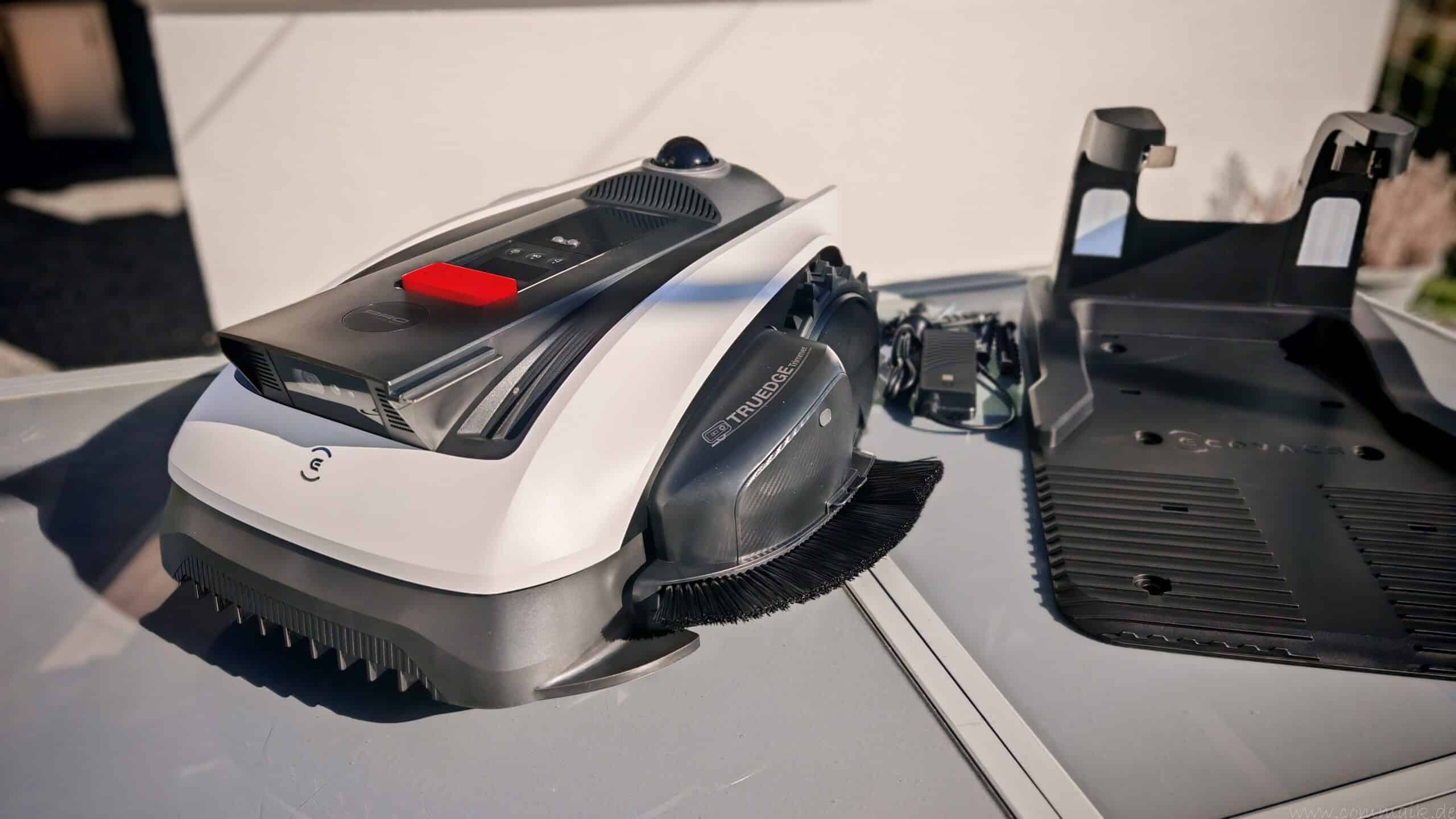
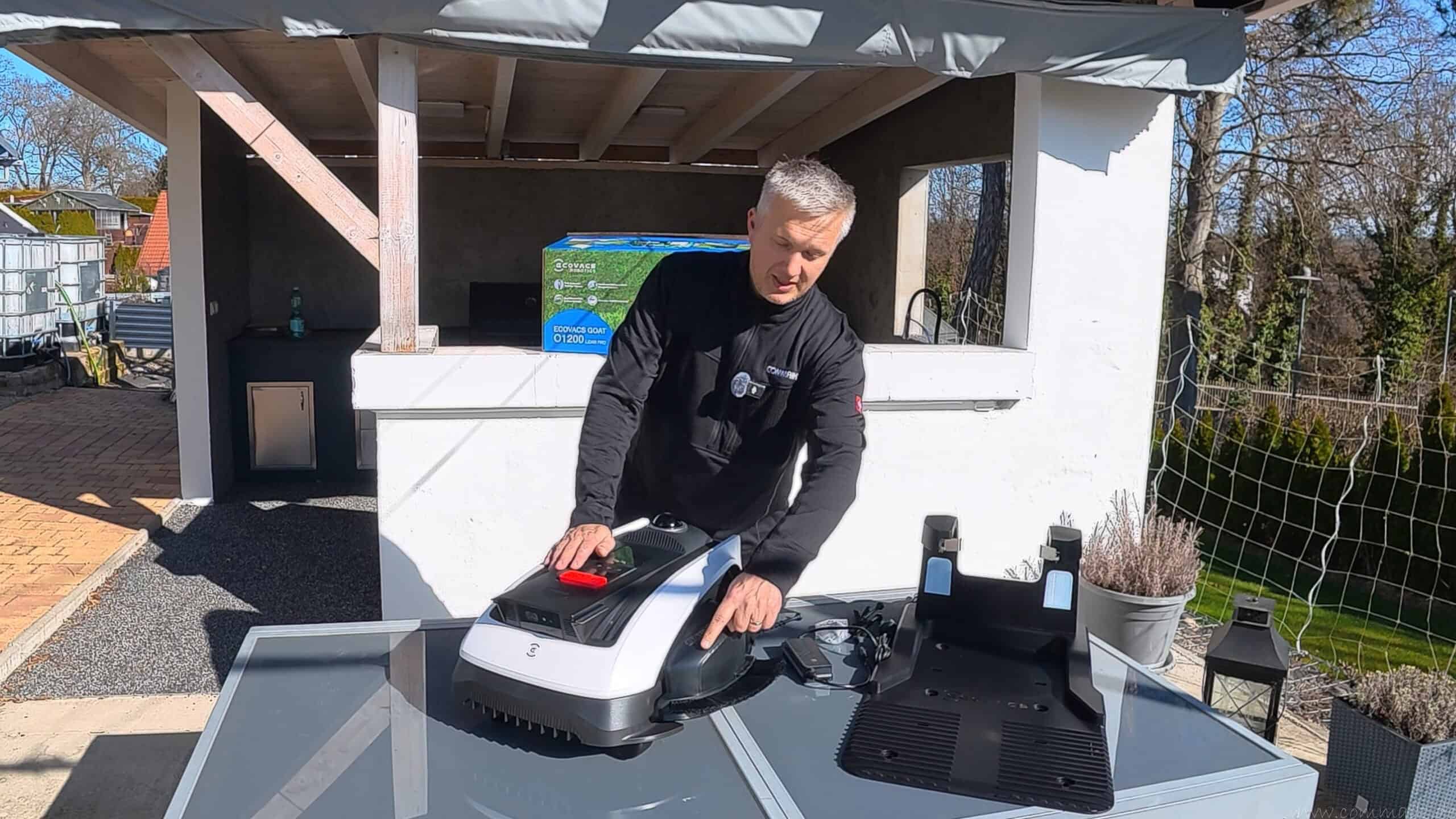
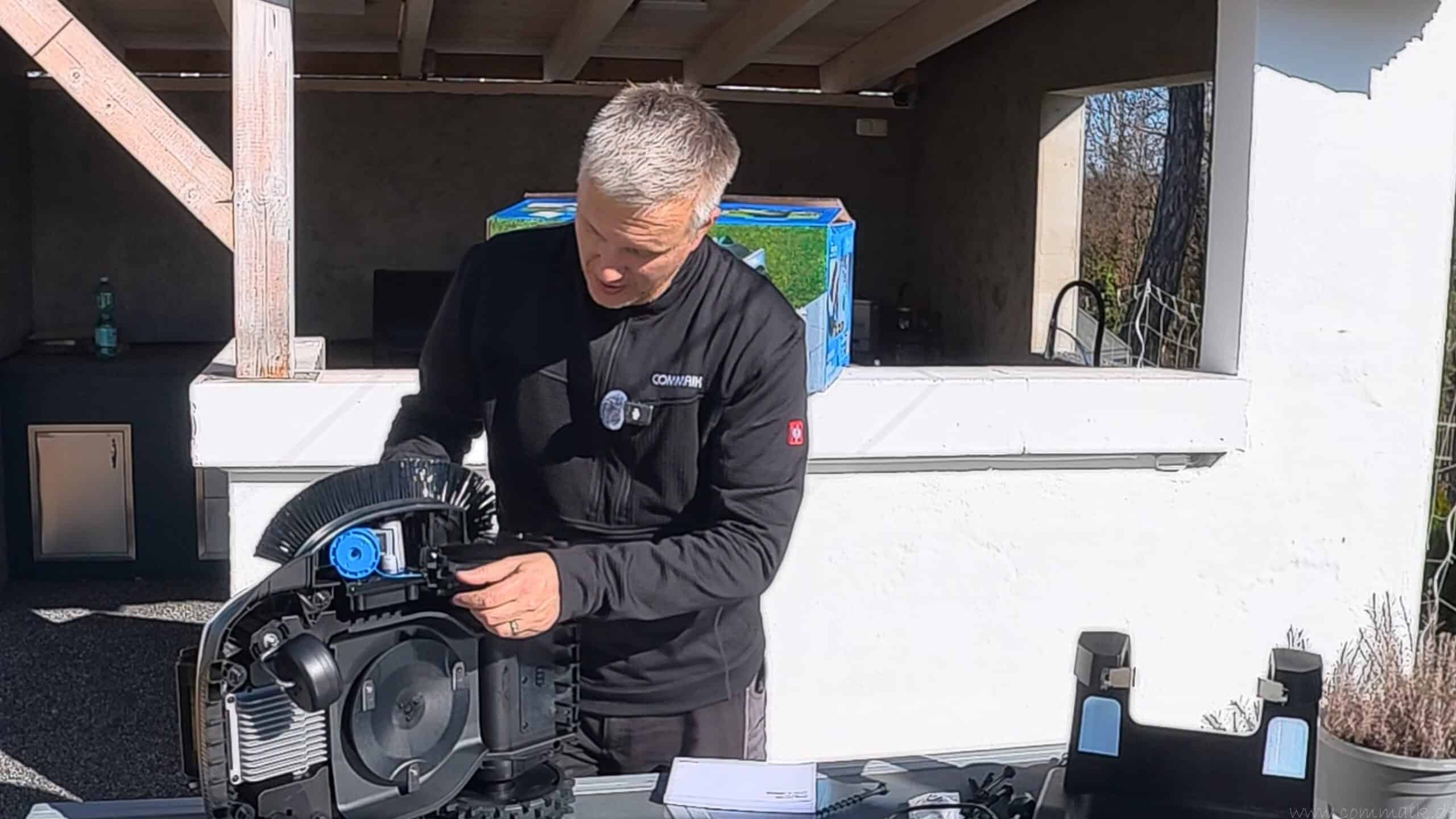
The robot looks more compact than the GOAT A1600 RTK I tested previously. The control panel and the large stop button are located on the top. The dual LiDAR system is located at the rear of the housing.
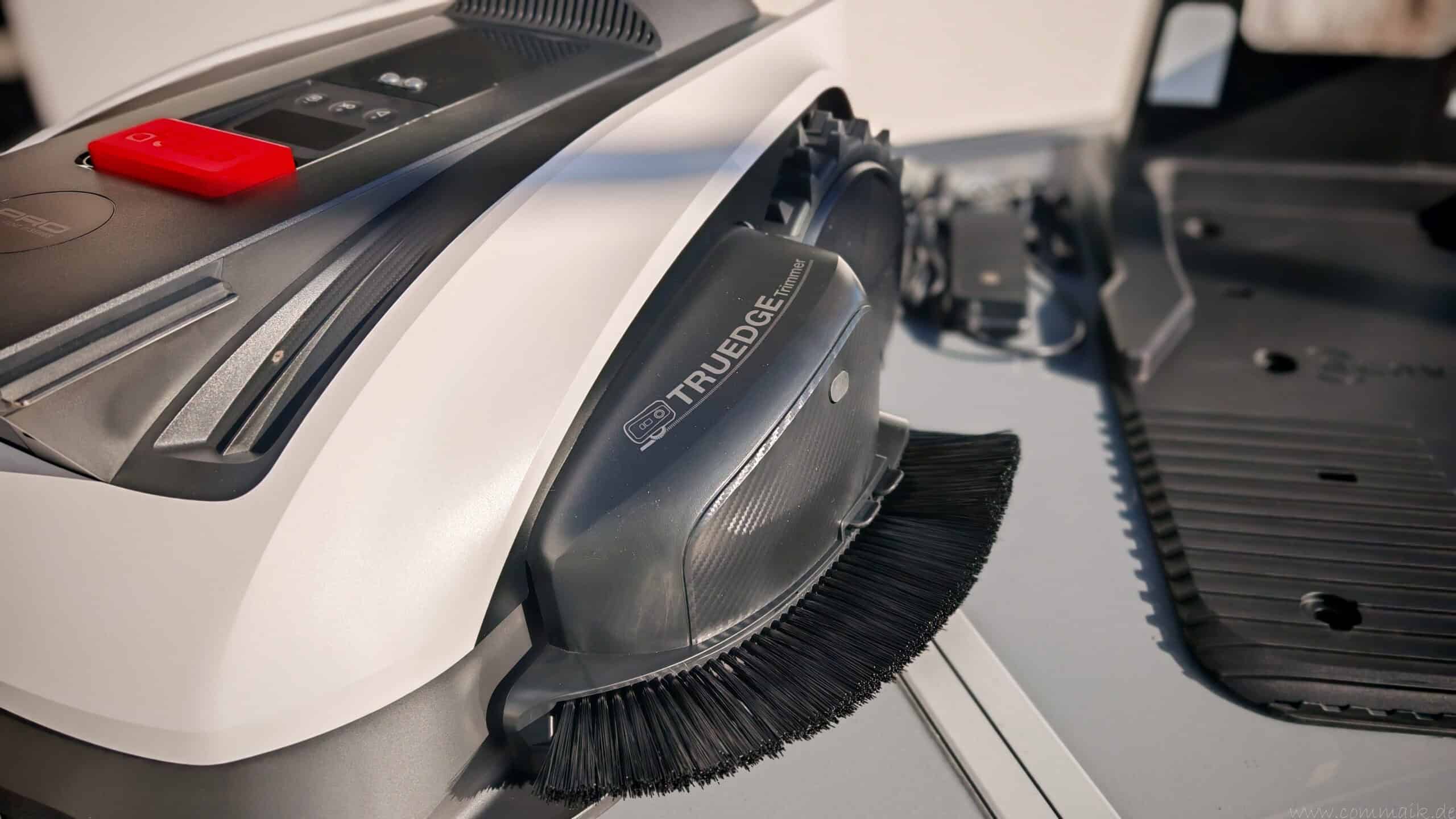
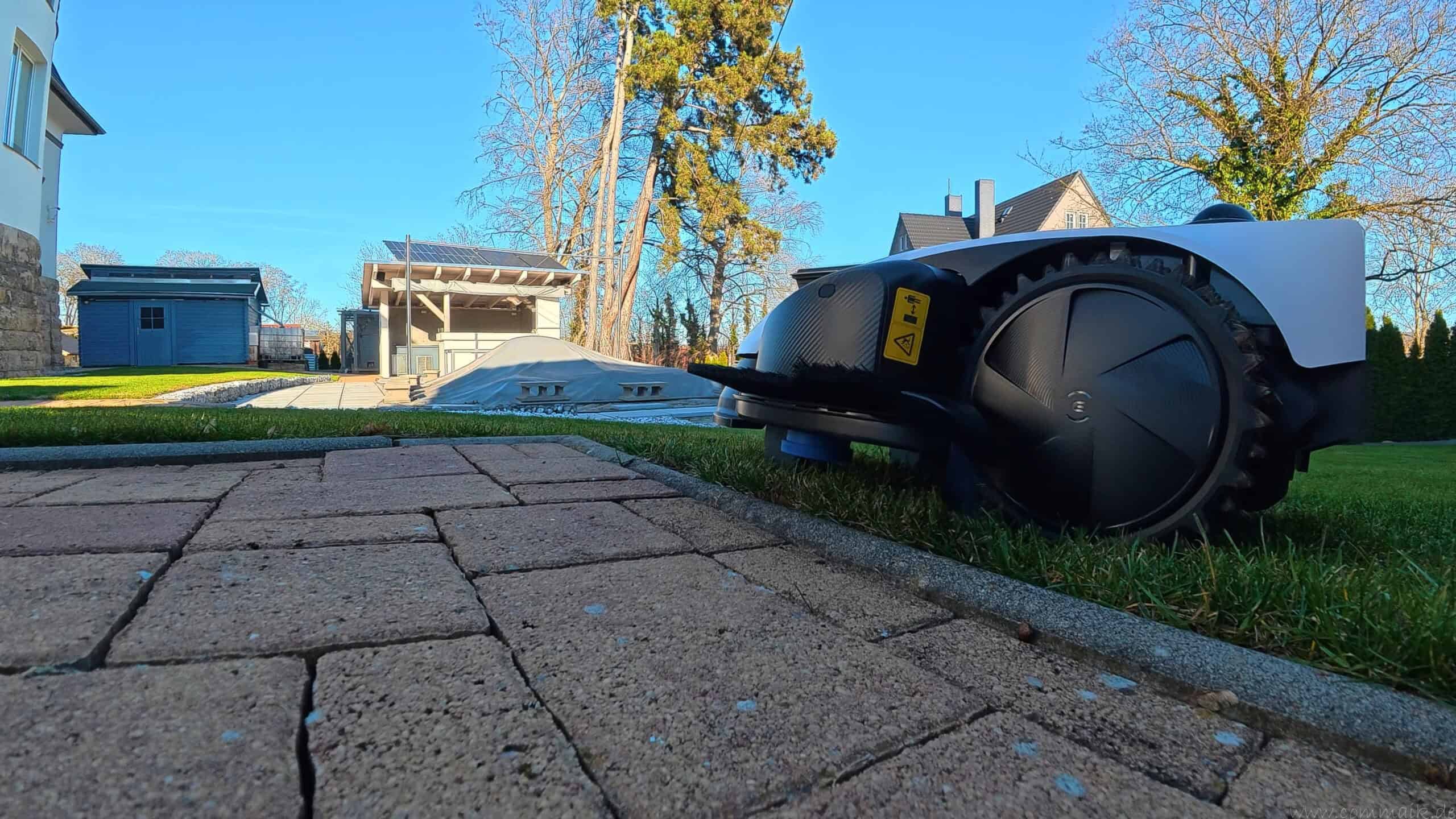
The mower assembly, which consists of a rotating disc and three blades, is located underneath the robot. The thread trimmer is mounted on the side. Its trimmer head is pulled upward into the parking position and only moves downward when trimming edges.
A garage is not included in the standard package. It can be purchased separately, but in my opinion, it is not absolutely necessary. According to ECOVACS, the mower has an IPX6 water resistance rating. The manufacturer therefore also allows the housing or the underside to be rinsed.
Technical Specifications of the Goat O1200
| Feature | ECOVACS GOAT O1200 LiDAR PRO |
|---|---|
| Recommended lawn area | Gardens up to 1,200 m² |
| Navigation | HoloScope 360 Dual-LiDAR |
| Boundary Wire | not required |
| RTK antenna | not required |
| Obstacle detection | 3D ToF, AI Camera, and LiDAR |
| Cutting width | 22 cm |
| Cutting height | 30 to 80 mm |
| Mowing Capacity | Approx. 120 to 180 m² per hour |
| Minimum clearance width | According to ECOVACS, approximately 0.8 m |
| Maximum Grade | According to ECOVACS, 45% and 24°, respectively |
| Battery | 5,200 mAh lithium-ion battery |
| Weight | approx. 13 kg |
| Protection class | IPX6 |
| Noise Specifications | Lawn mower: approx. 61 dB(A), trimmer: approx. 81 dB(A) |
The 180 m² per hour figure applies to the efficient mowing mode and is a manufacturer’s specification. The actual area mowed depends, among other things, on the lawn’s layout, paths, obstacles, cutting height, and the number of turns.

Robotic Lawn Mowers Without Boundary Wires: Setup and Automatic Mapping
With a traditional robotic lawn mower, you have to lay a boundary wire, and if it breaks later, you have to find and repair it. The O1200, on the other hand, operates wirelessly and without an RTK reference station. Its virtual boundaries are detected during mapping and then saved in the ECOVACS HOME app.
I installed the charging station on my paved walkway. It doesn’t necessarily have to be placed directly on the lawn. It is essential that there be unobstructed access and a location that the robot can reach autonomously at all times. The power cord is permanently connected to the charging station. In the current technical documentation, ECOVACS specifies a cable length of 10 m.
Set up the ECOVACS GOAT O1200 LiDAR PRO in the app
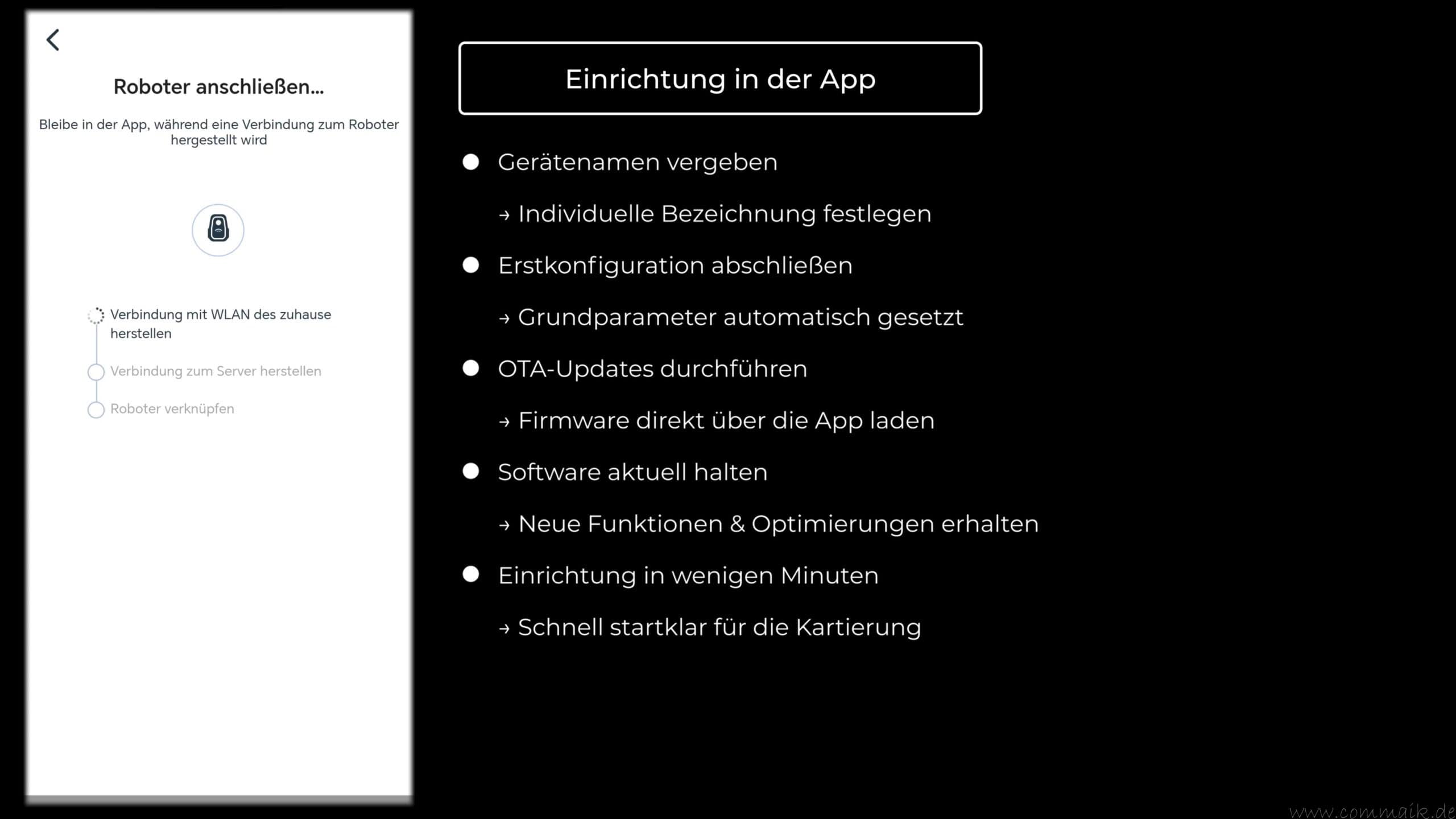
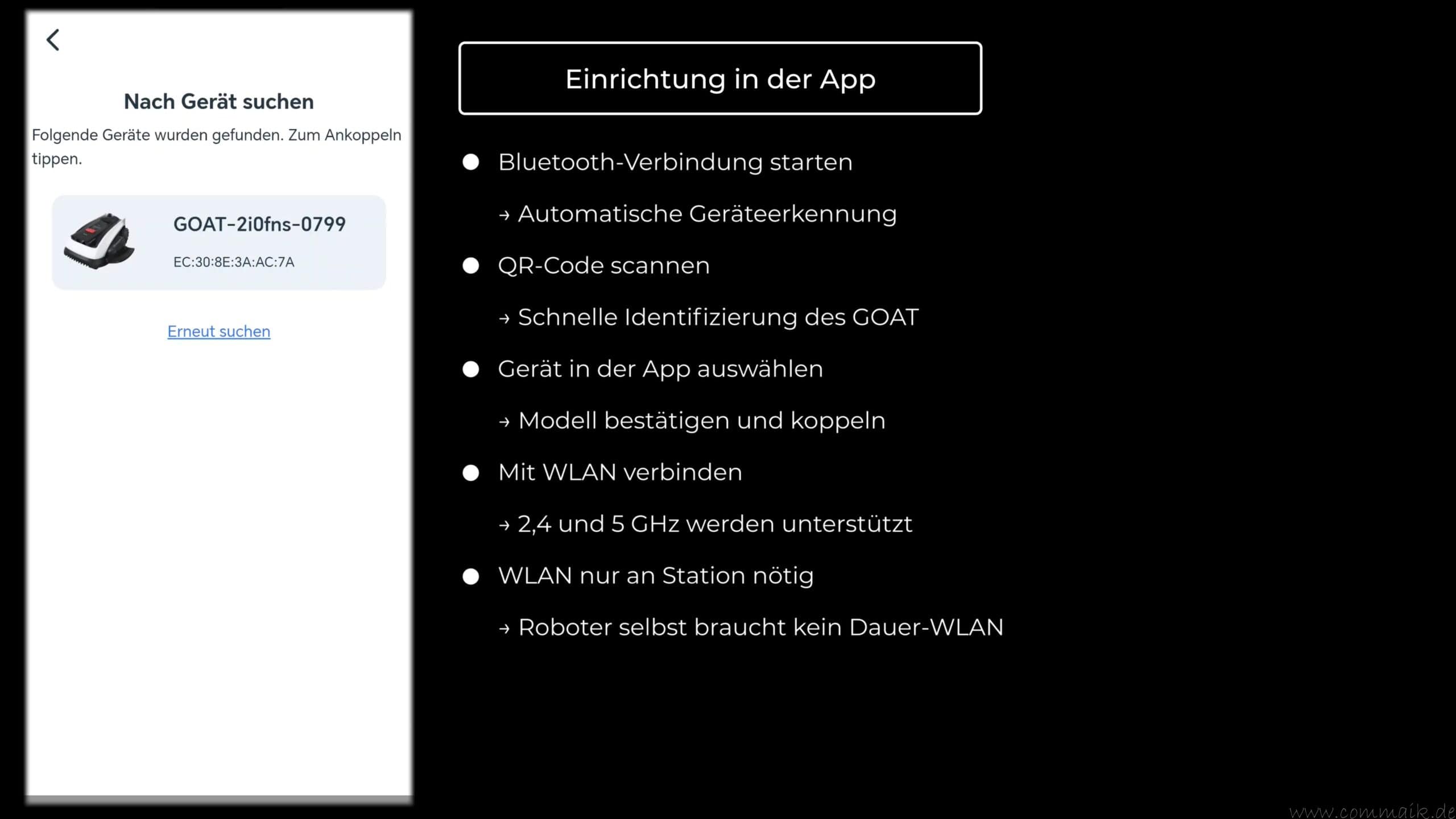
To set it up, I first installed the ECOVACS HOME app and created a user account. After that, only a few steps were needed:
- In the app, I selected the option to add a new device.
- I used the scan feature to scan the QR code on the back of the robot.
- I then followed the connection steps on the screen and added GOAT to my user account.
- Before the first mapping session, I installed the firmware update that was available at the time.
- After the update, I went to the robotic mower’s device view in the app.
- There, I opened the map section and began setting up a new lawn map.
Automatic mapping of the first lawn area
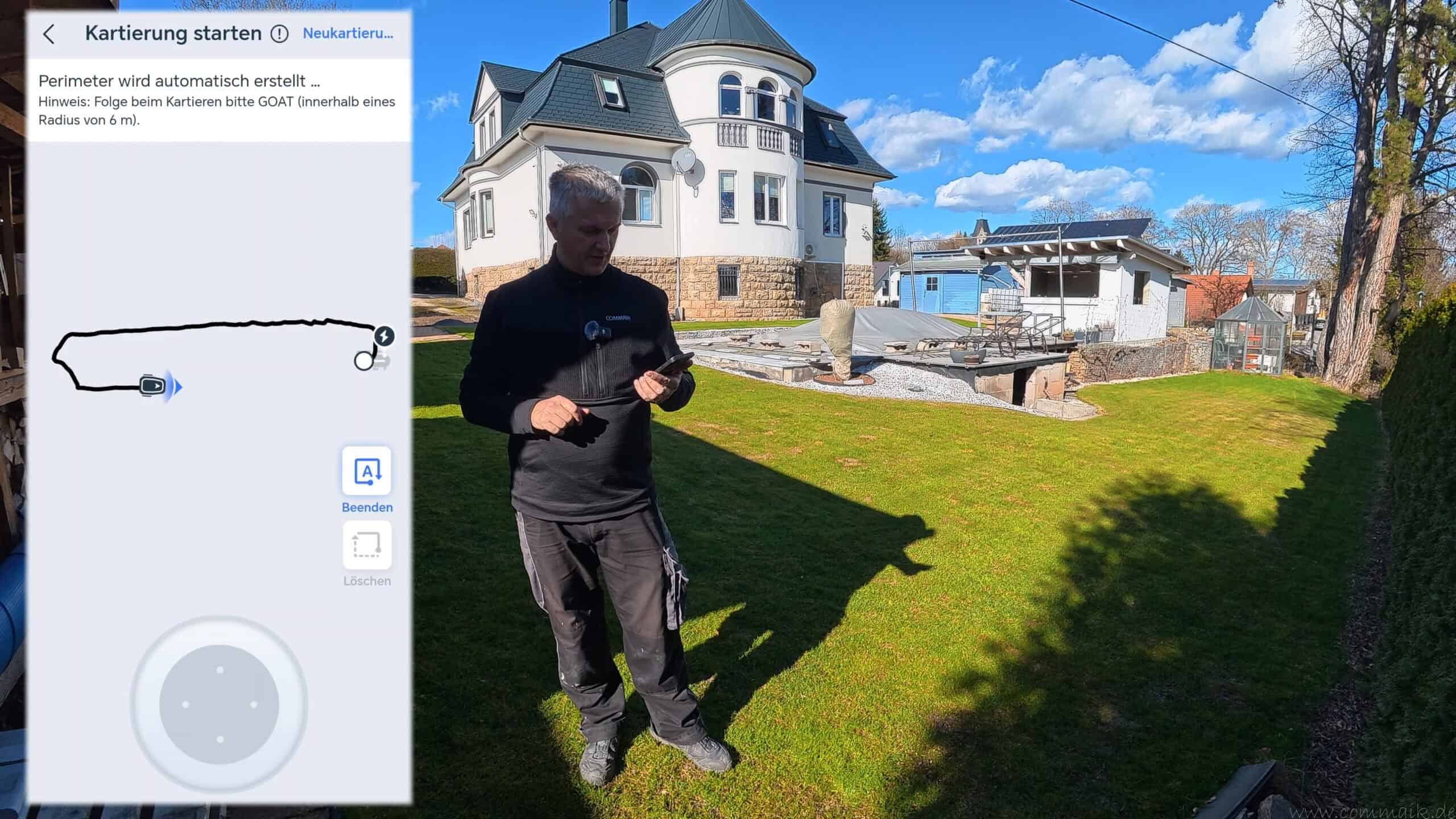
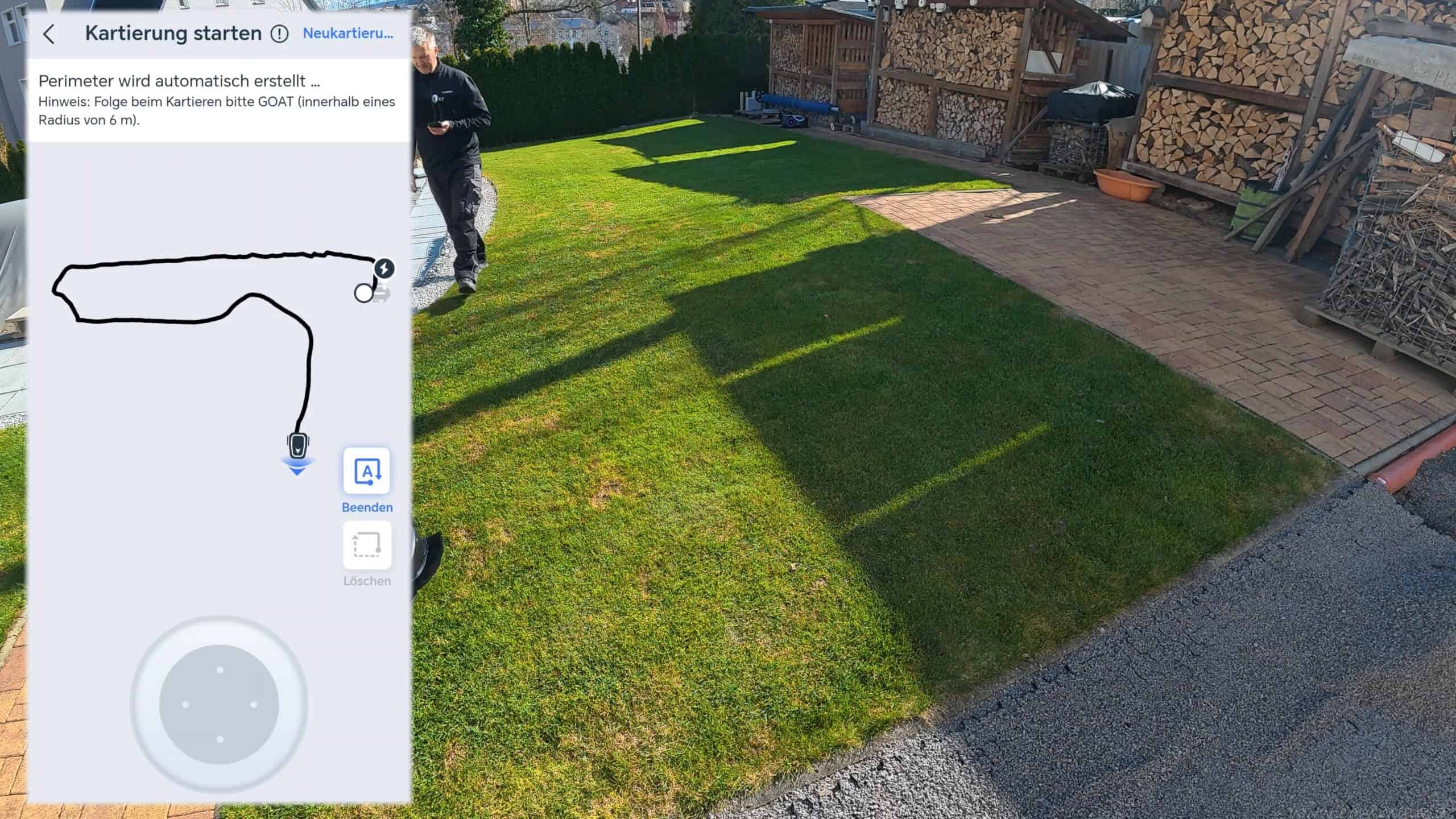
After mapping began, the robot left the charging station and started to map the boundaries of the accessible lawn on its own. To do this, it uses its dual LiDAR navigation system and additional sensors to distinguish between lawns, paths, hedges, and other structures.
I didn’t have to remotely control the GOAT along the entire edge of the lawn during this automatic mowing. The robot scanned the perimeter on its own and used that data to create a virtual boundary.
During this process, the lawn should be as clear as possible. Otherwise, temporarily placed objects could be included in the mapping as fixed boundaries or obstacles. That’s why I didn’t leave the patio furniture, hoses, toys, and portable devices in the designated areas.
After completing the route, the detected area was displayed as a map in the app. The automatic mapping feature detected the boundaries of my lawns with surprising precision. For the test shown in the video, I didn’t have to manually trace or correct the outer edges.
Add more lawn areas to the map
My garden consists of three separate lawns. After mapping the first areas, I added the third area as another section to the existing map.
To do this, I proceeded as follows:
- On the existing map, I selected the option to add another lawn area or a new section.
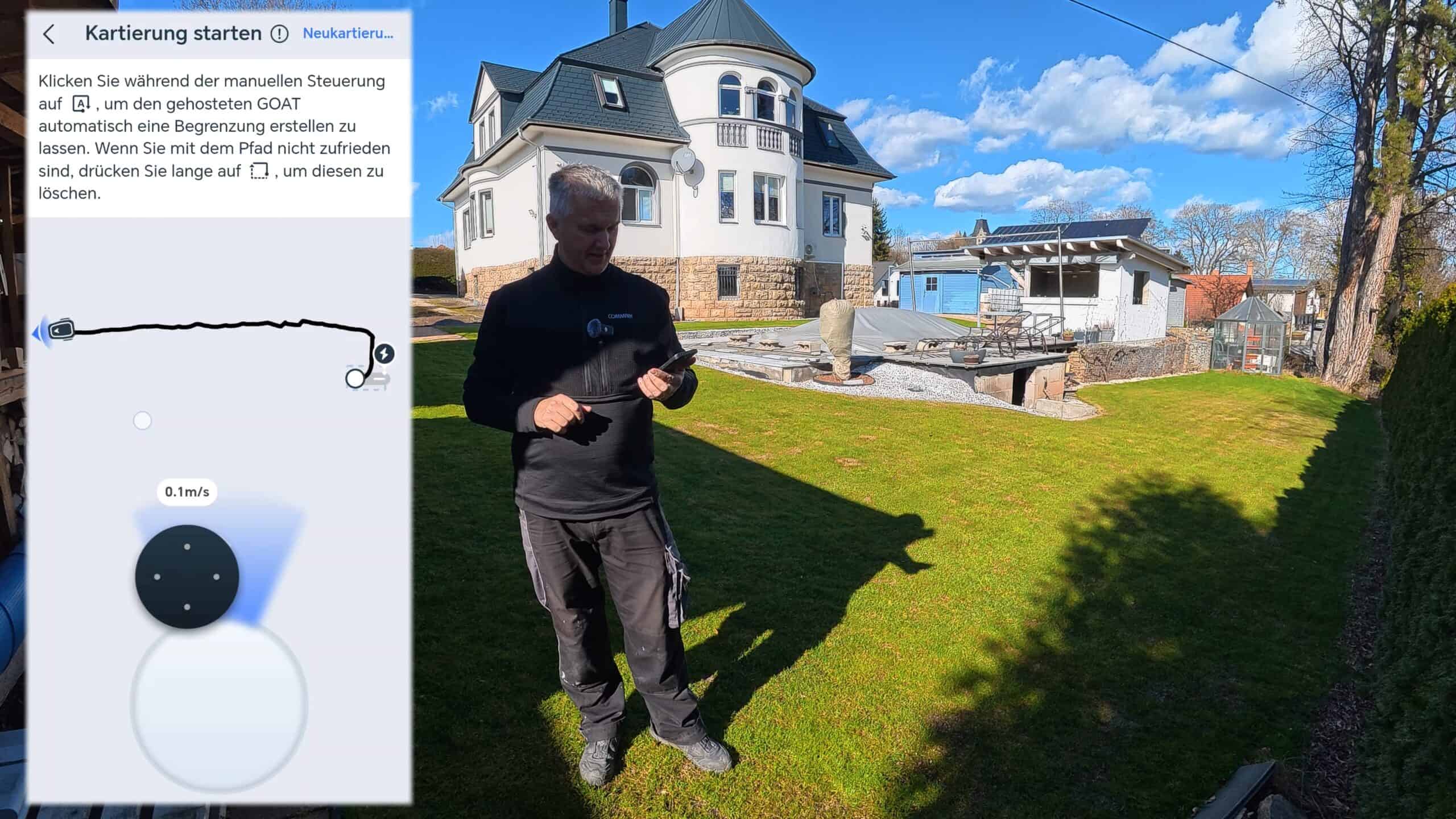
- I then switched to manual control mode.
- Using the app’s virtual remote control, I guided the robot from the existing paved area across the paved walkway to the next lawn.
- I restarted automatic mapping in the new area.
- The GOAT automatically detected the boundary there and added the new zone to the existing map.
- After I was done, I checked the areas, boundaries, and the marked-out path in the app.
The route driven manually between the lawns is saved as a future path. The robot then uses that exact route to automatically move from one zone to the next. That’s why I chose a route that is as direct as possible and will remain passable at all times.
Vehicles, patio furniture, trash cans, or other movable obstacles should not be left on this walkway on a regular basis. If the stored route is blocked, the robot may not be able to reach the next mowing zone on its own.
Check the map and configure mowing zones
After mapping, I was able to review the map in the app and configure the individual areas for future use. The following settings, among others, were available:
- Select individual mowing areas
- Start Zones Separately or Set Priorities
- Set mowing times for specific areas
- Adjust the cutting height and cutting direction
- Enable or disable edge trimming for individual sections
- Check the pathways between separate areas
- Edit virtual boundaries and off-limits areas
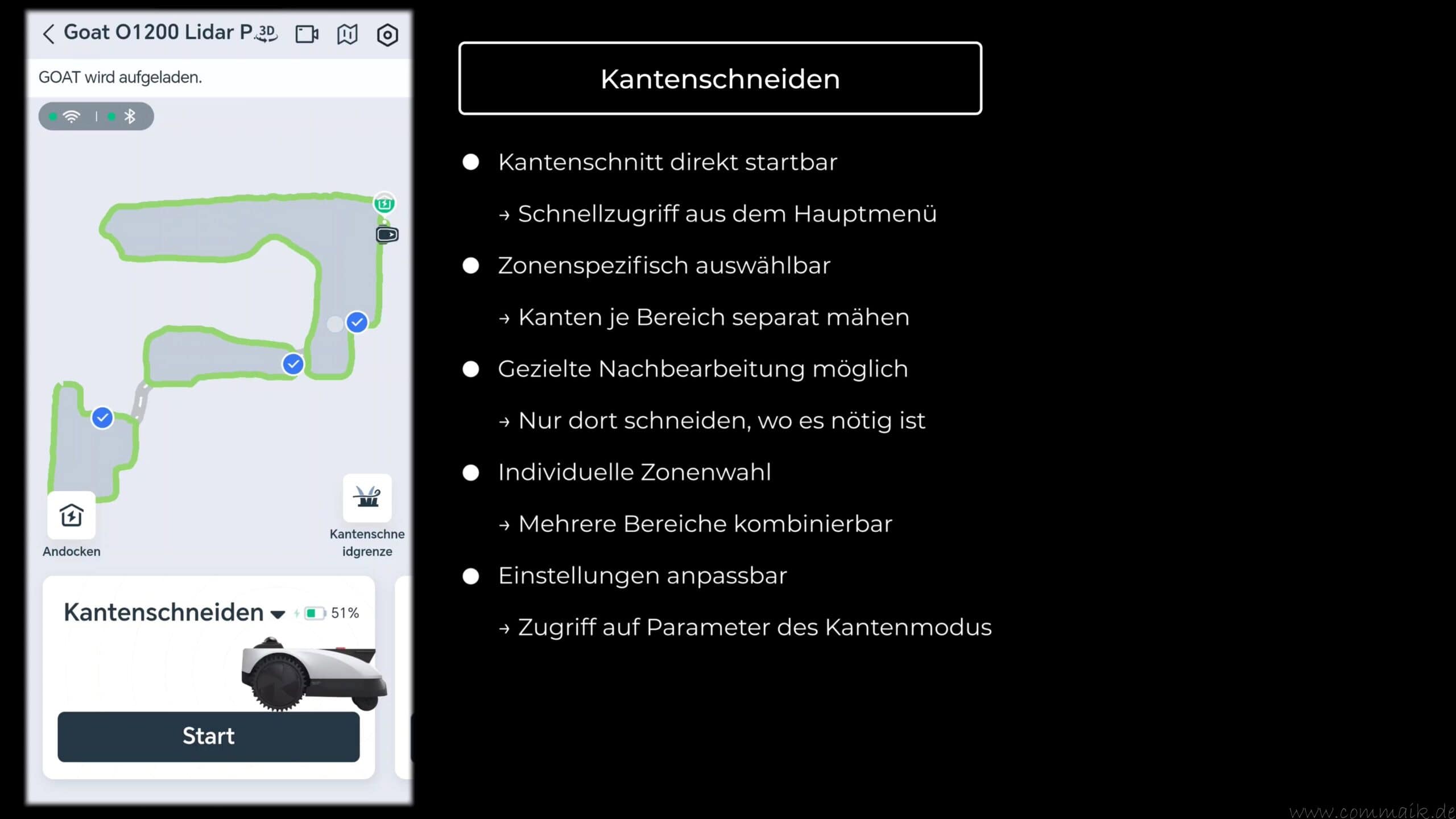
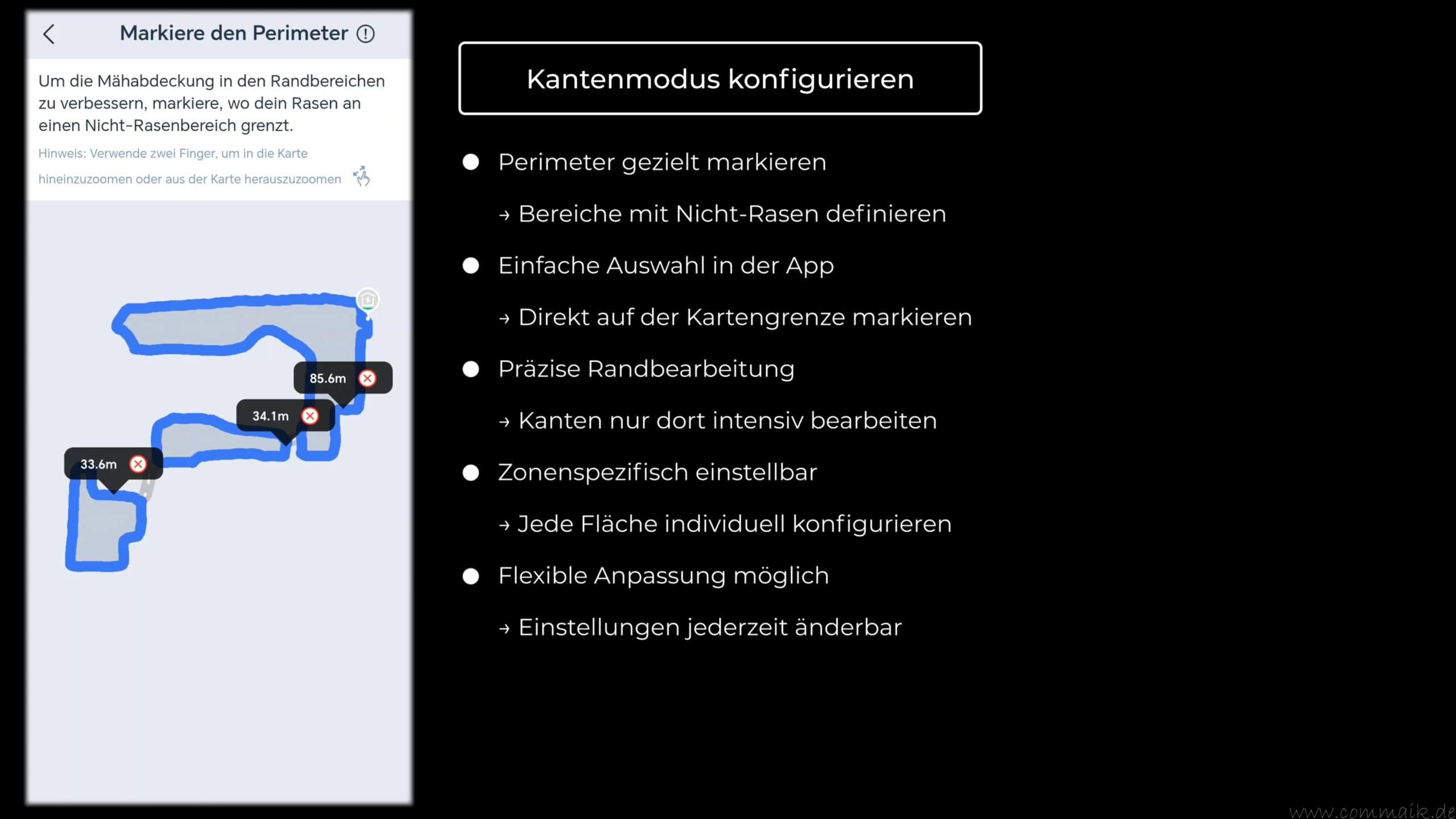
It was particularly important to inspect the edges afterward. In the map view, I was able to specify the sections where the TruEdge trimmer should be used. As a result, the string trimmer did not have to operate across every virtual boundary indiscriminately, but could be activated specifically for suitable lawn edges.
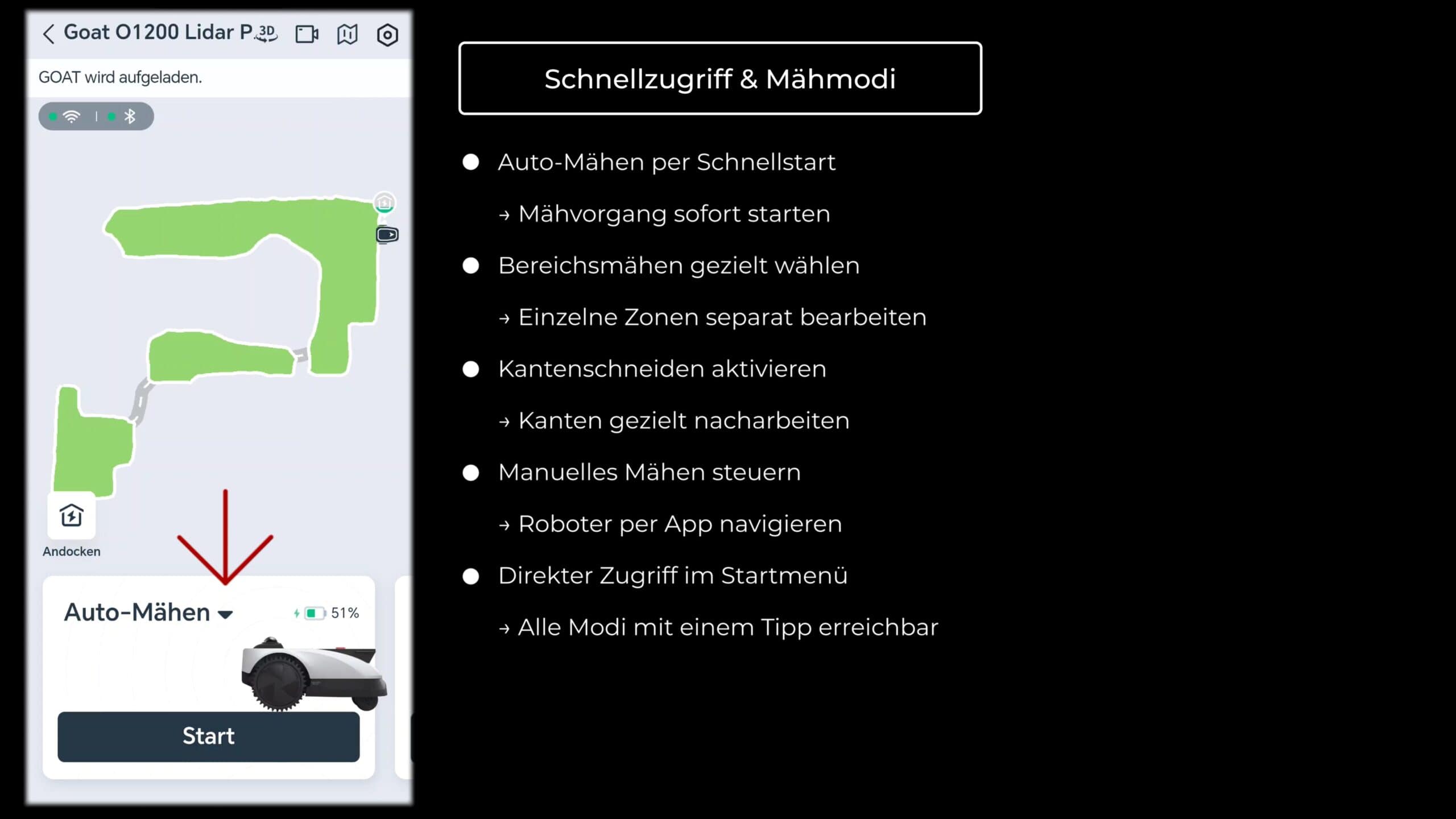
After checking the map, the robot was ready for operation. On the home screen, I could either have all areas mowed automatically or select individual zones for a specific job.

How does LiDAR navigation work on a robotic lawn mower?
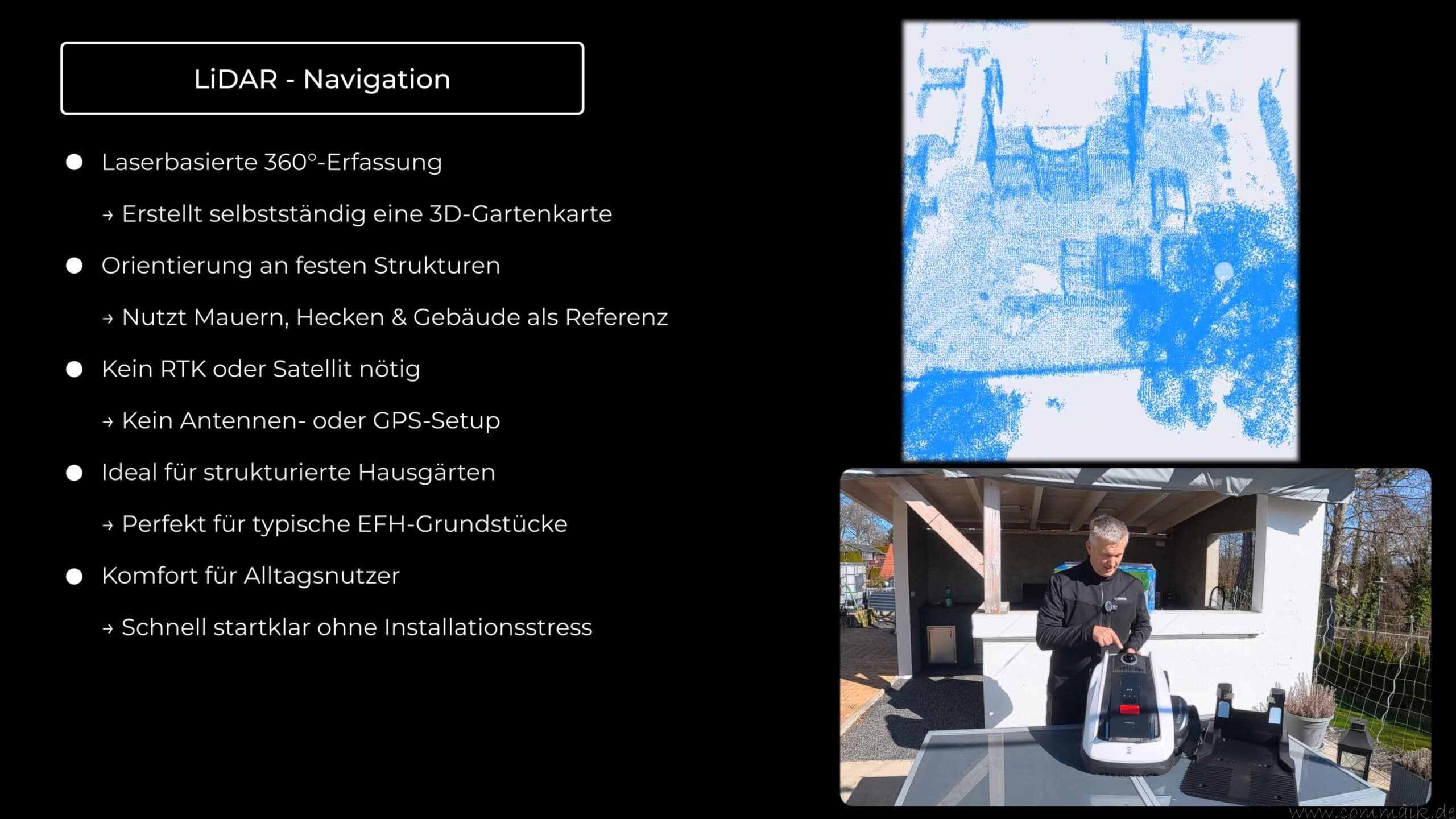
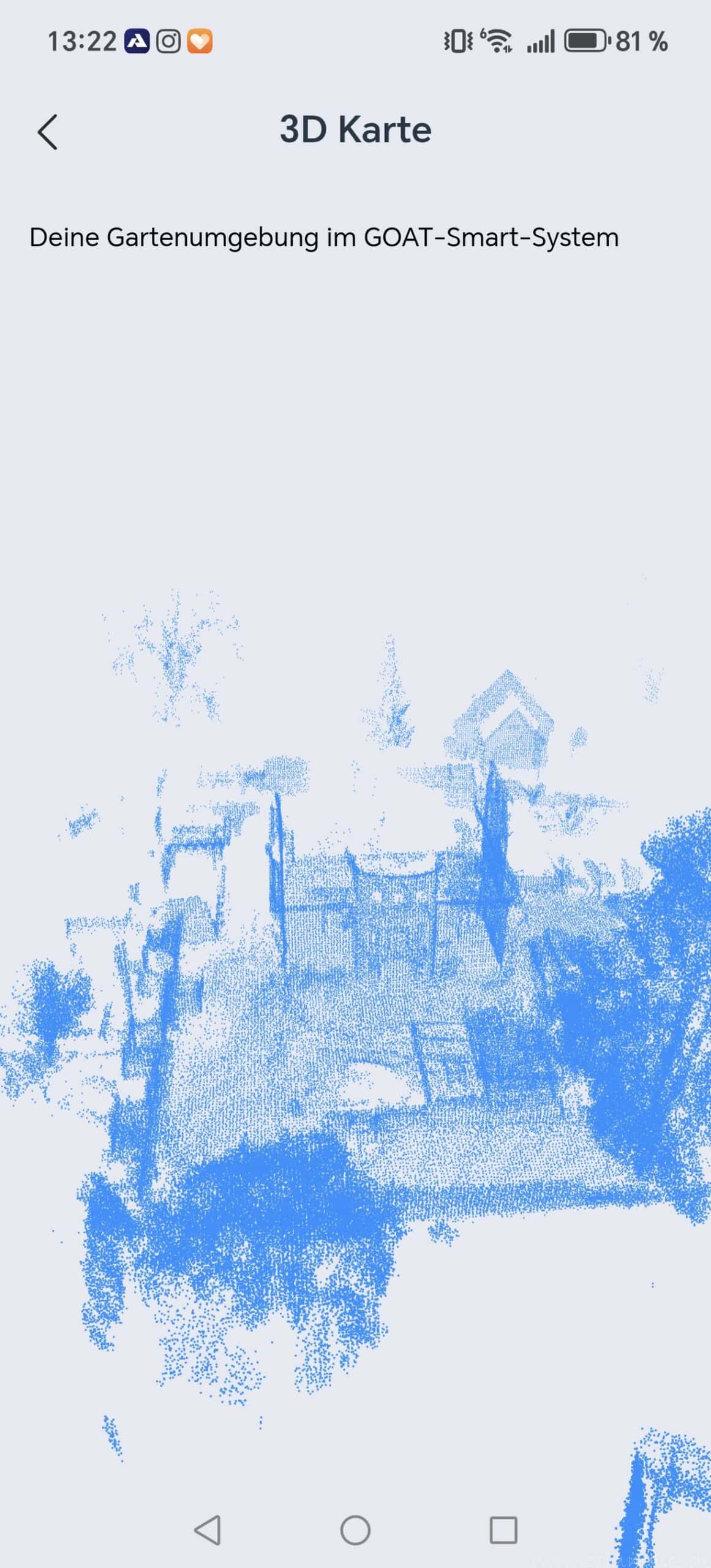
LiDAR stands for “Light Detection and Ranging.” Simply put, a LiDAR sensor continuously emits invisible laser pulses. When these light signals hit a hedge, a house wall, a tree, or another object, they are reflected back to the sensor.
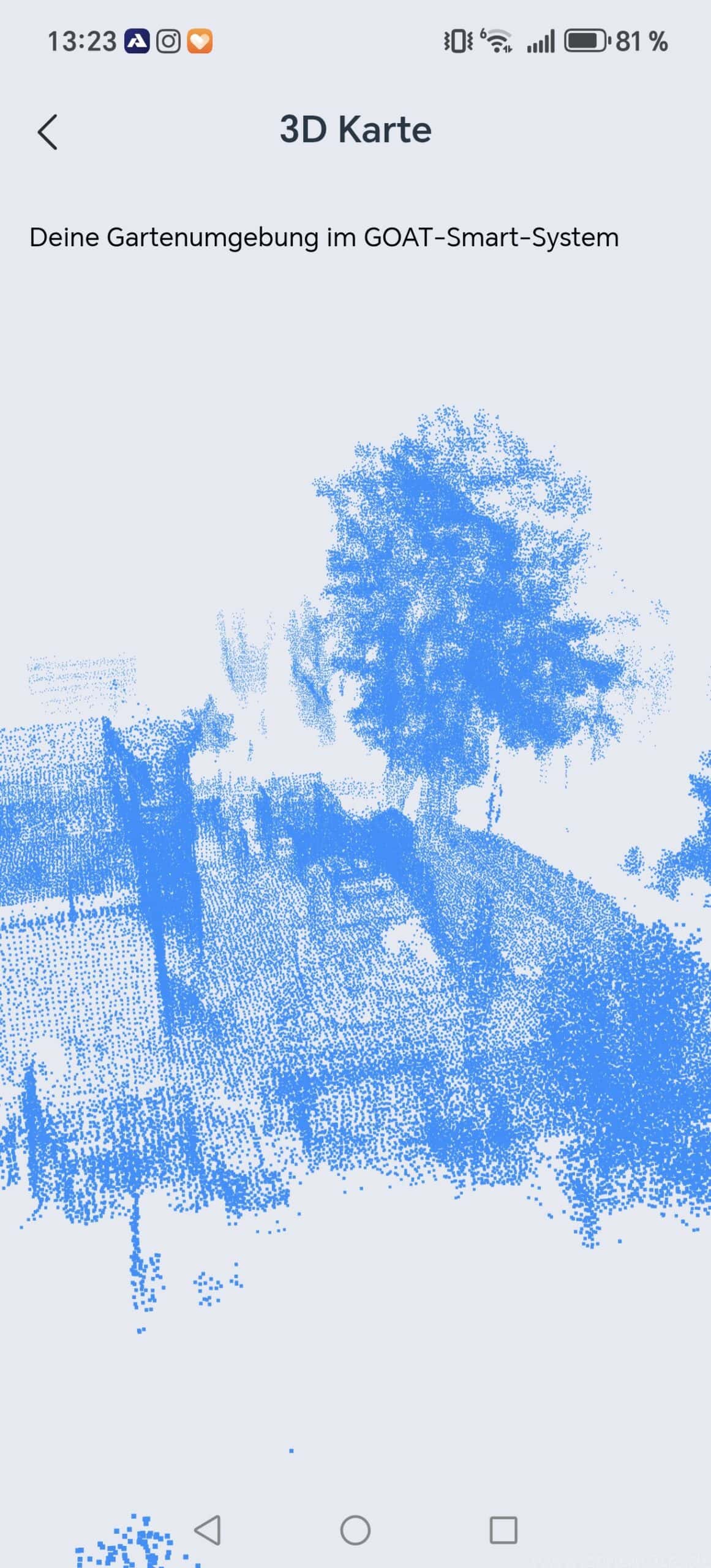
The system measures the time between the transmission of the signal and the arrival of the reflected signal. Since the speed of light is known, the distance to an object can be calculated from it. This process takes place very quickly and in many directions. The numerous individual measurement points are used to create a 3D point cloud of the surrounding area.
With the GOAT O1200 LiDAR PRO, the rotating 360-degree LiDAR is primarily responsible for mapping the entire garden. Through its continuous rotational motion, it measures distances around the robot. The additional solid-state LiDAR or 3D ToF sensor is designed for close-range detection. Unlike the rotating sensor, a solid-state system does not require any mechanical rotational motion. It monitors a defined field of view and supplements the measurements with detailed distance information at close range.
An AI camera provides additional image information. While LiDAR primarily measures distances and spatial structures, the camera can help distinguish between grass, plants, paths, and potential obstacles. The robotic lawn mower combines this sensor data to determine its position, detect virtual boundaries, and follow its planned paths.
How is the three-dimensional map created?
During the initial mapping process, the robot continuously collects measurement points and assembles them into a 3D model. At the same time, it uses previously recognized patterns to calculate how its own position is changing. This principle is often referred to as simultaneous localization and mapping.
Distinctive features such as house walls, fences, hedges, trees, or permanent garden features serve as spatial landmarks. As the robot moves through the garden, it compares the current measurement data with the stored map. This allows it to determine its position without relying on a buried boundary wire or correction data from an RTK reference station.
The GOAT uses this map to plan its mowing routes. Instead of driving around the area at random, he works his way through it systematically. If the system detects a deviation or an obstacle, the robot can adjust its direction of travel and route.
Advantages of LiDAR Navigation
One major advantage is that it is easy to install. There is no need to bury a boundary wire in the ground or to set up and align an RTK antenna. This eliminates the risk of cable breaks and the need to find a suitable location for a reference station.
Furthermore, LiDAR does not rely directly on the reception of satellite signals. Buildings, large trees, or covered areas can interfere with an RTK signal. The LiDAR robotic mower, on the other hand, navigates based on the actual structures in its immediate surroundings.
Other benefits include:
- spatial mapping of the surroundings in many directions
- Precise distance measurement to hedges, walls, and other structures
- Automatic mapping without having to manually drive along the entire perimeter of the lawn
- Systematic mowing patterns instead of random driving movements
- Reliable navigation even under trees and next to buildings
- Do not attempt to repair a damaged boundary wire
- Flexible adjustment of virtual areas and boundaries via an app
- Combination of a camera and a 3D ToF sensor for obstacle detection
- Operation is generally possible regardless of daylight conditions
In my garden, the practical benefits were particularly evident along the hedge and in the adjacent mulched area. The robot recognized the layout of the area and stayed precisely on the lawn, even though I hadn’t manually corrected the automatically detected boundary beforehand.
Disadvantages and Limitations of LiDAR
LiDAR isn’t flawless either. The quality of orientation depends on how well the sensor can detect usable structures in the environment. In very large, completely open areas with few fixed reference points, a satellite-based RTK system can offer advantages.
If the environment changes significantly after mapping, the stored measurement data and the current measurement data may differ from one another. Large pieces of outdoor furniture, vehicles, privacy screens, or major renovations may therefore require a review or adjustment of the map.
Other possible restrictions include:
- Dirt on the sensor covers can affect measurement quality.
- Highly reflective, very dark, or transparent surfaces may be more difficult for optical distance sensors to detect.
- Tall grass and overhanging plants can be interpreted as an altered boundary or an obstacle.
- Moving objects are not suitable as permanent landmarks.
- Very small or particularly flat objects can still pose a challenge, even with additional camera and ToF sensors.
- Precise positioning does not automatically mean that every corner that is difficult to reach mechanically will be mowed completely.
- The processing of sensor data and maps depends on the software and the current firmware version.
- Repairs to LiDAR sensors or the associated electronics can be more complicated than those for a simple robotic lawn mower with a boundary wire.
Dirt, grass clippings, and water droplets on the sensor surfaces should therefore be removed regularly. Do not use any harsh cleaners or abrasive materials.
LiDAR also does not replace careful landscaping. Walkways must remain clear; sensitive areas should be monitored, and hazardous objects should continue to be removed from the lawn. The technology makes navigation much easier, but it does not eliminate the need for a well-planned map and occasional checks.
Dual LiDAR Navigation and Obstacle Detection Put to the Test
The HoloScope 360 system combines a rotating LiDAR for environmental sensing with a solid-state LiDAR—or 3D ToF sensor—for close-range detection. Depending on the model, an AI camera enhances navigation and obstacle detection.
Thanks to LiDAR, a clear line of sight to the sky—which can be essential for satellite-based RTK systems—is not required. This is particularly interesting in gardens with buildings, trees, and hedges. Instead, the robot creates a three-dimensional map of its surroundings.
Navigation and Obstacle Detection on My Lawns
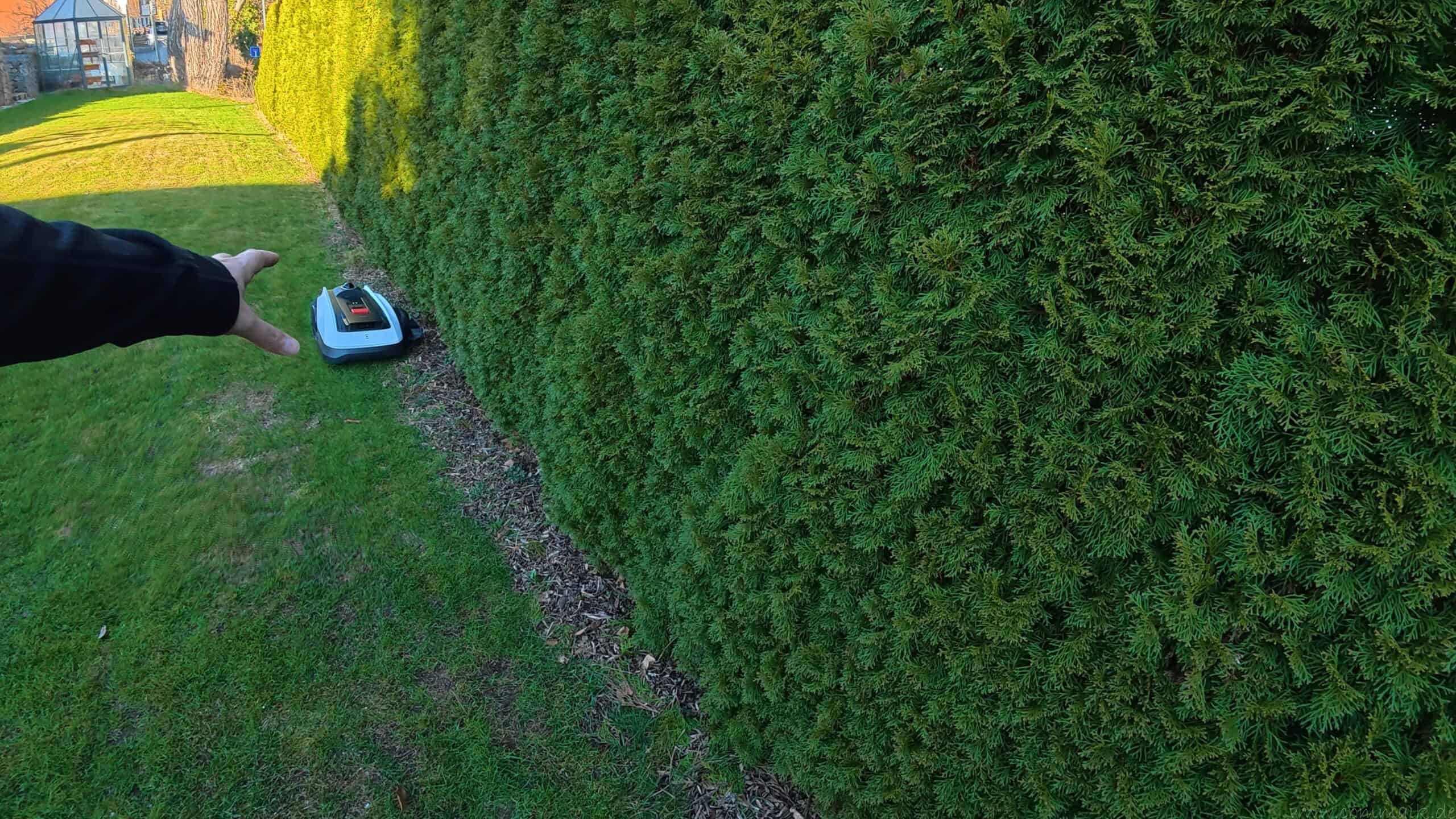
With the GOAT O1200 LiDAR PRO, I was particularly struck by how precisely it distinguished between the lawn and the adjacent mulched area. The robot drove right up to my hedge, but stayed on the grass. I didn’t have to manually adjust the automatically applied crop for that.
The lawn was mowed in even swaths. The robot moved back and forth instead of traversing the garden in a random pattern. This made it easy to track progress within the app.
The flat covers on my valve boxes were not treated as obstacles to be driven around. The mower drove over it, thereby also mowing the surrounding lawn. Other robotic mowers I’ve used had sometimes detected such covers as obstacles and driven around them.
What does “over 200 different obstacles” mean?
According to ECOVACS, the AIVI 3D obstacle detection system can distinguish between more than 200 different types of objects. The manufacturer also specifically mentions animals such as hedgehogs. During my tests with a lifelike plush hedgehog, a garden hose, and various pieces of garden furniture, I was able to successfully test the obstacle detection feature.
Regardless of the camera, sensor, or software, I never let robotic lawn mowers run at night or at dusk. Technical obstacle detection reduces risks, but does not guarantee that every small animal will be detected in time in every situation.

- 【Freihändiges Mähen】Leg in nur 15 Minuten los. Der GOAT A1600 LiDAR PRO kann alle Arten von Begrenzungen erkennen und speichern. Sobald ein Gebiet aufgezeichnet wurde, sind keine weiteren Maßnahmen zur Festlegung von Begrenzungen oder einer RTK-Referenzstation erforderlich. Drück einfach auf Start und überlass die automatische Kartierung dem System. Die APP Steuerung kann auch zum manuellen Mähen oder lediglich zur Überwachung des Rasens aus der Ferne verwendet werden.
- 【Der TruEdge Trimmer definiert Perfektion neu】Der TruEdge Trimmer verwendet schnell rotierende flexible Bänder zum Kantentrimmen, die einen maximalen sauberen Schnitt gewährleisten, kein Gras ungeschnitten lassen und selbst die schwierigsten Herausforderungen beim Kantentrimmen lösen. Um das zu schützen, was am wichtigsten ist, kann der A1600 LiDAR PRO, ausgestattet mit AI Vision und 3D-ToF-LiDAR, über 200 Arten von Hindernissen, einschließlich Igeln, präzise erkennen sowie umfahren und mit einem Abstand von nur 5 cm stabil navigieren.
- 【Außergewöhnliche Mäheffizienz】Die leistungsstarke 32-V-Hochleistungsplattform bietet ein branchenführendes Doppelklingensystem. Mit einer schnellen Bewegungsgeschwindigkeit von 0,7 m/s erreicht sie eine dreifache Mäheffizienz, 80 % mehr Leistung und eine um 33 % höhere Drehzahl, was eine Fläche von bis zu 400 m² pro Stunde ermöglicht. Der langlebige 5-Ah-Akku sorgt für minimalen Stillstand, da er in nur 45 Minuten vollständig aufgeladen werden kann. Ideal für große Flächen.
- 【Hervorragende Steigfähigkeit und Hindernisüberwindung】Der GOAT meistert selbst anspruchsvollstes Terrain mit einer Neigung von bis zu 50 % dank der leistungsstarken 32-V-Plattform. Es gibt keine schwer erreichbaren Stellen mehr, und mit einer Hindernisüberwindung von 4 cm sorgt er für gründliche Rasenpflege. Das neue, effiziente Pfadplanungssystem nutzt fortschrittliche Algorithmen, um automatisch die besten Mährouten zu erstellen – selbst auf gekrümmten oder geneigten Kanten, engen Streifen oder in Bereichen mit statischen Hindernissen.
ECOVACS HOME App: Operation, Zones, and Cutting Height
The ECOVACS HOME app serves as a common platform for the manufacturer’s various devices. In addition to the robotic lawn mower, you can also manage vacuum cleaners, window cleaners, and pool cleaners there, for example.
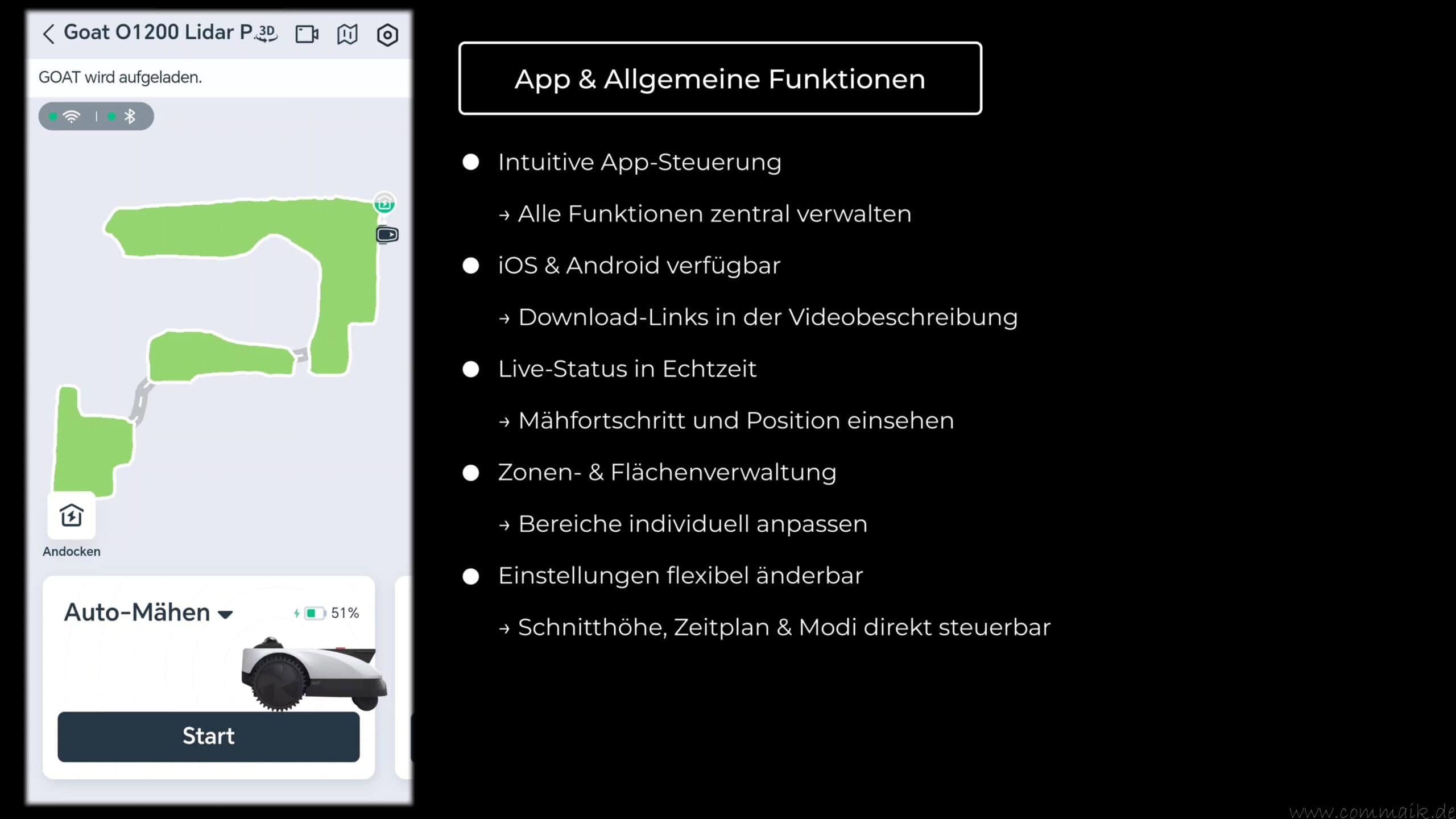
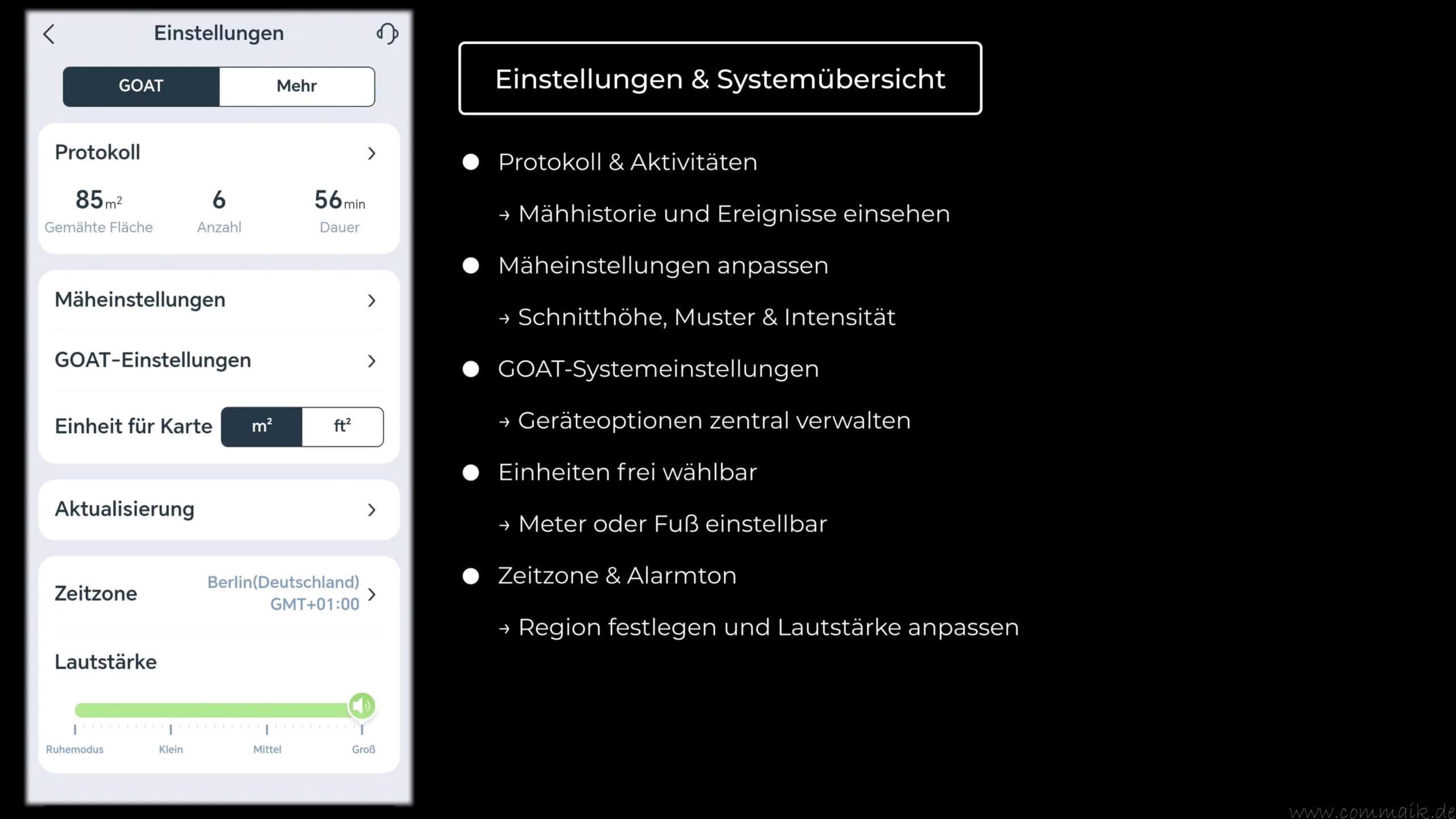
The app has a clear and organized layout. On the home screen, I could either start a full mowing job or select individual zones. Schedules, map editing, and mowing parameters are located in separate menus.
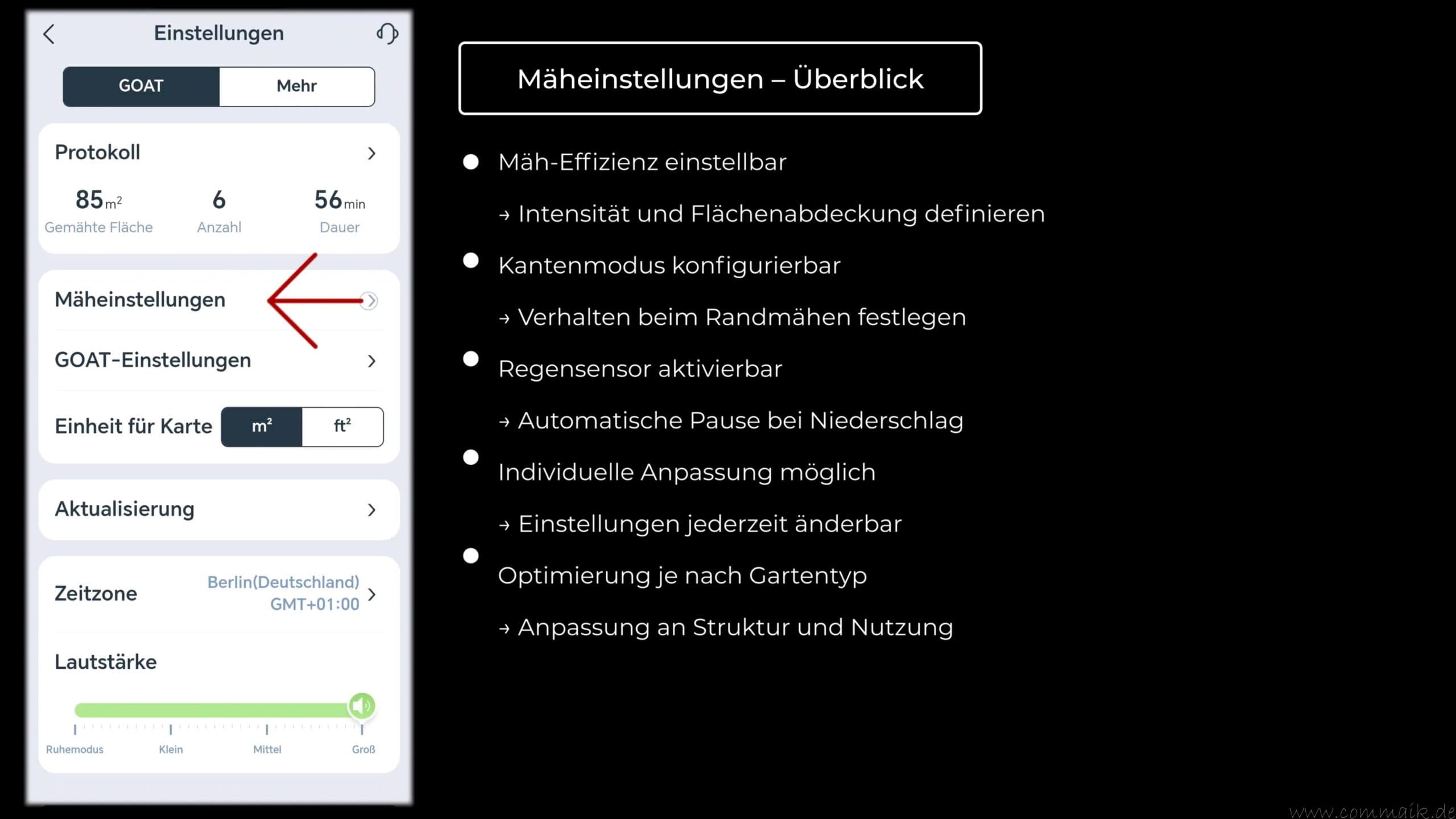
The GOAT O1200 offers the following settings, among others:
- Selecting Individual Mowing Zones
- Schedules for Automatic Operation
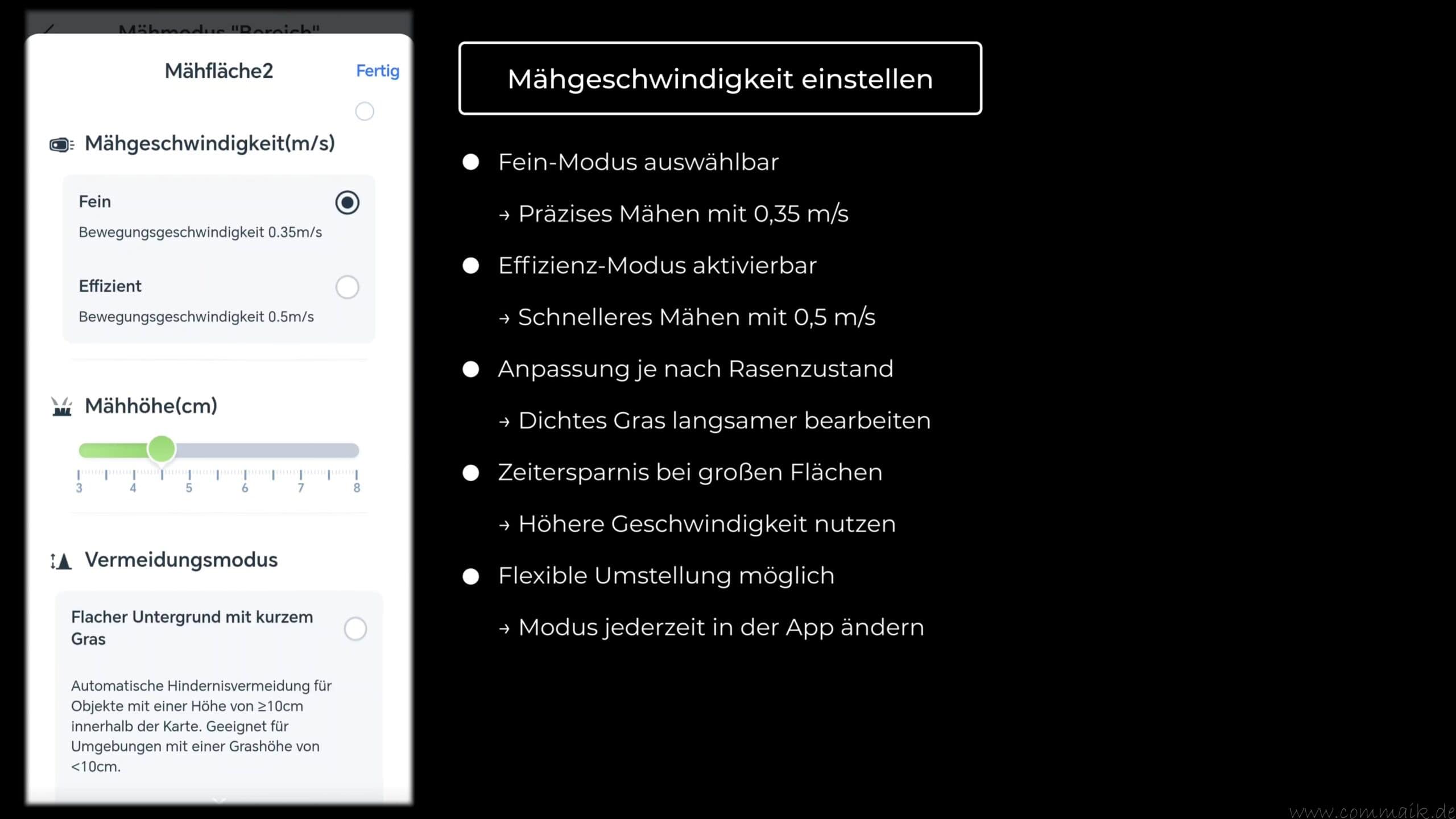
- Mowing Speed and Efficiency Mode
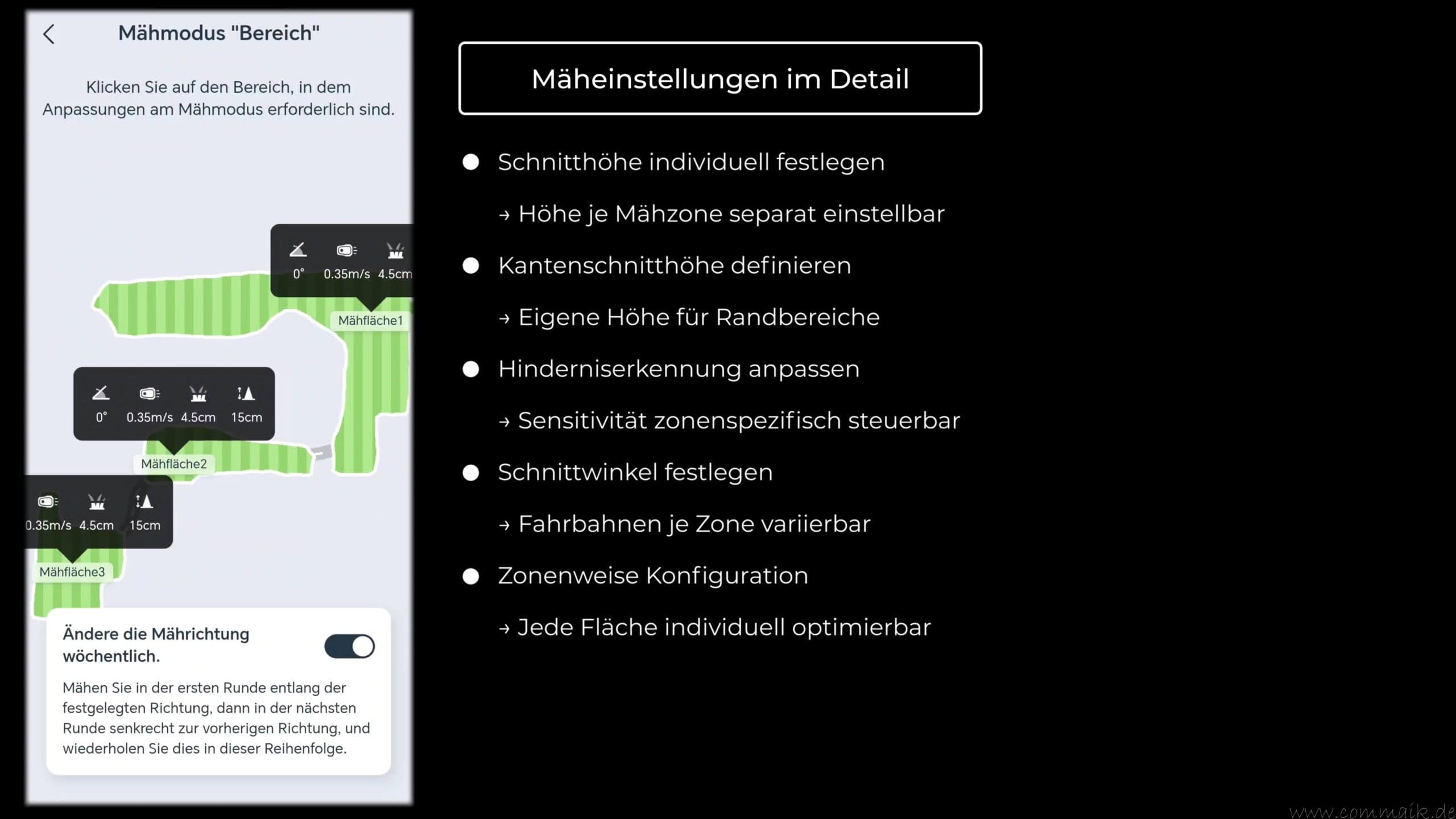
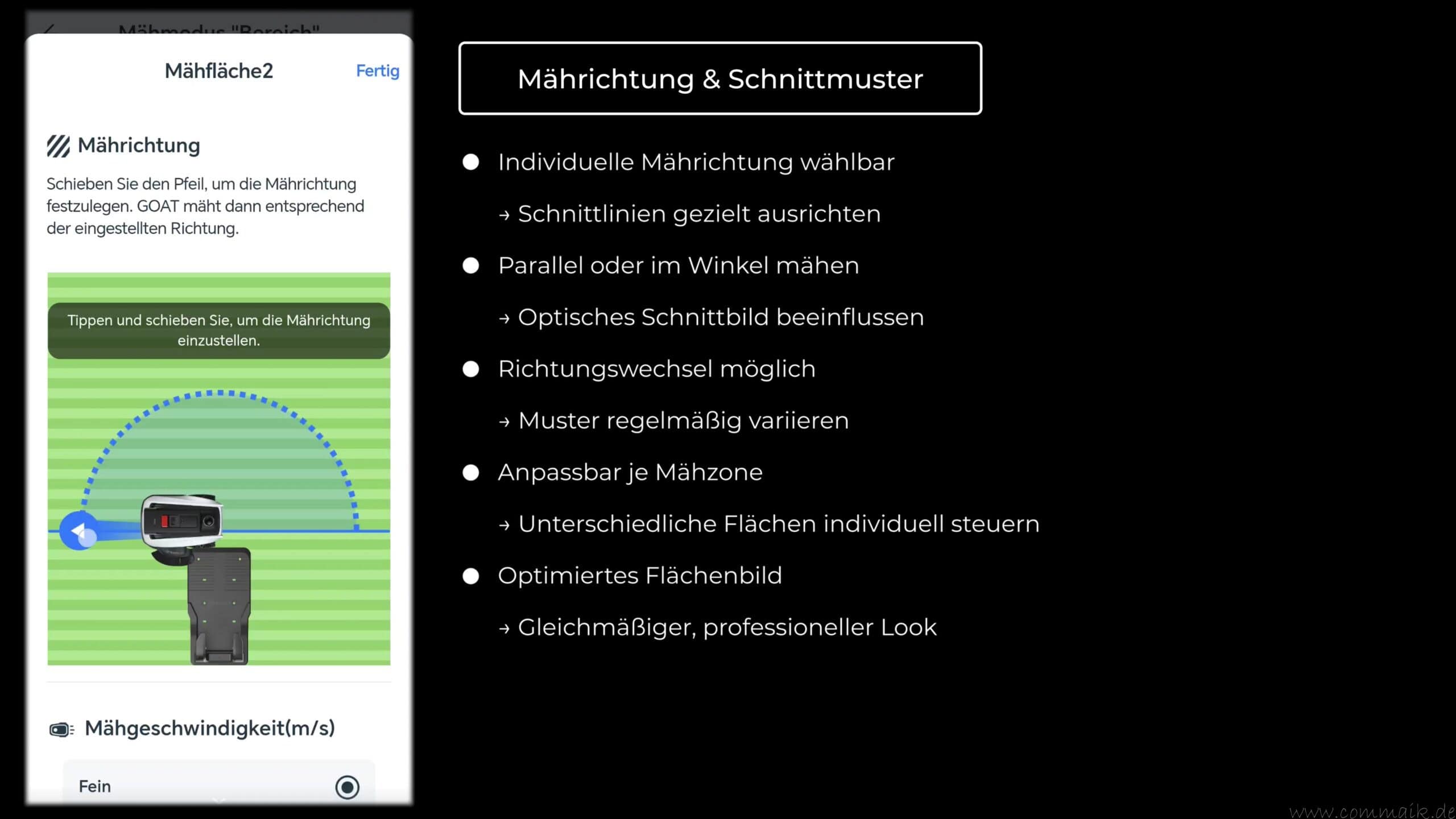
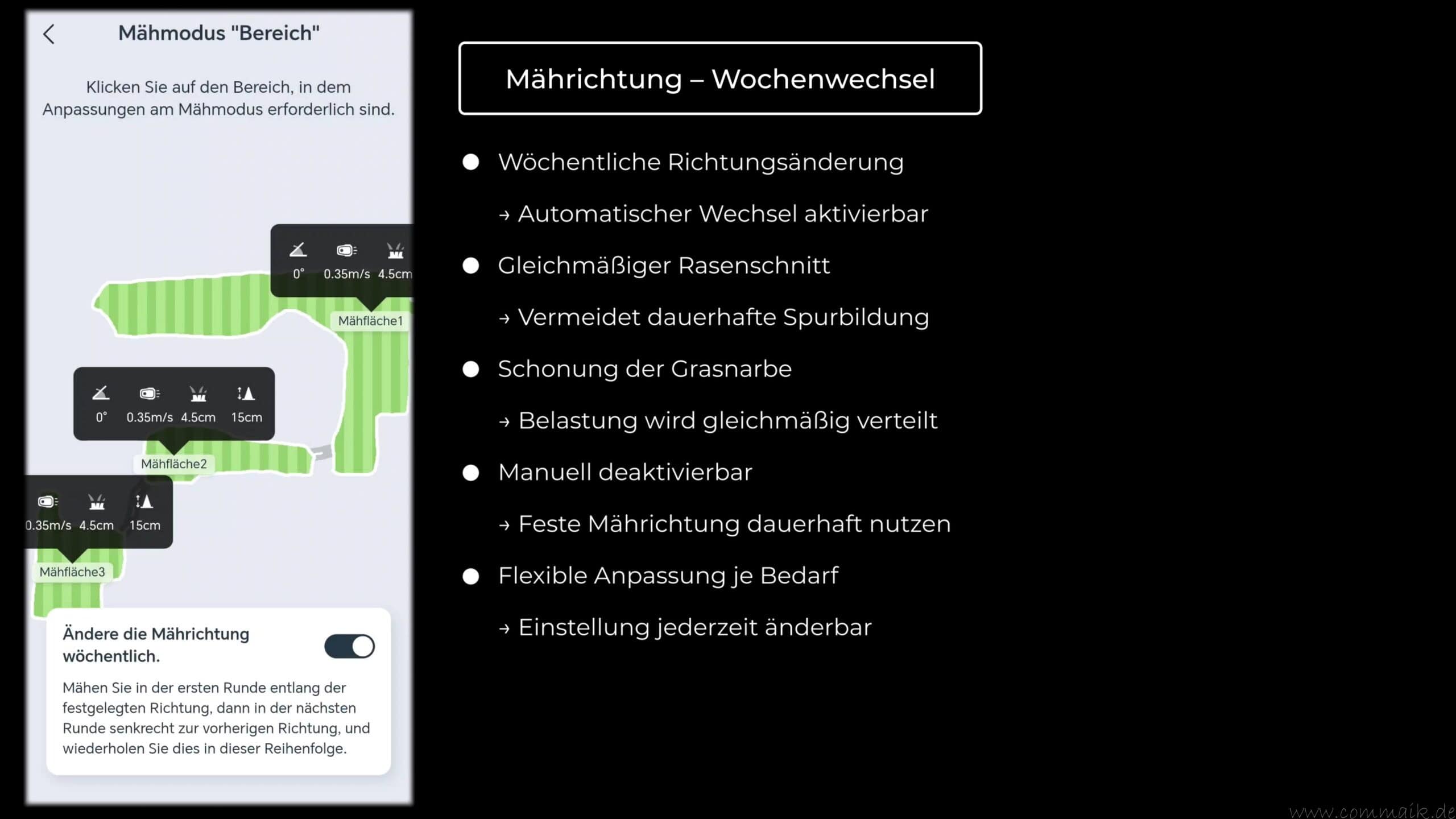
- Direction of travel and weekly change of direction
- Cutting height between 30 and 80 mm
- Edge Mode for Selected Areas
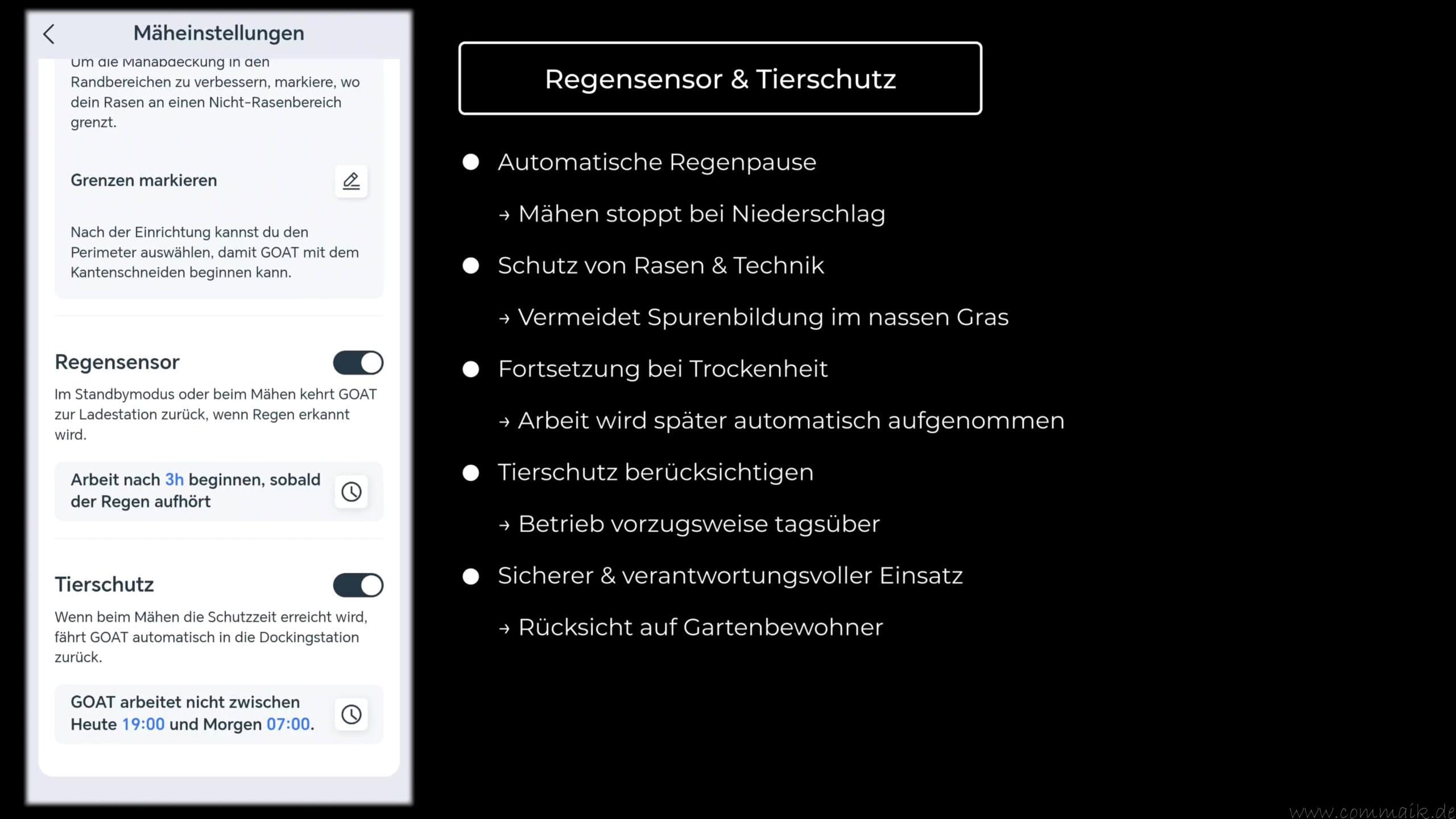
- Rain sensor
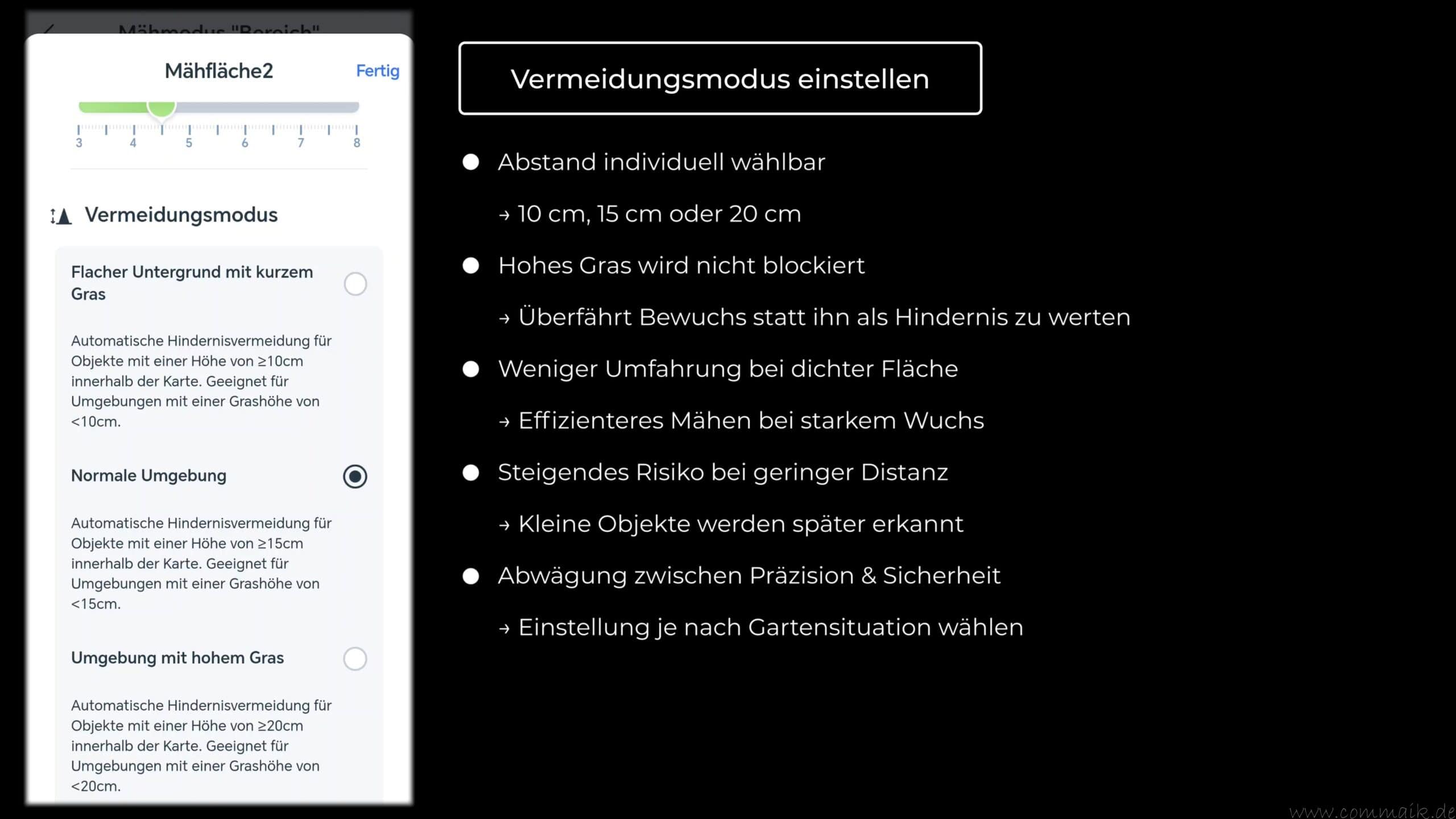
- Obstacle Avoidance Settings
- Animal Welfare Features
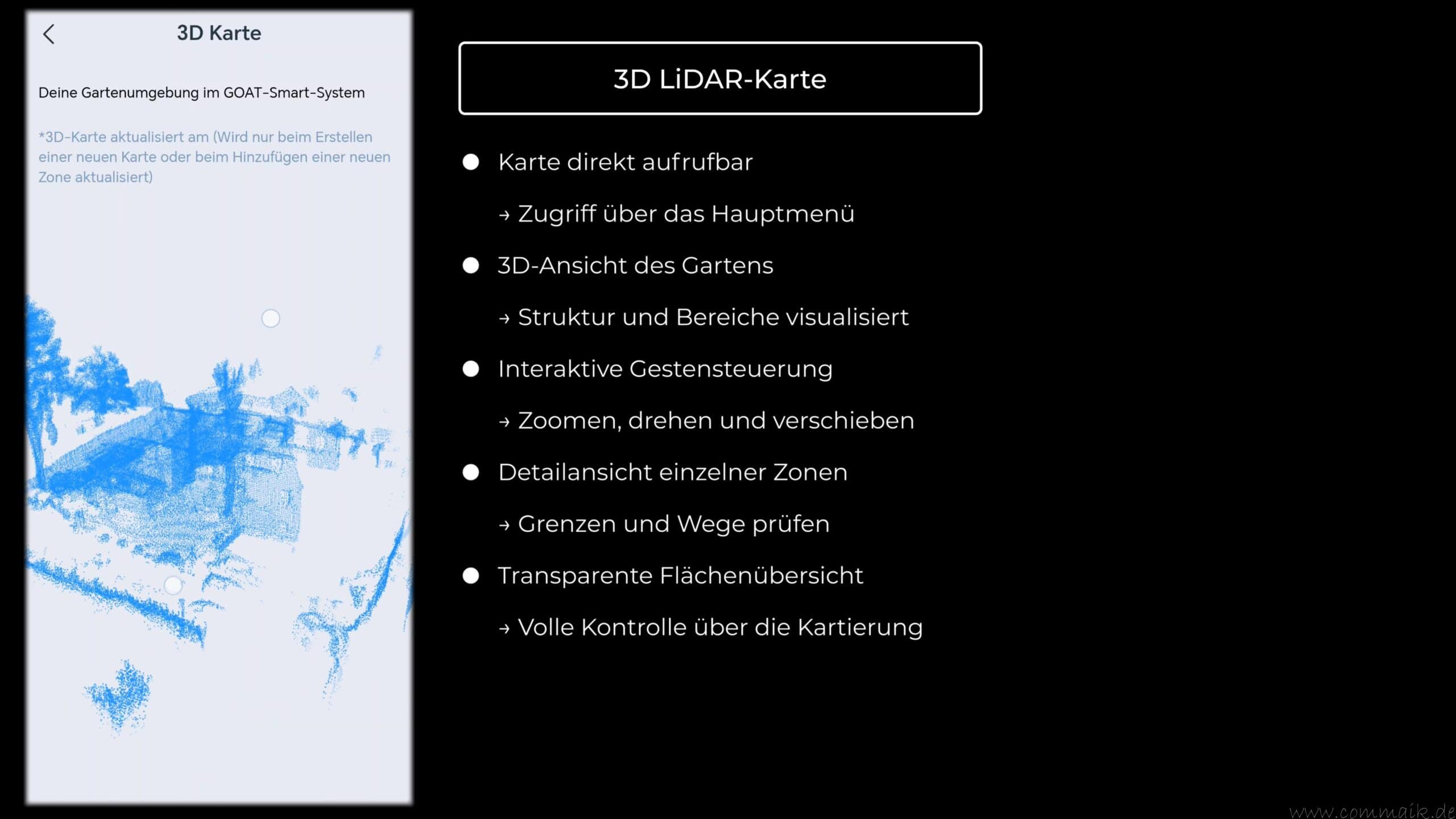
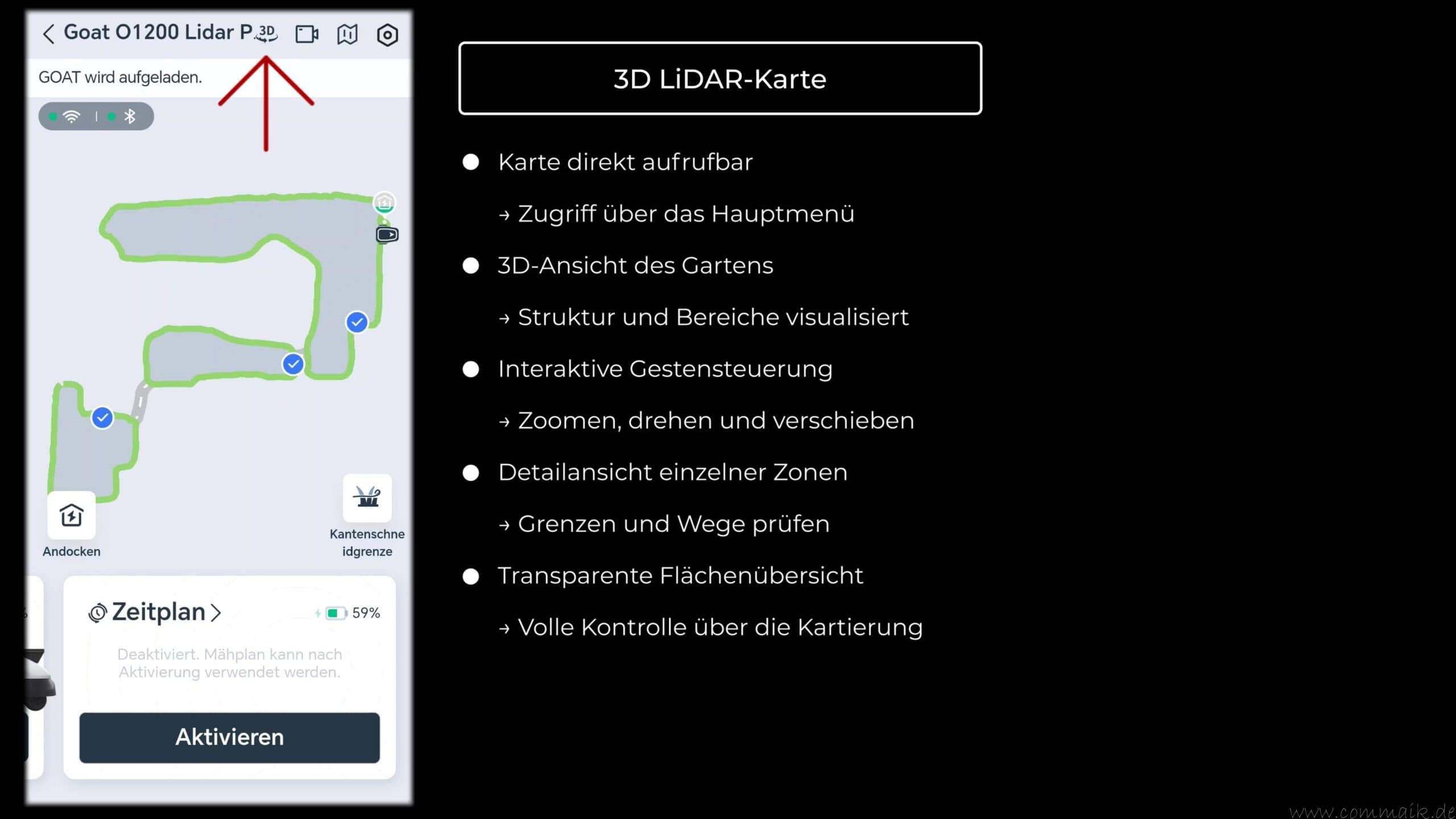
- three-dimensional map view
The cutting height is adjusted electronically via an app. No mechanical modifications to the mower are required for this. For example, this allowed me to set different cutting heights for my three lawns.
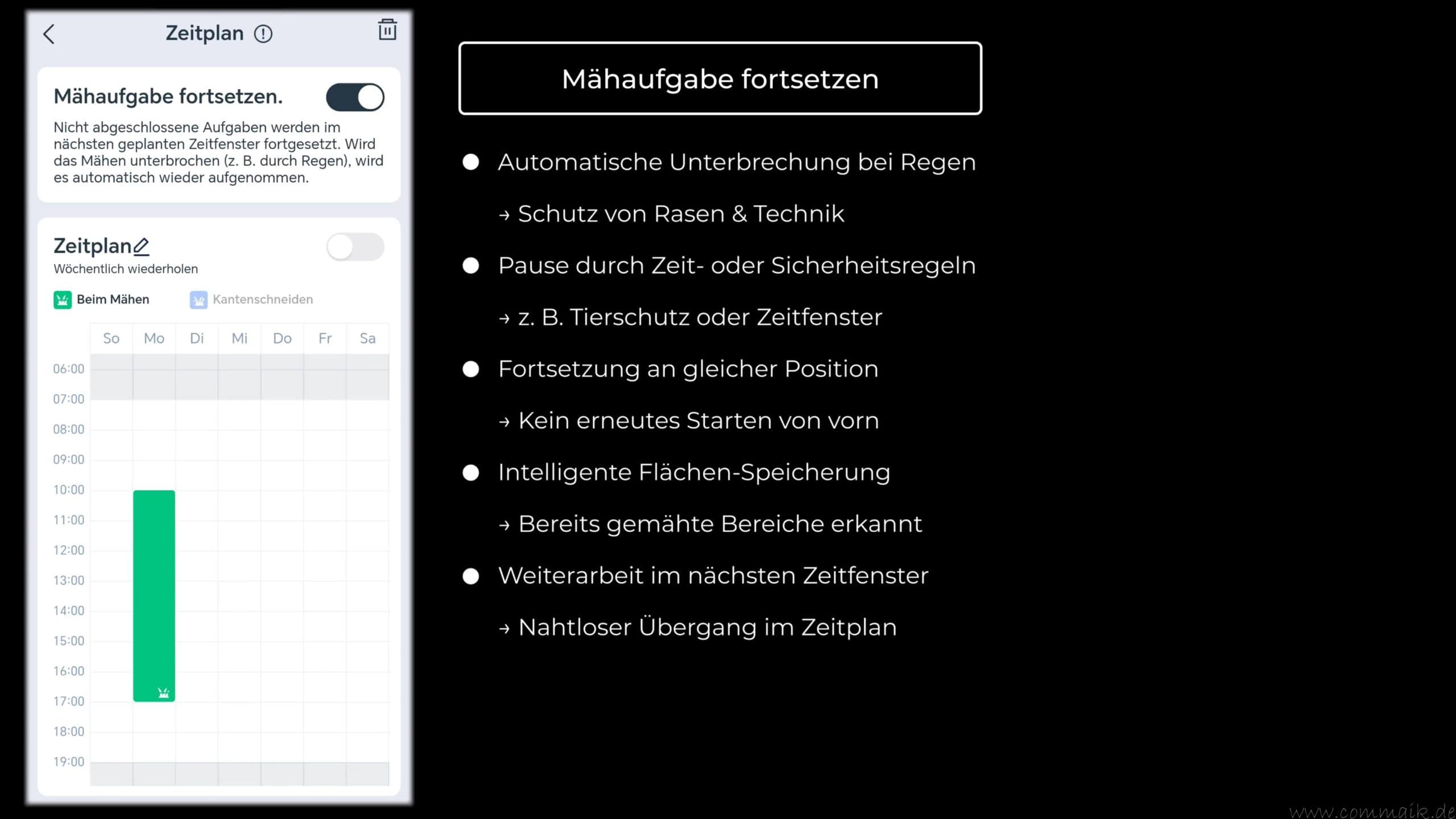
The region detection also worked flawlessly. As soon as the sensor on the top of the Goat detects moisture, the robotic mower returns to the charging station. After an adjustable pause for drying time, the mower resumes work at the exact spot where it had to stop. This prevents the mower from cutting wet grass while ensuring a thorough cut.



TruEdge Trimmer and Edge Cut in the GOAT O1200: A Review
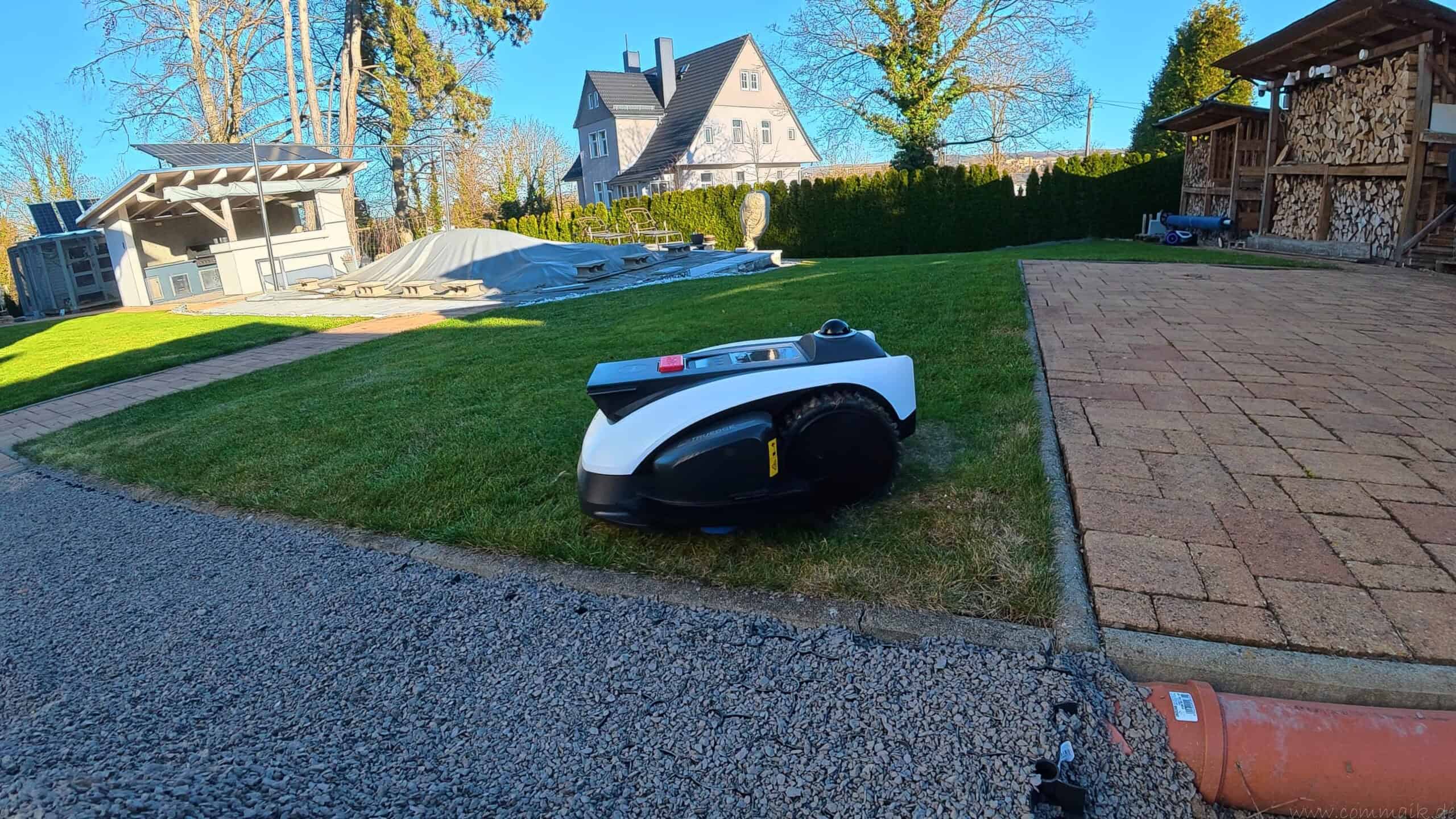
The TruEdge trimmer is the key distinguishing feature of this model. Instead of simply driving as close to the edge as possible with the internal mower, a side string spool folds down. This allows the thread to reach areas that are not covered by the three blades of the central cutting disc.
In my garden, I’ve used the string trimmer along a hedge, on flat lawn edges, along permanent edging, and next to WPC boards.
Edges along hedges and gentle slopes
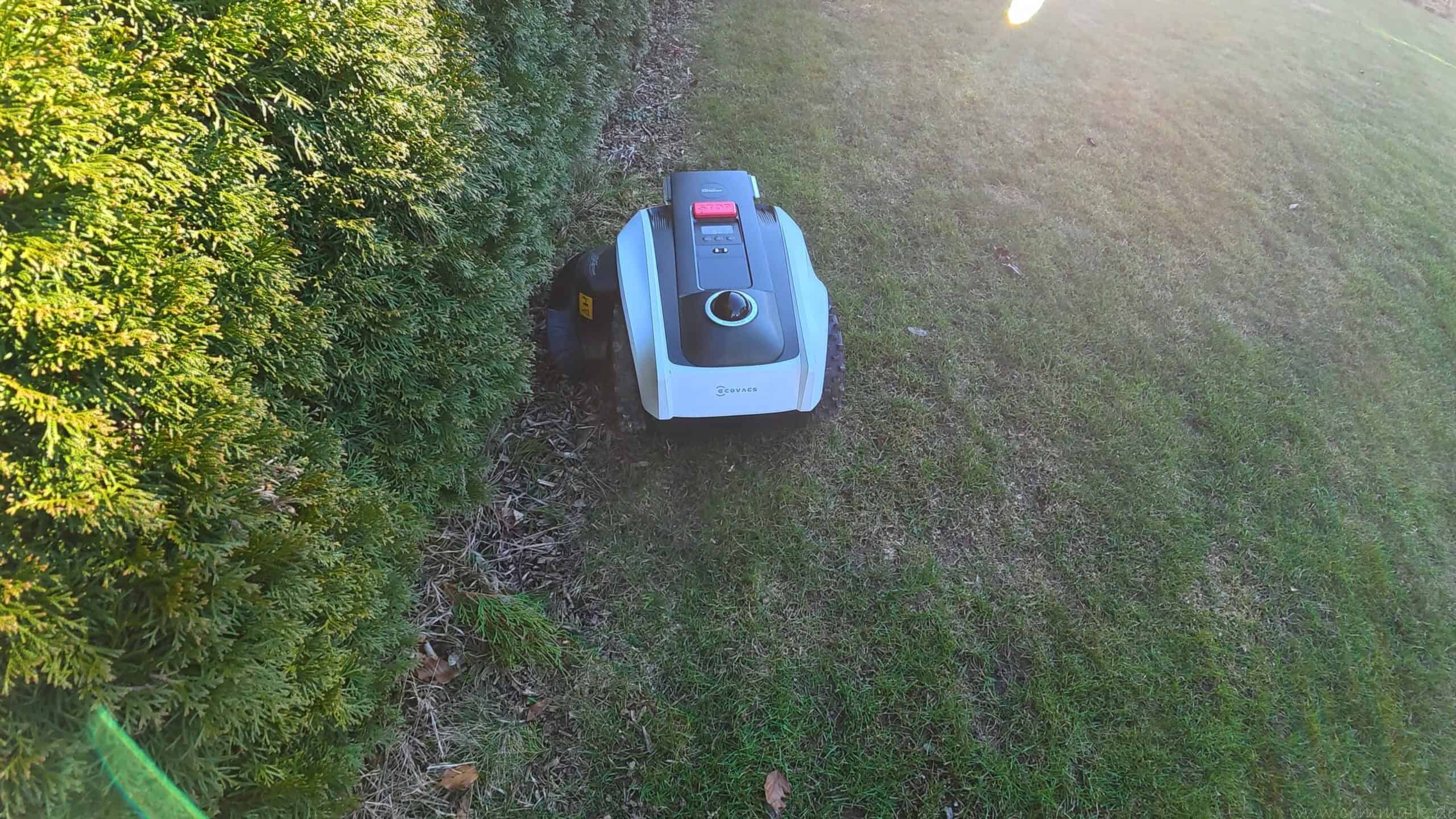
The trimmer really showed its strengths when working on the hedge. It reached into the lower vegetation and cut the grass there, which I had previously had to remove by hand with a lawn trimmer.
Not every longer tuft of grass was completely trimmed on the first pass. After a few more runs, the results improved. With regular use, the robot can keep the edges trimmed on an ongoing basis, rather than having to completely clear heavily overgrown edge areas all at once.
Straight and accessible lawn edges were precisely trimmed. On these sections, the amount of rework was significantly reduced.

- HOCHWERTIGE MESSER: Die Messer bestehen aus hochhärtetem Werkzeugstahl und bieten im Vergleich zu Edelstahl einen schärferen Schnitt sowie eine überlegene Haltbarkeit.
- HERVORRAGENDE SCHNEIDLEISTUNG: Mit einer Dicke von 0,9 mm verbessern sie die Leistung des Mähers und verkürzen effektiv die Mähzeit.
- PRÄZISE UND SANFTE SCHNITTE: Die Messer gewährleisten einen präzisen Schnitt und sind ideal für alle Arten von Rasen.
- EINFACHE INSTALLATION UND ERSATZ: Die Ersatzmesser sind mit Schrauben ausgestattet und lassen sich leicht mit einem einfachen Schraubendreher installieren und austauschen. Einfach die alten Messer entfernen, die neuen einsetzen und die Schrauben festziehen.
Walls, edging, and delicate materials
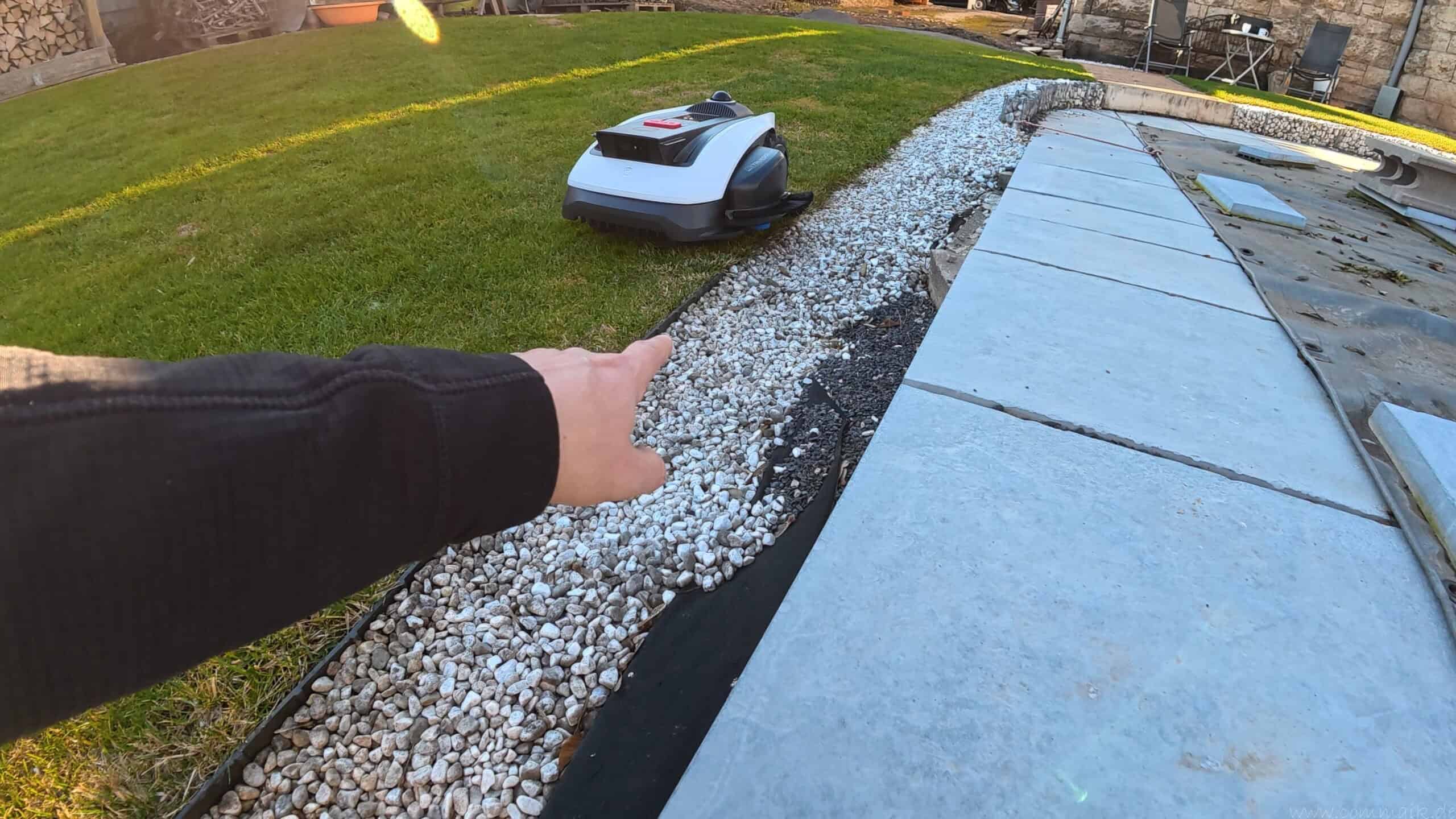
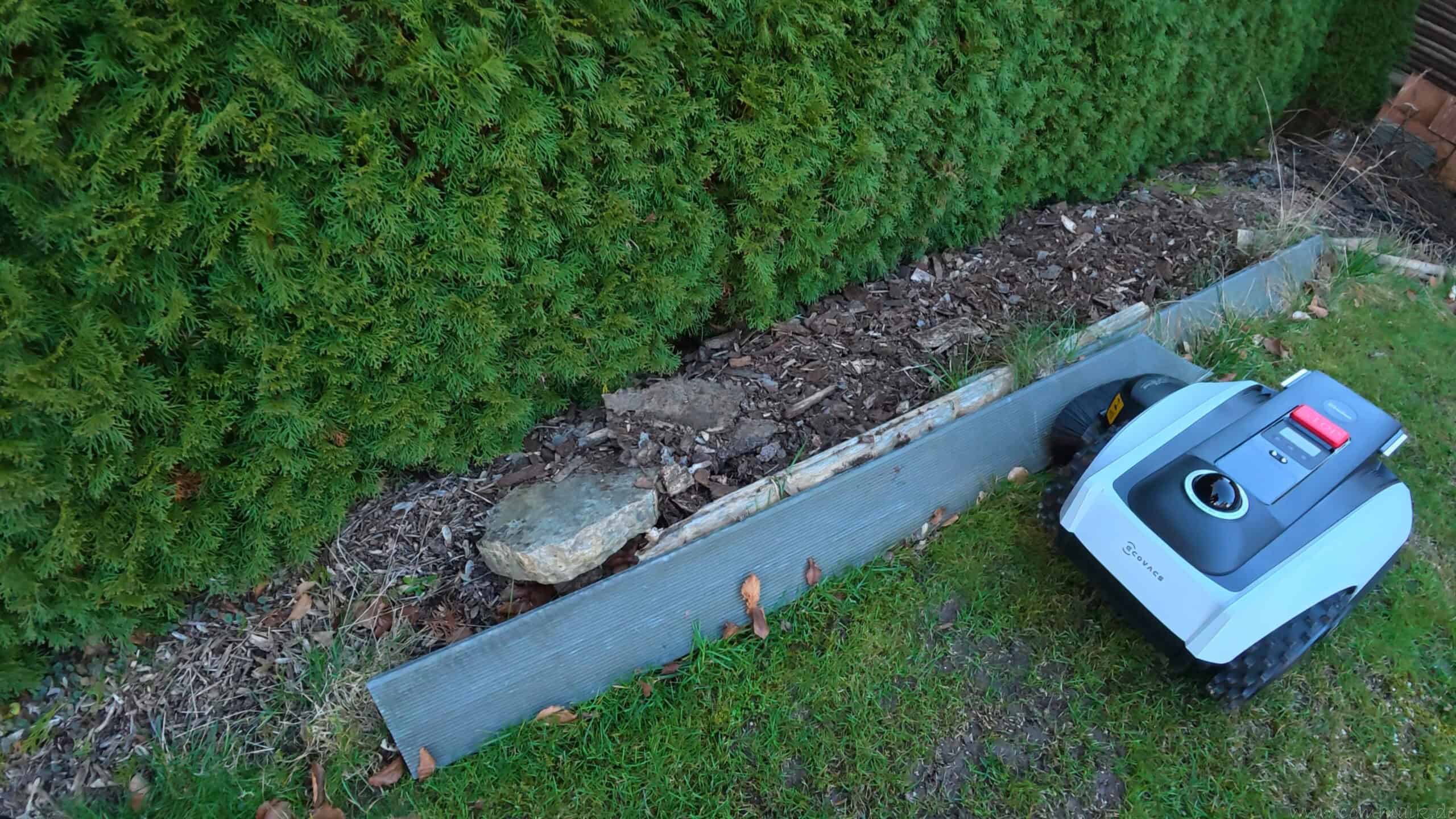
The trimmer operates with noticeable power. This is helpful for sturdy walls and lawn edging, but delicate materials may be damaged.
The trimmer line left visible marks on my WPC boards. This shows that the integrated technology is not equally suitable for every type of enclosure. Wood, soft plastic, painted surfaces, or delicate decorative elements should not come into regular direct contact with the thread.
Tight 90-degree inside corners remain a problem
Tight inside corners were clearly the weak spot. The robot couldn’t move at right angles all the way to the farthest corner; instead, it turned in an arc. As a result, a patch of grass with a radius of about 20 cm remained in the corner.
Even the trimmer, which extended to the side, could not always compensate for this geometric limitation. The O1200 significantly reduces the amount of manual work required along long edges, but it does not completely replace a hand trimmer in every garden with winding paths.
Trimmer Volume
I could barely hear the mower running on my lawns. As soon as the string trimmer started up, the background noise changed noticeably.
This subjective impression is consistent with the manufacturer’s technical specifications: ECOVACS lists approximately 61 dB(A) for the mower and 81 dB(A) when the trimmer is active. Therefore, edge trimming should not be scheduled for nighttime or during particularly sensitive rest periods.

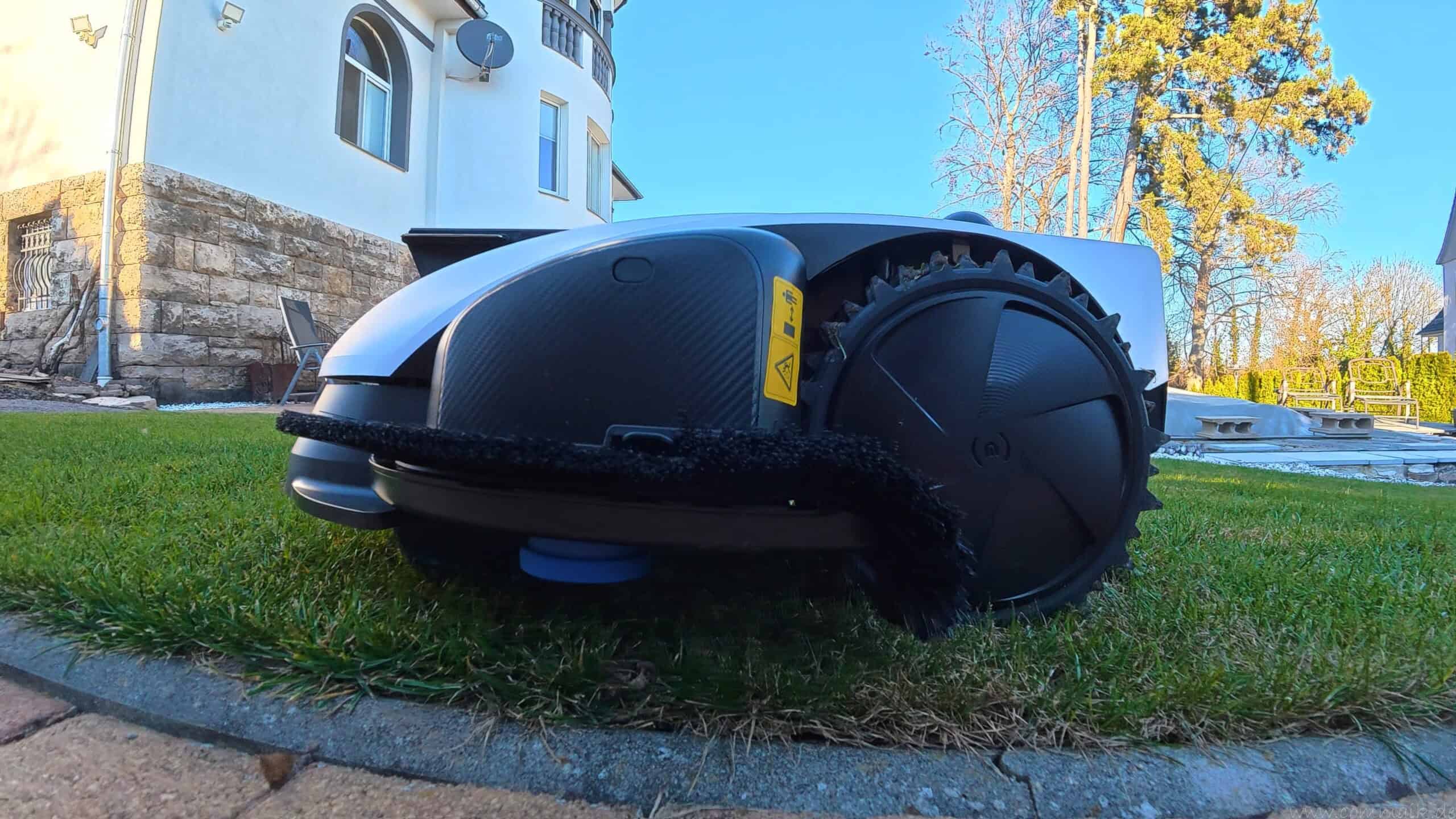
Safety feature on the built-in thread trimmer
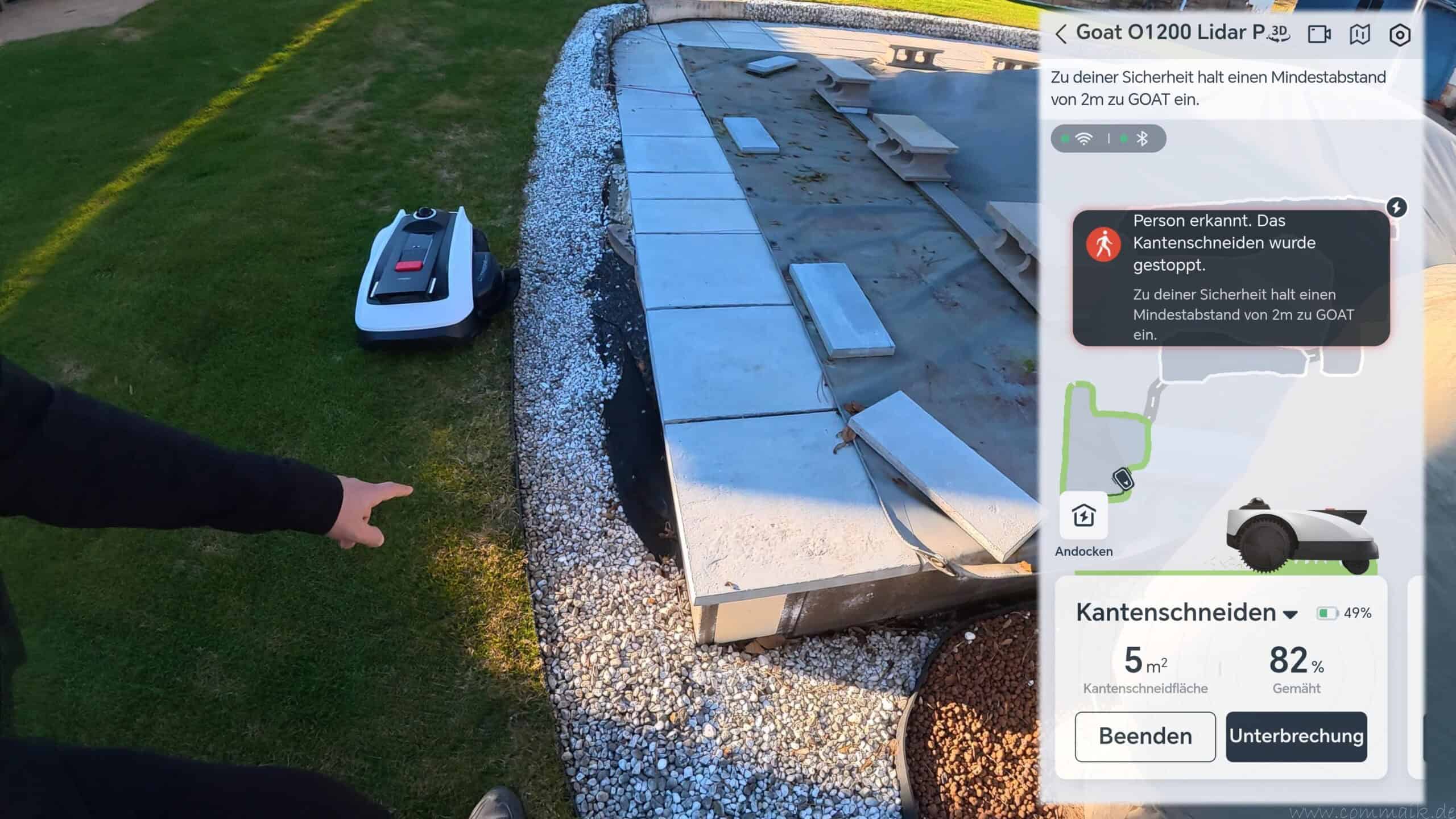
If a person gets too close to the robot, the trimmer stops automatically, while the normal mowing process can continue. Once there is sufficient clearance again, the robot resumes cutting along the edge.
The thread is also stopped when the stop button is pressed or in the event of a malfunction. These safety features are important, but they do not change the fact that a rotating trimmer can cause injuries and damage property.
In manual mode, support recommends a reasonable distance of about 1.5 to 2 meters. If the distance is too short, the trimmer may be deactivated by the motion sensor; if the distance is too great, the Bluetooth connection may cause problems for manual control.
Wear Parts and Consumables for the GOAT O1200 LiDAR PRO
During normal operation, typical wear-and-tear costs occur primarily on the mower deck and the TruEdge trimmer. The three moving blades, the trimmer line, and the side trimmer brush are key components. How long these parts last depends heavily on the size of the lawn, the operating times, and the surrounding materials.
Mower Blades
Three freely moving blades are mounted on the central mower. Over time, they become dull or damaged by grass, small twigs, stones, and other hard foreign objects. Dull blades no longer cut the stalks cleanly but increasingly tear them off. This is often evident in frayed or lightening grass tips.
That’s why I regularly check the blades for the following:
- Dull or damaged cutting edges
- bent knives
- Heavy soiling and caked-on grass clippings
- sufficient play in the mounting screws
- Unusual running noises or vibrations
In addition to the three installed blades, the package includes nine replacement blades with their corresponding screws. This allows for three complete changes. ECOVACS offers additional original blades as a replacement blade set. Compatible blades are also available at specialty stores and from various online retailers. It is important to use the correct dimensions, hole sizes, and screws for the GOAT series.
The robot must be completely turned off before any inspection or blade change. Sturdy work gloves are a good idea to protect against cuts. Damaged blades should always be replaced as a complete set to ensure that the mower remains balanced and to prevent unnecessary vibrations.
My measured yarn consumption per running meter
The TruEdge Trimmer automatically and continuously feeds the thread while trimming edges. To measure the actual feed rate, I made a mark on the trimmer line before the test. After trimming about 50 running meters of lawn edging, I checked to see how far the line had come off the spool.
The result was about 2 cm of thread that had been pulled through along 50 m of lawn edging. Mathematically, this corresponds to a consumption of about 0.4 mm per running meter. Based on this calculation, one meter of trimmer line—assuming a constant feed rate—would theoretically be enough for approximately 2,500 running meters of edge trimming.
Normal wear and tear does not depend directly on whether the thread comes into contact with grass, wood, or another type of edging. The trimmer continuously feeds the line and does not detect how much of it is actually being worn away at each edge. However, additional thread consumption may occur if the thread breaks prematurely due to a hard impact or if a large piece is cut off.
Rewind the trimmer spool with a different type of line
As a general rule, you don’t have to throw away the entire spool every time you run out of thread. In theory, the existing spool can also be refilled with a different type of trimmer line that is technically compatible. To do this, suitable nylon thread of the same thickness and type can be wound onto the empty spool.
In particular, the following properties must match those of the original thread:
- Thread diameter
- Cross-Section and Material
- Winding Direction
- maximum allowable thread length
- Secure fastening of the thread end
- uniform winding without crossings
Winding the cable yourself using third-party materials is a possible, cost-effective solution; however, it does not comply with ECOVACS specifications. When in doubt, the original thread is therefore the safer choice.
Trimmer Brush and Trimming Module
In addition to the thread, the side brush is also subject to mechanical wear. It guides and protects the robot as it moves along boundaries. Broken, severely bent, or completely worn-out brush elements should be replaced.
Where to Buy Blades, Floss, and Toothbrushes
Genuine replacement parts are available directly from ECOVACS and, depending on availability, from specialty retailers and online stores. For my contribution, the existing sources can be used:
Before placing an order, you should check the exact product name. ECOVACS offers several GOAT models, some of whose blades are compatible across different series, while trimmer parts are only compatible with certain LiDAR-PRO models.
- Trimmer Replacement Parts with Brushes*
- Replacement parts for trimmers or mowers*
- Genuine Accessories for ECOVACS GOAT
Note: All links marked with an * are affiliate links. If you make a purchase through these links, I’ll receive a small commission. This does not change the price.

- Das Kit enthält zwei 3 Meter lange Ersatz-Trimmerfäden und zwei Anti-Spritz-Trimmerbürsten, die Grasreste und Schmutz zuverlässig davon abhalten, auf das Robotergehäuse und die Sensoren zu treffen. Dank des einfachen Montage- und Demontageprozesses lassen sich sowohl Bürste als auch Faden im Handumdrehen austauschen. Das Kit ist kompatibel mit GOAT LiDAR PRO Modellen.
Video: ECOVACS GOAT O1200 LiDAR PRO in a Real-World Test
The following video shows the unboxing, setup, automatic mapping of my three lawns, operation via the app, and edge trimming while the robot is in operation. I have also documented how the system behaves near hedges, WPC edging, irrigation covers, and 90-degree inside corners.
You can find more hands-on reviews on my YouTube channel, COMMAIK, and in my playlist on robotic lawn mowers.
-

-
-
Price: € 139.00instead of: € 152.00
-
Price: € 499.00instead of: € 699.00
-
-
-
Price: € 849.00instead of: € 1,049.00


ECOVACS GOAT O1200 LiDAR PRO vs. A1600
Before the O1200, I had already been using the GOAT A1600 RTK in my yard. That’s why I can easily classify both models from a practical standpoint. In addition, the new GOAT A1600 LiDAR PRO is now available. Although I haven’t tested this model myself, the technical differences still make it clear what kind of gardens it’s designed for.
| Criterion | GOAT O1200 LiDAR PRO | GOAT A1600 RTK | GOAT A1600 LiDAR PRO |
|---|---|---|---|
| Recommended lawn area | up to 1,200 m² | up to 1,600 m² | up to 1,600 m² |
| Navigation | Dual LiDAR | RTK, Camera, and Sensors | Dual LiDAR |
| External RTK Antenna | no | yes | no |
| Boundary Wire | no | no | no |
| Cutting width | 22 cm | 33 cm | 33 cm |
| Cutting height | 30–80 mm | 30–90 mm | 30–90 mm |
| Active Edge Trimmer | yes | no | yes |
| Mowing Capacity | up to approx. 180 m²/h | up to about 400 m²/h | up to about 400 m²/h |
| Suitable Applications | smaller, winding gardens | medium to large lawns | medium to large lawns |
GOAT O1200 LiDAR PRO or A1600 RTK?
The biggest difference between the O1200 and the older A1600 RTK is in the navigation system. Both robotic mowers operate without a boundary wire. However, the A1600 RTK requires an additional reference station and sufficiently good satellite reception. The O1200 does not require this antenna at all, because it uses its dual LiDAR system to navigate based on the structures in the garden.
This makes setting up the O1200 much easier. Set up the charging station, connect the robot to the app, and start automatic mapping—that was pretty much all it took in my yard. With the A1600 RTK, I also had to find a suitable location for the reference station and ensure reliable reception.
In contrast, the A1600 RTK is significantly larger and faster. With its 33-cm cutting width, it handles larger areas much more efficiently than the O1200, which has a 22-cm-wide mower deck. On open grassy areas, the A1600 clearly capitalizes on this advantage.
The smaller O1200, on the other hand, is better suited to a winding backyard. It is easier to maneuver through narrow spaces and, according to the technical specifications, can pass through openings as narrow as 80 cm. That worked well with my three separate lawns and the narrower paths connecting them.
The O1200 also has a decisive advantage when it comes to edge cutting. Although the A1600 RTK can drive over flat lawn edges and thus mow very close to the edge, it does not have an active string trimmer. This works well on a curb that vehicles can drive over. If there is a wall, a raised border, or a hedge right next to the lawn, a narrow strip will remain due to the layout.
That’s exactly where the O1200’s TruEdge Trimmer comes in. In my yard, it was able to cut the grass along the hedge and along barriers that couldn’t be driven over. So the O1200 wasn’t any faster, but it did reduce the amount of manual rework required on suitable edges.
You can find my in-depth review of the larger model in the article “ECOVACS GOAT A1600 RTK – A Robot Lawn Mower Without a Boundary Wire Put to the Test.”
GOAT O1200 or GOAT A1600 LiDAR PRO?
The new GOAT A1600 LiDAR PRO essentially combines the key advantages of both models described above. Like the O1200, it navigates using dual LiDAR without an RTK antenna. At the same time, it features the wider cutting deck and higher area coverage of the A Series. The active TruEdge trimmer is also included in both LiDAR-PRO models.
The O1200 is designed for lawns up to 1,200 m² and covers approximately 120 to 180 m² per hour, depending on the selected mowing mode. The A1600 LiDAR PRO is designed for areas of up to 1,600 m² and, with its 33-cm-wide dual mower deck, can cover up to 400 m² per hour.
So, for me, the choice comes down mainly to the size of the garden and the shape of the lot. For a smaller, winding garden with narrow pathways, the more compact O1200 is a better fit. For larger or predominantly open lawns, the A1600 LiDAR PRO offers significantly higher mowing performance.
The A1600 also offers a cutting height ranging from 30 to 90 mm, while the O1200 allows you to select a height between 30 and 80 mm. In a typical home garden, this difference is unlikely to be a deciding factor. More important are the wider cutting width, the higher speed, and the additional space the A1600 needs to turn.
Since I haven’t used the GOAT A1600 LiDAR PRO in my own yard yet, I can’t evaluate its mowing quality or the trimmer based on my own experience. Technically, however, it is the obvious alternative if you like the O1200 design but your lawn is too large for the smaller mower.
The A3000 LiDAR PRO takes this concept a step further for areas up to 3,000 m². Models such as the GOAT O800 RTK, on the other hand, belong to a different series and continue to use a combination of RTK and additional sensors. For a direct comparison with the O1200, the two current LiDAR PRO models are therefore of particular interest.

- Für den Einsatz unter härtesten Bedingungen entwickelt: Dieser Mähroboter wurde speziell dafür konzipiert, selbst extremen Außenbedingungen standzuhalten, und überzeugt durch seine hohe Widerstandsfähigkeit gegenüber witterungsbedingtem Verschleiß. Seine robuste Konstruktion minimiert die Auswirkungen von Witterungseinflüssen, verlängert die Lebensdauer und verlangsamt die Alterung von Außengeräten. Dank seiner außergewöhnlichen Langlebigkeit bietet er auch in extremen Umgebungen zuverlässige Leistung.
- Mühelose Installation und Wartung: Dank des intuitiven Designs ist die Installation schnell und unkompliziert, sodass Sie Ihren Rasenmäher mit minimalem Aufwand einrichten können. Die Reinigung ist einfach und sorgt dafür, dass Ihr Gerät stets in einwandfreiem Zustand bleibt, wodurch Ausfallzeiten und Wartungsaufwand reduziert werden.
- Robuste Konstruktion für maximalen Schutz: Mit seiner soliden und langlebigen Bauweise bietet dieser Mähroboter zuverlässigen Schutz vor potenziellen Risiken, schützt die internen Komponenten und gewährleistet einen reibungslosen Betrieb.
What types of gardens is the GOAT O1200 LiDAR PRO suitable for?
For me, the O1200 is primarily a robotic lawn mower designed for typical home gardens, where the focus is not on maximum coverage but on flexible navigation and the cleanest possible edge cutting. It really shines on small to medium-sized, more structured plots.
Structured and winding home gardens
With its relatively compact design, the O1200 is well-suited for lawns that are divided by hedges, flower beds, paths, and other garden areas. In my yard, he had to mow three separate lawns and move between them along paved paths.
The automatic mapping and the saved routes worked well. However, this is contingent on the route, once established, remaining permanently passable. If garden furniture, trash cans, or other objects are regularly left there, the transition to the next zone may be disrupted.
The O1200 is also a good choice for narrow passages. It can travel on paths that are about 80 cm wide or wider. For even narrower passages or very tight turns, you should carefully check before purchasing whether, in addition to the clear passage width, there is also enough space to turn the vehicle.
Gardens without a suitable location for an RTK antenna
It is not always practical to set up an RTK reference station in every garden. Tall buildings, dense trees, and other sources of shade can make it difficult to choose a location. Added to this is the extra work involved in installation and wiring.
The O1200 does away with the external antenna entirely. It uses its dual LiDAR system to navigate around the existing structures in the garden. This is especially convenient if there are already walls, house walls, hedges, or trees surrounding the lawn.
As a result, the setup was straightforward in my case. I set up the charging station, connected the robot to the app, and then started the automatic mapping. I didn’t have to lay a boundary wire either.
Several separate lawns
The O1200 can manage multiple areas on a single map. This is suitable for properties where the lawn areas are separated from one another by paths, patios, or narrow walkways.
The connection between the areas is traced once manually and then saved. After that, the robot can use this path on its own. However, the crossings must be at ground level or, at the very least, easily passable. Of course, the app-based control system can’t compensate for steps, high thresholds, and closed gates.
Gardens with long hedges, walls, and defined lawn edges
The TruEdge Trimmer offers the greatest advantage in areas where a standard mower, due to its design, cannot reach all the way to the edge. This applies, for example, to lawns along:
- House and Garden Walls
- Hedges
- raised garden borders
- Fences with a low top
- sturdy curbstones
- lawn edging that cannot be driven over
The trimmer also cut the grass growing between the lower branches of my hedge. I used to have to go over these areas by hand on a regular basis. On long, straight sections, the O1200 was therefore actually able to reduce the workload.
The benefit is less significant if the entire lawn is already surrounded by wide, fully drivable paved edging. Even a robotic mower without a string trimmer can drive its cutting deck over the edge there and achieve a clean edge.
Gardens up to about 1,200 m²
The O1200 is designed for areas up to 1,200 m². However, this number alone does not indicate how quickly a particular lawn can be mowed in its entirety. Many small areas, long transition paths, numerous obstacles, and frequent turning maneuvers take more time than a simple rectangular area.
With a cutting width of 22 cm and a mowing capacity of approximately 120 to 180 m² per hour, the robot is significantly slower than the larger models in the A Series. For a typical home garden, this isn’t necessarily a drawback, since a robotic mower operates regularly and largely on its own.
However, the closer the actual area gets to 1,200 m², the more important the shape of the lot and the timeline become. If the area is large and has many nooks and crannies, I would allow for some extra power and, if necessary, choose a wider model.
Who is the GOAT O1200 not really suitable for?
Despite its good navigation and handy trimmer, the O1200 isn’t the best choice for every garden.
Very large or mostly open lawns
On large, open lawns, the compact design offers few advantages. The most important factors there are cutting width, speed, and short reloading breaks. With its 22-cm-wide cutting deck, the O1200 takes significantly longer than a GOAT A1600 or A3000.
For a large, open space, I would therefore tend to choose a more powerful model. The A1600 LiDAR PRO also operates without an RTK antenna, but features a 33-cm-wide mower deck and achieves a significantly higher area coverage rate.
Gardens with many tight inner corners
The thread trimmer improves edge cutting, but it cannot compensate for the robot’s dimensions and turning radius. In tight 90-degree interior corners, my O1200 took a wide turn and didn’t quite reach the far corner.
If a garden consists of many small nooks, right-angled recesses, and narrow dead-end paths, manual follow-up work will therefore still be necessary. The trimmer is particularly effective on longer edges, but it’s no substitute for a small handheld trimmer in every corner.
Delicate edging right at the edge of the lawn
The trimmer line is cutting vigorously and sometimes comes into direct contact with the side guide. He left visible marks on my WPC boards.
Delicate wooden surfaces, soft plastics, painted components, thin protective films, or decorative trim can be damaged by regular contact. In such areas, the trimmer would need to be disabled, or the virtual boundary would need to be set farther away. However, this eliminates the very advantage of automatic edge cutting.
Very uneven terrain and extreme inclines
The O1200 does not have all-wheel drive. Normal unevenness and the existing slopes in my yard weren’t a problem, but I haven’t tested it on extremely steep slopes.
On steep slopes, consistently soft ground, or uneven terrain, an AWD robotic mower may be the better choice. It’s not just the maximum gradient on paper that matters. Turning maneuvers on slopes, wet grass, and the condition of the ground also affect traction.
Gardens with steps and walkways that are not accessible by vehicle
Multiple mowing zones can only be connected automatically if the robot can navigate the entire route on its own. Steps, stairs, high curbs, and gates that are regularly locked make it impossible to cross the area automatically.
In such cases, the mower would have to be moved by hand. That is technically possible, but it runs counter to the goal of operating as independently as possible.
Very quiet residential areas and sensitive response times
Normal mowing operation is pleasantly quiet. In contrast, the active string trimmer is quite noticeable due to the noise it makes. Edge trimming should therefore not be scheduled at night, early in the morning, or during local quiet hours.
If the robot is only allowed to operate during very narrow time windows, the noisy trimmer can limit scheduling options. However, edge mode can be activated selectively and does not need to be enabled for every normal mowing job.
Anyone who doesn’t want any maintenance or consumables
The TruEdge Trimmer reduces manual labor, but comes with additional wear parts. The thread and brush must be inspected and replaced as needed. In addition, there are the standard blades of the mower.
In my test, about 2 cm of grass was left behind along approximately 50 m of trimmed lawn edge. That’s not a particularly high consumption rate, but it shows that the trimmer function isn’t completely maintenance-free.
In addition, after about two months, the drive mechanism of the trim module on my test unit malfunctioned. No general failure rate can be derived from this. Nevertheless, it remains an important point in my personal assessment. If you’re buying a robotic lawn mower mainly for its built-in trimmer, you should make sure the warranty service is reliable and that replacement parts are readily available.
My assessment
The GOAT O1200 LiDAR PRO is particularly well-suited for a small or medium-sized home garden with multiple zones, narrow paths, and long hedges or wall edges. This is where its compact design, automatic LiDAR mapping, and active trimmer come together effectively.
For large open areas, steep slopes, numerous tight interior corners, or delicate edging, there are more suitable solutions available with other robotic mowers. The O1200 is not a universal robotic mower suitable for every property, but rather a specialized model designed for structured gardens where a clean edge cut is more important than maximum coverage.
Products and Accessories Used
- ECOVACS GOAT O1200 LiDAR PRO*
- Replacement trimmer with brushes*
- Replacement trimmer*
- ECOVACS GOAT A1600 RTK*
- ECOVACS GOAT O800 RTK*
- ECOVACS Garage for GOAT Robotic Lawn Mowers*
Note: All links marked with an * are affiliate links. If you make a purchase through these links, I’ll receive a small commission. This does not change the price.
My Conclusion on the ECOVACS GOAT O1200 LiDAR PRO Review
The GOAT O1200 made a good impression in my garden. Setup was straightforward; my three separate lawn areas were automatically detected, and the navigation worked reliably. I was also satisfied with the cross-section. The robotic lawn mower moved across the lawn in neat rows and cut the grass evenly to the set height.
For me, the real highlight was the TruEdge Trimmer. He cut the grass, especially along my hedge, which I used to have to remove regularly with a handheld trimmer. Even along walls and other barriers that the robot couldn’t drive over, the thread came significantly closer to the edge of the lawn than the standard mower.
That means the trimmer isn’t just a gimmick to me. On long, easily accessible edges, it can handle a large portion of the manual finishing work. The amount of thread used—about 2 cm for 50 running meters of lawn edging—was also quite manageable.
Still, it wasn’t possible to get by without any rework at all. In tight 90-degree interior corners, the robot couldn’t maneuver far enough in, so some grass was left behind there. Caution is also advised when dealing with delicate frames. The thread is quite strong and has left visible marks on my WPC boards.
I also really liked the automatic mapping feature and the fact that it doesn’t require an RTK antenna. I didn’t have to lay a boundary wire or look for a suitable location for an additional reference station. This is a practical advantage, especially in a structured garden with buildings, trees, and hedges.
Taking care of my three lawns also went smoothly. The individual zones could be selected via the app and linked together using saved routes. Cutting height, cutting direction, schedules, and edge cutting could also be easily adjusted.
In my opinion, the O1200 is particularly well-suited for small and medium-sized home gardens with narrow paths, multiple lawns, and long hedges or walls. This is where its compact design, LiDAR navigation, and active edge trimmer come together effectively.
For large, mostly open areas, I would tend to choose a model with a wider cutting deck and higher coverage rate. Even when dealing with many tight inside corners or delicate trim, some manual work is still required.
All in all, the ECOVACS GOAT O1200 LiDAR PRO is a well-designed robotic lawn mower for structured gardens. It navigated my lawn with precision, produced an even cut, and significantly reduced the amount of manual touch-up work needed along the edges of the lawn. It didn’t completely replace my handheld trimmer—but I had to use it much less often.
Frequently Asked Questions About the ECOVACS GOAT O1200 LiDAR PRO
Does the ECOVACS GOAT O1200 LiDAR PRO require a boundary wire?
No, the O1200 operates entirely without a boundary wire. The dual LiDAR system maps the lawn and saves the detected boundaries as a digital map in the ECOVACS HOME app. This eliminates the need to run a wire as well as the subsequent search for possible cable breaks.
Does the GOAT O1200 LiDAR PRO require an RTK antenna?
No, an external RTK antenna is not required. The robot uses its LiDAR sensors to navigate based on the structures in its surroundings. As a result, there is no need to plan for a suitable antenna location or an additional power supply for a reference station.
This is particularly interesting in gardens with buildings, trees, and hedges, since navigation does not rely on a clear, unobstructed view of the sky at all times.
How does automatic mapping work?
To do this, create a new map in the Maps menu of the ECOVACS HOME app and start automatic mapping. The robot then leaves the charging station and autonomously maps the boundaries of the accessible lawn area.
Once mapping is complete, the detected area is displayed in the app. There, you can check the boundaries and edit them if necessary. In the practical test conducted, the existing outer edges were detected with such precision that no manual correction was initially required.
Before mapping, any movable objects should be removed from the border area. Garden furniture, toys, or equipment temporarily left out may interfere with automatic detection or be interpreted as part of the boundary.
Can the O1200 mow several separate lawns?
Yes, multiple separate lawns can be managed on a single map. To do this, add another area in the map menu. The robot is then guided to that section of the lawn using the manual controls, and automatic mapping is restarted there.
The route traveled manually between the two areas is saved as a connection route. The robot can use this route automatically later. The route must remain permanently accessible and must not contain any steps, high curbs, or objects that are regularly left there.
How narrow can the paths between the lawns be?
The GOAT O1200 is designed for passages that are at least 80 cm wide. In addition to the clear passage width, however, there must be sufficient space for entering, steering, and turning.
A straight path is easier to navigate than a path of the same width that has a sharp curve right at the entrance. In a real-world test, the vehicle navigated the narrow passage reliably. However, a test track exactly 80 cm wide was not set up.
Does the TruEdge Trimmer completely replace a standard lawn trimmer?
Along long hedges, walls, and easily accessible lawn edges, the TruEdge trimmer can significantly reduce the need for manual touch-ups. In a field test, it also cut the grass under a hedge, which previously had to be trimmed regularly with a handheld trimmer.
However, the built-in trimmer does not completely replace a handheld trimmer in every garden. In tight 90-degree interior corners, the robot moves in an arc and does not always reach the far corner. Even at complicated intersections, traffic can occasionally come to a standstill.
How is it determined which edges the trimmer will cut along?
The areas to be cleaned are selected in the map view of the ECOVACS HOME app. This allows you to enable edge detection specifically for suitable areas. The trimmer does not need to be used at every virtual boundary.
This is especially useful for delicate frames. The thick thread may leave visible marks on WPC, wood, soft plastic, or painted surfaces. In such areas, you should either allow for more space or disable the trimming function.
The boundaries of restricted areas must also be monitored separately. Just because a restricted zone has been created doesn’t automatically mean that the entire edge of that zone will be trimmed by the trimmer.
How much trimmer line is used?
To measure consumption, a mark was made on the thread before the test. After cutting along the edge for about 50 running meters, a check was made to see how far this marking had moved out of the spool due to the automatic thread feed.
The result was about 2 cm of twine per 50 m of lawn edging. That works out to about 0.4 mm per running meter. Assuming a constant feed rate, one meter of trimmer line would theoretically be enough for about 2,500 meters of edge trimming.
The trimmer automatically and continuously feeds the line. It cannot tell whether the thread is touching grass, wood, or some other surface. Additional thread loss can occur if a long section breaks off during a hard impact.
How can you tell when the trimmer line is worn out, and can you rewind the spool yourself?
Once the line runs out, the trimmer head continues to rotate but can no longer cut the edge of the lawn. To check this, the robot must be completely turned off and the coil removed.
ECOVACS offers pre-assembled original coils and a matching trimmer kit. In general, you can also rewind the existing spool with a suitable trimmer line. The diameter, material, winding direction, and thread length must match those of the original.
A specific universal replacement thread was not tested as part of this test. Before winding, the existing thread should therefore be carefully compared in terms of thickness, shape, and material.
Can the charging station be placed outside the lawn?
Yes, the charging station doesn’t have to be placed directly on the lawn. For example, it can be installed on a paved path, on the house, or under a canopy.
It is important to have a level location, unobstructed access, and sufficient space for the automatic entry system. The path from the charging station to the lawn must be mapped during the mapping process and then kept clear at all times.
How loud is the GOAT O1200 when mowing and trimming?
Normal mowing is relatively quiet. The robot becomes much louder as soon as the TruEdge Trimmer is turned on.
The technical specifications list approximately 61 dB(A) for normal mowing operation and about 81 dB(A) for the active trimmer. Edge trimming should therefore be scheduled during the day and outside of local quiet hours.
Can the O1200 mow at night, and does it detect animals like hedgehogs?
LiDAR navigation generally works even in the dark. For animal welfare reasons, a robotic lawn mower should still be used only during the day whenever possible. Many small animals are active mainly at dusk and at night.
AIVI 3D Obstacle Detection can detect a wide variety of objects, including small animals. However, this should not be the only measure relied upon when protecting hedgehogs and other garden dwellers. Cameras, LiDAR, and other sensors reduce the risk but do not guarantee detection under all conditions.
Is 1,200 m² realistic for every garden?
The area of 1,200 m² represents the planned maximum size of the garden. How quickly this area can be processed depends heavily on its shape and layout.
A simple rectangular area takes less time than a garden with many sections, obstacles, narrow passages, and long connecting paths. Depending on the mowing mode, the O1200 covers approximately 120 to 180 m² per hour.
The closer the actual lawn area is to the upper limit, the more important it is to plan your schedule appropriately and keep travel distances short. For large, mostly open areas, a model with a wider mower deck and higher coverage rate may be more suitable.

- 【Zuverlässige TrueMapping 2.0 RTK-Navigation】Viermal schneller und 30 % stabiler als andere RTK-Technologien, selbst im Schatten von Bäumen oder Gebäuden. In Gebieten mit schwachem Signal gewährleistet das visuelle Positionierungssystem ein kontinuierliches und präzises Mähen für eine umfassende Rasenpflege.
- 【Schnellstart in 15 Minuten 】Keine aufwendige Einrichtung oder Begrenzungsdrähte erforderlich. Der intelligente GOAT O600 RTK kann verschiedene Arten von Begrenzungen automatisch erkennen und speichern. Sobald die automatisierte Karte generiert wurde, kannst du sie ganz einfach anpassen. Außerdem kannst du den GOAT O600 mit deinem Smartphone steuern, um manuell zu mähen und deinen Rasen von überall aus zu überprüfen.
- 【Erkennt über 200 Arten von Hindernissen 】Die KI-Kamera wurde mittels Deep Learning trainiert und erkennt intelligent über 200 gängige Arten von Hindernissen im Garten, darunter auch Igel. Sie ergreift proaktive Sicherheitsmaßnahmen, um deine Familie, Haustiere und Gartenelemente zu schützen. Mit der TrueMapping 2.0 RTK-Navigation und einer KI-Kamera bietet der Mäher eine hervorragende Schnittleistung bis zum Rand und hinterlässt nur minimale Grasreste.
- 【Mäheffizienz und einstellbare Schnitthöhe 】Der GOAT O600 RTK bietet eine um 150 % höhere Schnittleistung und ermöglicht mühelos professionelle, gleichmäßige Schnitte. Die Schnitthöhe ist in 1-cm-Schritten von 3 bis 8 cm einstellbar, wodurch ein optimaler Schnitt für alle Grasarten und ein gesunder, gepflegter Rasen gewährleistet werden.
- 【Navigiert problemlos 0,7 m breite Wege 】Bewältigt anspruchsvolles Gelände mit bis zu 45 % Neigung und einer Hindernisüberwindung von 3 cm. Das schmale Design und die intelligente Kantenerkennung ermöglichen mühelose Navigation auf 0,7 m breiten Pfaden ohne manuelles Eingreifen, für gründliche Rasenpflege. Dank fortschrittlicher Algorithmen plant der GOAT O600 automatisch die effizientesten Mährouten, auch entlang gekrümmter, geneigter Kanten oder schmaler Streifen, wodurch die Effizienz und Mähabdeckung maximiert werden.
- 【Bearbeitbare Karten, individuelle Mähpläne】Durch die Verbindung mit der ECOVACS Home-App bietet der GOAT sowohl einstellbare Mähmodi als auch eine komfortable Kartenverarbeitung. Dank der editierbaren Sperrbereiche müssen Outdoor-Aktivitäten wie Picknicks nicht unterbrochen werden. Darüber hinaus kannst du ganz einfach das Mähen bestimmter Bereiche basierend auf deinen Präferenzen und deinem persönlichen Zeitplan festlegen.
- 【Mehr Ersatzteile für erhöhte Haltbarkeit】Die GOAT O600 Care Kit-Version enthält zusätzlich 24 Klingen und einen hochpräzisen RTK-Netzadapter für verbesserte Leistung. Genieße ein gleichmäßiges und langlebiges Mäherlebnis mit minimalem Aufwand.
Dieser Beitrag ist auch verfügbar auf:
 English
  Deutsch


Ähnliche Beiträge
Pool heating with ribbed pipe systems – Build your own solar heating for the pool
Robot lawn mower – Find and repair a broken control cable easily