Lymow One in test: Robot mower without boundary wire with RTK navigation and chain drive
The Lymow One robotic lawnmower is one of the most exciting developments in the field of robotic lawnmowers without a boundary wire. My test shows how far modern RTK navigation, VSLAM, a robust chain drive and a wide mowing deck can simplify work on large lawns. The focus is on performance, precision and off-road capability – characteristics that I was able to test extensively on my own property and another larger test area.
The report summarizes all the important aspects: from design and scope of delivery, set-up, mapping and app control to mowing performance, cutting pattern, obstacle detection and practice on uneven terrain. In addition to the test, I provide impressions from the video, technical details and an assessment of the plot sizes and application scenarios for which the beast among robot mowers is particularly suitable.
What you can expect in this blog post
- Overview of Lymow Tech, the manufacturer behind the Lymow One, and background information on the successful Kickstarter campaign
- Analysis of design, housing and scope of delivery with a focus on chain drive, workmanship and accessories
- Technical data on RTK, VSLAM, mower, battery, climbing ability, navigation and sensors
- Step-by-step setup: charging station, app pairing, firmware, RTK reference station
- Detailed explanation of mapping, zone structure, no-go zones and fine adjustments
- Practical test on large and complex lawns including slopes up to 45°
- Evaluation of mowing performance, cutting pattern, mulching quality and behavior on edges
- Insights into the app functions, schedules, safety functions and mowing patterns
- Notes on maintenance, cleaning, battery care and winter storage
- Assessment of off-road capability, advantages and disadvantages of the chain drive
- Recommendation for suitable properties and areas of use
- Sources of supply, accessory tips and direct video link to the practical test


Portrait of the manufacturer: The Lymow Tech company
Lymow Tech is based in China and has been developing intelligent robotic lawn mower solutions for several years. The focus is on powerful, autonomous robot mowers without boundary wires, which are specially designed for large plots and demanding lawns.
The Lymow One is the manufacturer’s first model to be launched via a crowdfunding campaign on Kickstarter. According to my research, this is one of the most successful Kickstarter projects in the garden tool sector. The campaign achieved a very high level of funding in a short space of time and attracted a great deal of international attention.
The official Kickstarter campaign can be viewed here:
🔗 https://www.kickstarter.com/projects/lymowone/lymow-one-boundary-free-robot-mower-for-any-terrain-and-size?lang=de
The Lymow One was advertised there as a “Boundary-Free Robot Mower” – a robotic mower without a boundary wire that can be used on almost any terrain. The promised functions included, among other things:
- precise RTK navigation,
- VSLAM mapping,
- High off-road mobility due to chain drive,
- and a possible daily output of up to 7,000 m².
The Kickstarter success not only provided Lymow Tech with a solid financial basis for series production, but also opened the door to international markets. With the Lymow One, the company is sending out a clear signal as to where modern robotic lawnmowers without boundary wires can go in the future – especially for large, complex and demanding areas.
Design & scope of delivery
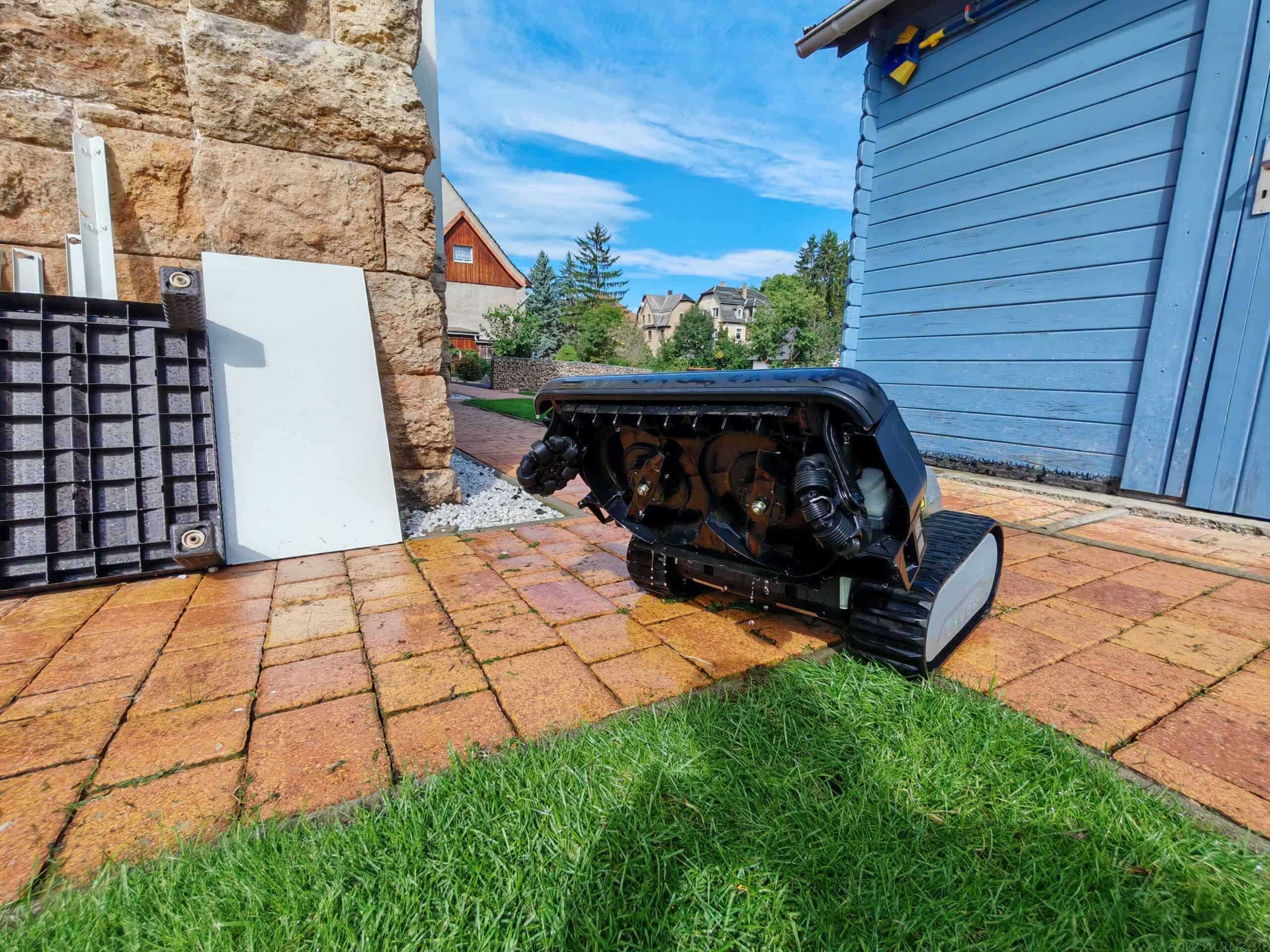
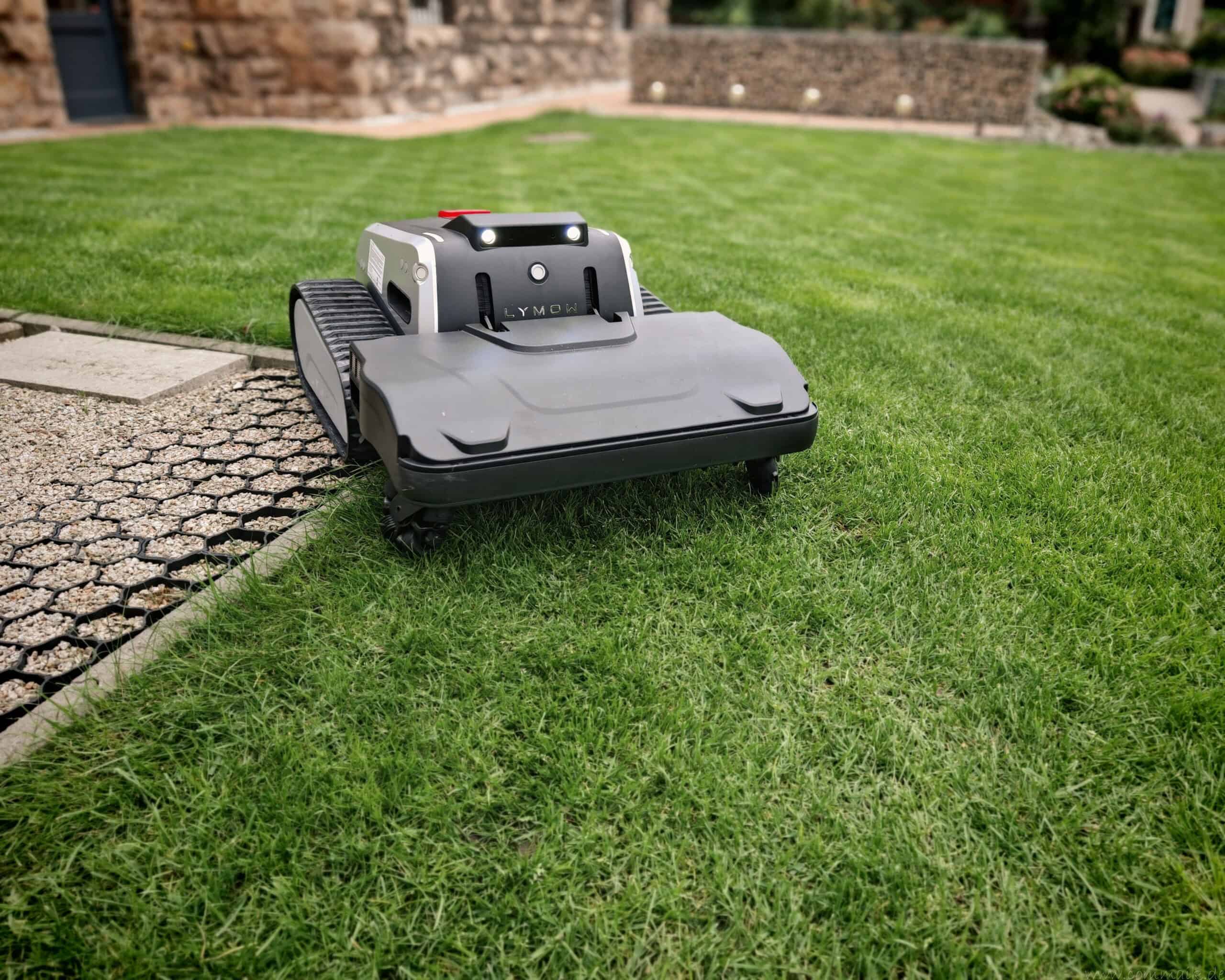
The housing of the Lymow One gives a high-quality and robust impression. The design is more reminiscent of a compact tracked vehicle than a classic lawn mower, not least because of the wide track drive. The solid body with a stable support surface, strong tank chains and a sophisticated chassis ensures a high level of off-road mobility, even on challenging surfaces or uneven terrain.
Scope of delivery
The scope of delivery of the Lymow One clearly stands out from many other products on the market. The standard package already includes several components that often have to be purchased separately for other robotic lawn mowers:
- Lymow One robotic lawnmower
- RTK reference station incl. Power supply unit
- Charging station with 10 m cable
- Standard charger
- Quick charger (charging time 90 minutes from 10-90 %)
- Tool and spare parts set
- User manual
Particularly noteworthy is the quick charger, which was only available later at the time of my test. For large areas and intensive use, however, it is a clear recommendation, as it considerably reduces loading times and significantly increases the actual mowing time per day.
The combination of RTK station, two chargers and extensive accessories makes the Lymow One a well-rounded overall package that sets it apart from many competitor models and makes it easier to get started with a wireless RTK system.


Video: Lymow One in test – robotic lawnmower without boundary wire with RTK navigation and chain drive
In the accompanying video I show the Lymow One in a detailed practical test. I explain how the robotic lawnmower uses RTK navigation and VSLAM to determine its position to the centimeter without a boundary wire and how the combination of camera and ultrasonic sensors helps to detect obstacles.
A central part of the video is the installation of the charging station, the setup of the RTK reference station and the initial setup via app. I demonstrate how the lawn is mapped, how zones and no-go zones can be defined and what options are available for fine-tuning the mowing strategy.
I then test the robot’s performance on large surfaces, its behavior on inclines of up to 45° and the traction of the chain drive in difficult passages. Edge mowing, reaction to obstacles and behavior on uneven terrain are also demonstrated.
The video gives a practical impression of the strengths and special features of the Lymow One and shows the plot sizes and application scenarios for which this model is particularly suitable.
You can find more videos about my projects involving robotic lawnmowers, garden maintenance and technology on my YouTube channel COMMAIK or in the video overview on my blog.
Zuletzt aktualisiert am 2. April 2026 um 08:04 . Ich weise darauf hin, dass sich hier angezeigte Preise inzwischen geändert haben können. Alle Angaben ohne Gewähr. (*) Bei den verwendeten Produktlinks handelt es sich um Affiliate Links. Ich bin nicht der Verkäufer des Produktes. Als Amazon-Partner verdiene ich an qualifizierten Verkäufen. Dein Preis ändert sich jedoch nicht.


Where to buy the Lymow One robotic lawnmower and accessories
The Lymow One robotic lawnmower can be ordered directly from the official Lymow store. With the discount code commaik you can make additional savings on your purchase. Orders are placed via Lymow’s international dealer platform, which offers both the device and compatible accessories.
The official LYMOW app is available for Android and iOS and is required during setup.
- Android: https://play.google.com/store/apps/details?id=com.lymow.app
- iOS: https://apps.apple.com/us/app/lymow/id6739445510
Several accessories are available for the Lymow One, including replacement blades, alternative blade sets and an additional battery, which is a particularly useful addition for large areas.
Here are the direct sources of supply:
- Lymow One
- Mulching blade set – Replacement blades for the dual mower deck. Ideal for consistently sharp cuts and a fine mulching result
- Super Swing blade set – Swinging high-performance blades that react more robustly to stone contact and are particularly suitable for uneven or stony terrain
- Spare battery – An additional 15 Ah battery for longer operating times – particularly useful for very large areas or if the robot is to mow several mowing zones in one day
Thanks to the extensive catalog of accessories, the robotic lawnmower can be flexibly adapted to large plots, changing mowing conditions and longer operating times.


Technical data of the Lymow One robotic lawnmower
| Feature | Value / Description |
|---|---|
| Model | Lymow One robotic lawnmower |
| Cutting width | 40 cm |
| Cutting height | 30-100 mm (adjusted from 3 to 10 cm) |
| Mower | Dual rotating, mulching knife blades, 6,000 revolutions per minute |
| Mowing performance per day | up to 7,000 m² (according to the manufacturer) |
| Max. Area per load | approx. 2,300 m² |
| Navigation | RTK + VSLAM (Visual Simultaneous Localization and Mapping) |
| Satellite reception | GPS, GLONASS, Galileo, BDS |
| RTK coverage | up to 1 km radius around the base station |
| Mowing zones | Up to 80 zones can be managed |
| Obstacle detection | Camera + 5 ultrasonic sensors |
| Obstacle avoidance | smart / fixed avoidance |
| Gradient | up to 45° (100 %) |
| Obstacle height | Can be driven over up to 50 mm |
| Drive | Chain drive / caterpillar drive |
| Driving speed | 0.3-1.0 m/s (adjustable via app) |
| Battery | LiFePO₄, 15 Ah, 528 Wh |
| Operating time | up to 3 hours |
| Loading time | 90 minutes (10-90 %, quick charger), approx. 360 minutes with standard charger |
| Charging cycles | approx. 2,500 cycles |
| Charging station | Automatic return (“charging station back”), IPX protection |
| Water protection robot | IPX6 |
| Communication | Bluetooth, WLAN (2.4 GHz), 4G |
| App support | Zones, no-go zones, schedules, mapping, control, PIN code |
| Security | Lift sensor, tilt sensor, impact sensor, electronic stop |
| Anti-Theft | Virtual fence, GPS lock, acoustic signals |
| Dimensions | 747 × 558 × 320 mm |
| Weight | 35.2 kg |
| Packaging weight | 47 kg |
| Housing material | Weatherproof plastic housing, reinforced structure |
| Battery temperature operation | -10 °C to +45 °C |
| Storage of the battery | -20 °C to +55 °C |
| Further information | SIM slot for 4G, front LED, reverse mode, line-follow mode |
The Lymow One combines a 40 cm cutting width with a flexibly adjustable cutting height of between 30 and 100 mm, which is suitable for manicured ornamental lawns as well as taller lawns. The dual mower deck with rotating mulching blades operates at up to 6,000 revolutions per minute, resulting in a fine and even cut. The brushless motor of the Lymow One also promises a long service life.
The built-in LiFePO₄ battery with 15 Ah offers high cycle stability and enables a range of up to 2,300 m² per charge. In combination with the quick charger, the downtime can be significantly reduced, which is particularly advantageous for large areas. The maximum daily output of 7,000 m² also makes the Lymow One interesting for very large plots.
Thanks to the combination of RTK and VSLAM navigation, the robotic lawnmower works without a boundary wire and achieves high mapping precision. Intelligent obstacle detection via camera and ultrasonic sensors ensures safe navigation in everyday life. The chain drive increases off-road mobility and enables gradients of up to 45 degrees, making it particularly suitable for slopes and uneven terrain.
With a protection class of IPX6, automatic return to the charging station, a variety of app functions and a robust design, the Lymow One has a complete technical package that is specially designed for large and demanding areas.
Setup & commissioning
Commissioning the Lymow One is clearly structured and largely self-explanatory. After setting up the charging station and connecting the power supply unit, the robotic lawnmower is fully set up via the app. The procedure is similar to other models without boundary wire, but differs in the additional steps involved in setting up the RTK.
As already described in my test reports on the Ecovacs GOAT A1600 RTK and the Anthbot Genie robotic lawnmower, the basic configuration is carried out directly via the app. With the Lymow One, this process is similarly intuitive, but more focused on RTK precision and connectivity.
Setup procedure in detail
- Setting up the charging station
The charging station is placed on a level surface, secured and connected to the power supply unit. It is important to have a clear area in front of the station so that the mower can start up correctly and dock automatically. - Initial start and Bluetooth pairing
The Lymow One is activated by pressing and holding the power button. Bluetooth pairing then takes place and the robot automatically appears in the app. This step corresponds to the procedure used by many current robotic lawnmowers without a boundary wire. - Setting up the WLAN connection (2.4 GHz)
The WLAN is then set up. Only the 2.4 GHz band is supported, which is common for outdoor devices due to the greater range. This connection is required for firmware updates, RTK synchronization and app control. - Firmware update
Immediately after the WLAN setup, the Lymow One automatically checks whether new software is available. This step should definitely be completed before the RTK coupling in order to avoid possible error messages with older versions. - Coupling the RTK reference station
Finally, the RTK antenna is linked to the robot via the QR code on the base station. This activates the precise RTK navigation. This step is a significant difference to other models such as the Anthbot Genie, which works without RTK.
The entire initial setup takes about 10-15 minutes, depending on the WLAN configuration and firmware updates. The Lymow One is then fully operational and ready for mapping and setting up the mowing zones, which is covered in the next section.


Navigation & mapping
The Lymow One robotic lawnmower uses a combination of RTK (Real-Time Kinematic) and VSLAM (Visual Simultaneous Localization and Mapping). This hybrid navigation enables centimeter-precise positioning without the need for a boundary wire. The fusion of camera, satellite systems (GPS/GLONASS/Galileo/BDS) and the RTK antenna is designed to precisely capture even large and complex lawns and store them permanently in the app.
Mapping procedure
After the initial setup, the robot is set to mapping mode. Mapping is carried out in several steps:
- Initial positioning
The Lymow One must be positioned within the RTK coverage. As soon as sufficient satellite signals are available, the app activates high-precision RTK positioning. - Control via app (joystick)
The base map is created by manually guiding the robot along the edges of the lawn using the app control.
This is a deliberate approach: unlike models that automatically drive a mapping lap, the joystick control enables very precise control – for example on edges, walls, pools or surfaces with narrow passages. - Automatic VSLAM supplementation
While the robot is guided along manually, the VSLAM camera creates an optical point cloud of the surroundings, recognizes structures, lines and objects and adds this information to the map in real time. - Saving the base map
The map is automatically saved after the round trip.
Zones, connecting channels, no-go zones or edge optimizations can then be created directly in the map. - Fine calibration and RTK stability
Before mowing for the first time, it is advisable to check the RTK stability.
– A value between 0.01 and 0.05 m provides the best precision.
If coverage is poor, RTK and VSLAM are automatically combined to maintain accuracy.
Comparison: Lymow One vs. Dreame A1 Pro during mapping
A direct comparison shows that the Lymow One relies much more heavily on manual control and RTK precision.
In the Dreame A1 Pro test, the focus was on fully automatic detection of the lawn using a combination of 360° LiDAR tower and 3D environment detection. To do this, the Dreame travels the boundaries independently and creates a very detailed 3D map without a joystick.
The Lymow One takes a different approach:
- Mapping is initiated and carried out manually, which provides more control.
- The precise RTK positioning results in very clear and straight edges on the map.
- The combination of RTK + VSLAM leads to particularly stable results – even between tall buildings or trees.
- No-go zones and mowing zones can be created directly during mapping, which makes it easier to structure large plots of land.
This more “technical” mapping process of the Lymow One is ideal for users who want to define the area precisely and need full control over how the robotic lawnmower recognizes boundaries and passages.
Obstacle detection in practice
Obstacle avoidance works reliably in the test: Whether flower pots, garden furniture, flower bed edging or a garden hose – the robot recognizes objects early on via the camera + five ultrasonic sensors and circles them safely.
In contrast to many models, which slow down and stop at small obstacles, the Lymow One has a smooth swerving behavior, which contributes to the higher area performance.
How does RTK work with the Lymow One?
RTK (“Real-Time Kinematic”) is a satellite-based positioning method that significantly increases the accuracy of GPS signals. While conventional GPS achieves an accuracy of around 1-3 meters, RTK reduces this deviation to a few centimeters.
With the Lymow One, RTK works as follows:
- An RTK reference station is located on the property and permanently receives GPS, GLONASS, Galileo and BDS signals.
- This base station compares the satellite data with its defined position and calculates correction data from it.
- The correction data is transmitted to the robotic lawnmower in real time.
- The robot combines this precise RTK data with its VSLAM camera to generate a stable and centimeter-accurate image of the situation.
- As a result, the Lymow One can drive precisely along edges, maintain precise mowing strips and ensure a clean line even on large areas – without a boundary wire.
RTK thus ensures the high precision that the Lymow One relies on, especially on large or complex plots of land. Further information: Robot mower without boundary wire.


Chain drive, incline & off-road mobility
The chain drive is one of the most striking features of the Lymow One and clearly distinguishes it from classic robot mowers with rubberized individual wheels. The wide tracks increase the contact surface and ensure stable traction, even in difficult conditions such as damp grass, loose soil or uneven terrain. This is where the Lymow One really comes into its own, especially on demanding surfaces with changing ground conditions.
Inclines up to 45° in practice
The 45 degrees (100 % gradient) specified by the manufacturer is an exceptionally high value.
For comparison:
- Many conventional robotic lawnmowers with wheel drive can manage 15-20°
- 25-30° is the upper limit for the more powerful models
- 45° can only be achieved by a few special devices with caterpillar drive
In practice, a slope of 45° means that the ground is twice as high as it is wide – an extremely steep slope that rarely occurs in private gardens. This value is nevertheless relevant: areas with wet embankments, lawn terraces, slope access roads or transitions to natural stone walls can be driven on safely.
In the test, the Lymow One remained stable on its support surface even at maximum inclination, without slipping sideways. The chains grip evenly and distribute the weight so that the robot does not tip over or dig in.
Influence of weight
Weighing around 35 kg, the chain-driven robotic lawnmower is one of the heavier robotic lawnmowers on the market.
The high weight has two sides:
Advantages:
- Better grip on inclines
- More stable directional stability
- Greater precision when driving over edges
- Less spinning of the drives on wet grass
The sturdy housing and solid body also support off-road mobility.
Disadvantages:
However, the heavy weight also has an impact on sensitive lawns. The caterpillar drive can be particularly effective in damp soil or on ornamental lawns:
- leave visible print marks
- Flattening grass fibers
- Create slight depressions on soft, softened floors
- cause slight compaction during repeated trips
These effects are more pronounced in robotic lawnmowers with tracks than in models with narrow individual wheels. They are not critical on normal lawns, but are visible on ornamental lawns with a very soft structure.
When the chain drive is ideal – and when it is not
Suitable for:
- Large, uneven lawns
- Slopes and embankments
- Angled areas with changing surfaces
- Gardens with narrow transitions or a higher terrain profile
Less suitable for:
- very soft, damp soil (e.g. after days of rain)
- extremely well-kept ornamental lawns with sensitive leaf structure
- Freshly sown areas or areas of lawn with few roots
Overall, the chain drive ensures exceptionally strong off-road mobility, which sets the Lymow One apart from many other models, especially on large plots of land with challenging terrain.
Mowing performance, cutting pattern & mower deck
The mowing deck of the Lymow One works with two rotating mulching blades, each of which is mounted separately and rotates in opposite directions. This dual configuration creates a clean, even suction that lifts the grass and cuts it very finely. In contrast to many robotic lawnmowers, which rely on simple, free-swinging blades, the Lymow One uses a fully-fledged rotating mower, which is more reminiscent of a classic lawnmower – but in a compact, robotic format.
Design and function of the dual mower
The mowing deck combines two separate blades that together cover a 40 cm cutting width. The rotating movement of the two blades creates a constant air flow under the cutting deck, which supports a very homogeneous cutting pattern. The 6,000 revolutions per minute of the brushless motor ensure a high cutting performance – even with dense, slightly damp grass.
There are clear differences compared to the standard swing blade systems used by many robotic lawnmowers:
Advantages of the rotating dual mower deck:
- Significantly cleaner cut, as the blades actively cut instead of “tearing”
- More stable cutting performance even with taller or denser grass
- Finer mulch distribution, as the grass is shredded several times
- less fraying on the blades → promotes a healthier turf
- More even tracks, as the full working width is used
Disadvantages compared to swing blades:
- More susceptible to damage from direct stone contact
- Increased operating noise at full speed
- higher power input → slightly more energy consumption
For large areas, however, the advantage of the active mower is clearly noticeable: the cutting pattern is more precise and uniform than with many robotic mowers that rely on simple swivel blades.
Cutting pattern, cutting width & cutting height
The cutting width of 40 cm ensures a high area output, as more lawn is covered per pass. The cutting height of 30-100 mm offers great flexibility – from short ornamental lawns to taller utility lawns.
In my test, the grass was evenly covered even at maximum height without leaving any stalks.
Mulching function & side discharge
The Lymow One works purely as a mulching mower. The finely shredded clippings are discharged to the outside by the air flow and distributed evenly over the surface. This creates a natural nutrient cycle that visibly and measurably supports the lawn when mowed regularly.
However, the lateral ejection has a typical effect:
- The mulch remains barely visible on ornamental lawns
- Grass can accumulate on the sides of edges or next to paths
To avoid this, the app offers a “Turn Off Outer Mowing Motor” function. This deactivates the outer motor and prevents side discharge during edge mowing.
This is particularly useful:
- along flower beds
- on paved paths
- at the edge of the pool
- on terraces or wall edges
This keeps the area clean without blowing clippings onto hard surfaces.
Mowing performance on edges & borders
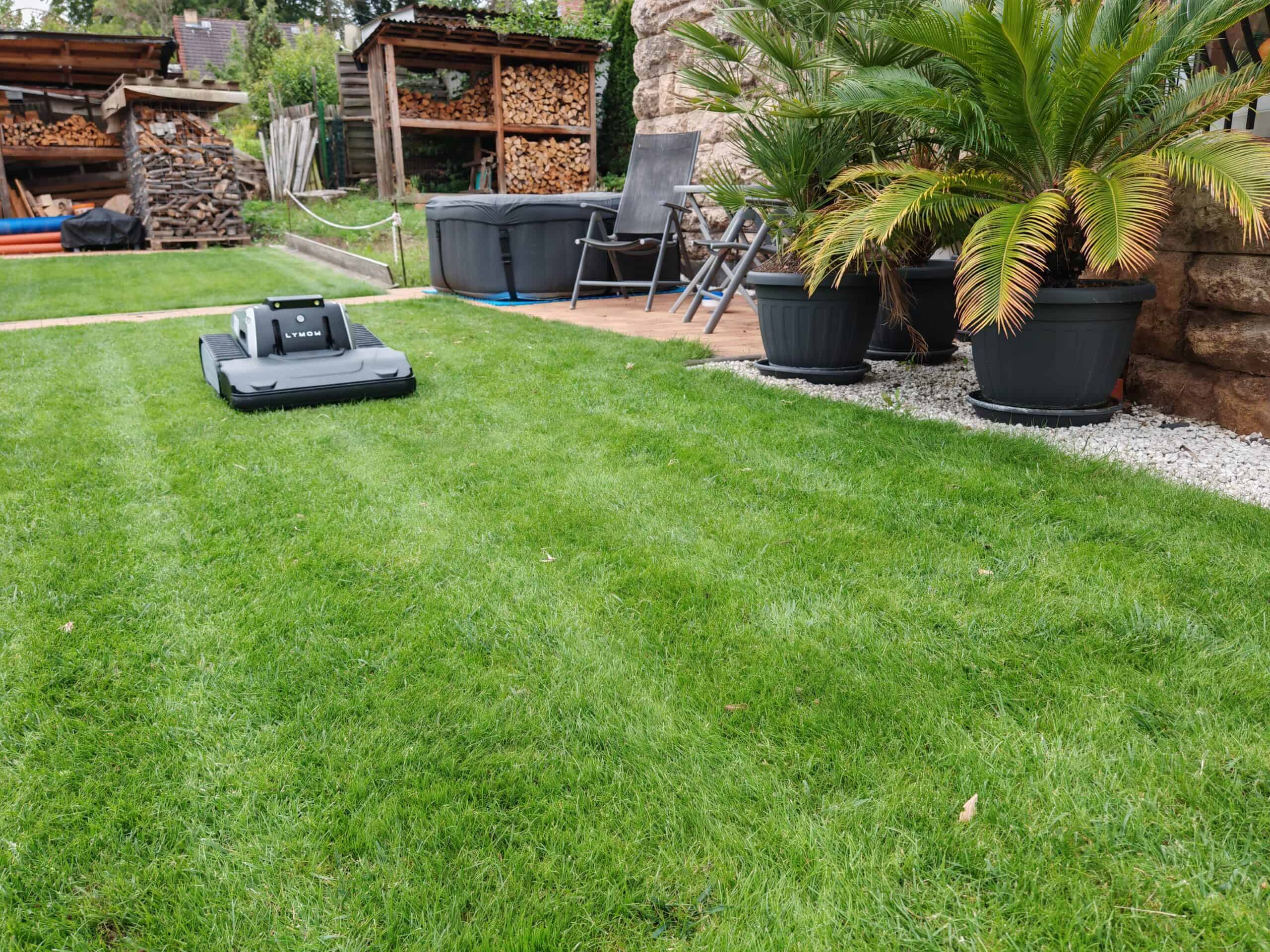
Thanks to its precise RTK control and stable handling, the Lymow One reaches edges very reliably. The test showed:
- the edges are captured cleanly and completely
- Tight areas, bends and corners are driven very precisely thanks to RTK
- the robot keeps the line clean without oscillating or deviating
Compared to models without RTK, it works much more precisely on edges and reduces manual reworking.


App functions & control
The Lymow One is controlled entirely via an app, which serves as a central user interface for setup, mapping, configuration and monitoring. All relevant settings of the robot can be made directly via the smartphone, which means that no operation on the appliance itself is necessary. The app is clearly structured, detailed and offers extensive options for adapting the mowing process precisely to the property, terrain and individual requirements.
Map management & zone control
After mapping, the app provides a detailed overview of the detected lawn area. Here you can:
- Mowing zones are created or deleted
- No-go zones are defined (e.g. flower beds, play areas, ponds)
- Channels can be created between zones
- Edge areas can be subsequently corrected or extended
Impact:
The surfaces can be structured very precisely, allowing the robot to reliably process even large, angled or complex plots.
Adjustment of cutting height, mowing speed & rotational speed
The cutting height, forward speed and speed of the mower can be adjusted via the app:
- Cutting height: 30-100 mm
- Mowing speed: 0.3-1.0 m/s
- Blade speed: up to 6,000 rpm
Impact:
A lower speed or higher speed improves the cutting pattern. A higher speed accelerates surface progress, but reduces precision.
Mowing pattern, sequence & edge mode
The app offers several options for adjusting the mowing strategy:
- Zigzag, Checkerboard, Relative checkerboard
- Perimeter First / Main Area First
- Perimeter laps for precise edge processing
- Turn Off Outer Mowing Motor for clean edges without lateral ejection
Impact:
The lawn can be mowed more visually appealingly, more efficiently or particularly precisely – depending on your wishes and the type of lawn.
Automatic return to the charging station
The robot automatically returns to the charging station as soon as the battery reaches a defined charge level or a schedule has been completed.
Impact:
The mowing work is completely autonomous – no intervention required.
Schedules & automation logic
Individual schedules can be created for each zone in the app:
- Multiple time slots per zone
- Different days of the week
- Adjustment of the cutting parameters per zone
Impact:
The robot works on demand – ideal for large plots or areas that only need to be mowed at certain times.
Rain sensor & weather logic
The Lymow One has an integrated rain sensor. As soon as moisture is detected, the mowing process pauses automatically.
Impact:
The robot leaves fewer tracks on soft ground and the mulch quality is maintained.
Obstacle detection & safety functions
The app displays obstacles detected during operation. The camera and the five ultrasonic sensors work autonomously in the background.
Impact:
The robot stops or takes evasive action at an early stage, which prevents damage to the appliance or the garden.
Anti-theft mode & virtual fences
The app allows you to set up a virtual safety radius:
- GPS-based lock
- Motion detection outside the area
- Acoustic warning signals
- Remote lock via app
Impact:
Provides protection against unauthorized use or theft – especially on large, open properties.
Firmware updates via WLAN
Software updates are installed automatically via the 2.4 GHz WLAN. firmware updates:
- Navigation & RTK stability
- Improved obstacle detection
- New app functions
- Stability and security updates
Impact:
Over time, the robot becomes more reliable, more precise and gains new functions without the need for hardware changes.


Maintenance & cleaning
Maintenance of the Lymow One is largely uncomplicated and designed for a long service life. Despite the high IPX6 protection class, which protects the robot against strong water jets, the manufacturer expressly recommends gentle cleaning without direct high pressure and without rinsing completely with large quantities of water.
The mowing deck is best cleaned with a soft brush, a damp cloth or – in the case of dry grass residue – with compressed air. Removing mulch and dirt deposits in the area of the blades is also quick and easy, as the mulching blades can be replaced in just a few simple steps.
The tracks should be regularly cleaned of grass, soil and damp residue, as this improves off-road mobility and prevents dirt from accumulating between the rollers.
Cleaning with a garden hose – yes or no?
With IPX6 certification, the Lymow One is protected against powerful water jets. Nevertheless, the manufacturer does not recommend cleaning with a garden hose in order to:
- Avoid moisture ingress if sealing surfaces are open or damaged
- protect electrical components
- avoid unnecessary strain on bearings, sensors and drives
The following therefore makes sense in practice:
- easy rinsing with little pressure is possible,
- However, high-pressure cleaners or hard water jets should be avoided at all costs,
- Cleaning with a brush, compressed air or a damp cloth remains the gentlest method.
Battery care
The built-in LiFePO₄ battery is one of the longest-lasting battery technologies in the robotic lawnmower sector. With up to 2,500 charging cycles, it achieves an exceptionally long service life and is ideal for daily operation over several years. LiFePO₄ batteries are also significantly more resistant to heat and have a lower self-discharge rate than conventional lithium-ion cells.
Behavior in winter & at sub-zero temperatures
Clear recommendations apply for winter operation and storage:
- The battery must not be operated below -10 °C.
- The charging temperature must be within the range of 0 to +45 °C; charging at freezing temperatures can permanently damage the cells.
- During longer breaks, the battery should be charged to 60-70% capacity.
- The robot should not be left outside in winter if temperatures fall below -15 °C.
- For the winter break, dry storage indoors is recommended, ideally at temperatures between +5 and +20 °C.
- If the robot is not used for more than three months, the battery level should be checked every two months and recharged if necessary.
These measures protect the cells from cold stress, maintain chargeability and significantly extend the overall service life.
Conclusion on the Lymow One from Lymow Tech
After the extensive practical test, the Lymow One can be classified as a robotic lawn mower consistently designed for large, complex and demanding lawns. With the combination of RTK and VSLAM navigation, chain drive and a wide mowing deck, Lymow Tech realizes exactly what is laid out in the manufacturer’s portrait: The company Lymow Tech: a powerful robotic mower without boundary wire that works where classic systems with wire and wheel drive reach their limits.
In practical use, the Lymow One impresses above all with its precision mapping, very clean mowing paths and high off-road mobility. The track drive with caterpillar tracks, the climbing ability up to 45° and the robust design make it particularly interesting for slopes, uneven terrain and large, structured areas. The dual mower deck with two rotating mulching blades delivers a clean cutting pattern, and the combination of high cutting performance, large cutting width and powerful LiFePO₄ battery ensures that even very large lawns can be mowed efficiently.
The app control with zone management, no-go zones, schedules, adjustable mowing patterns and detailed parameters for cutting height, speed and edging mode fits in well with this technically oriented concept. In combination with the RTK reference station, the result is a system that is much closer to professional solutions than to simple consumer robotic lawn mowers.
At the same time, the approach also entails clear requirements: The Lymow One is no lightweight, and the high dead weight in combination with the chain drive can leave visible marks on very soft ground or sensitive ornamental lawns. The setup with RTK base, app, mapping and fine-tuning is somewhat more complex than with simple models, but rewards this effort with noticeably more control and precision.
All in all, the Lymow One shows where modern robotic lawnmowers without boundary wires can develop: away from a pure comfort device for small standard gardens to a highly specialized tool for large plots, slopes and complex lawn structures. The Lymow One is a very exciting option for precisely these application scenarios – especially when performance, area capacity and navigation accuracy are more important than maximum lawn protection in ornamental lawns.
Summary
The Lymow One robotic lawn mower from Lymow Tech is one of the most powerful robotic lawn mower systems in its class. Thanks to the combination of RTK navigation, VSLAM, camera and ultrasonic sensors, the robotic lawnmower works with centimeter precision without a boundary wire, making it ideal for large plots and complex lawns. The robust chain drive enables exceptional off-road mobility, even on inclines of up to 45°, uneven terrain or slopes.
With a wide cutting deck, two rotating mulching blades, a cutting width of 40 cm and a flexibly adjustable cutting height of 30-100 mm, the Lymow One delivers a clean cutting pattern and high area performance. The system can be fully controlled via app, including zone management, no-go zones, mowing patterns and automatic return to the charging station.
Thanks to the long-lasting LiFePO₄ battery with up to 2,500 charging cycles and a range of around 2,300 m² per charge, the Lymow One is particularly suitable for demanding areas and large gardens that often cannot be reliably covered by conventional robotic lawn mowers.
Overall, the Lymow One sets clear standards in the segment of robotic lawnmowers without a boundary wire and shows where modern, RTK-based solutions for large and complex lawns are heading.
FAQ – Frequently asked questions about the Lymow One and RTK robotic lawnmowers
1. what is the Lymow One and for which properties is it suitable?
The Lymow One is a robotic lawnmower without a boundary wire with RTK and VSLAM navigation. It is particularly suitable for large plots, slopes, uneven terrain and complex lawns with multiple zones.
2 How does RTK navigation work with the Lymow One?
The RTK reference station sends correction data to the robot and combines it with GPS, camera and VSLAM. This allows the robot to mow with centimeter precision, even in difficult environmental conditions.
3. does the Lymow One need a boundary wire?
No. The robot works completely wirelessly. The boundaries are defined once via the app mapping and saved permanently.
4. how well does the Lymow One cope with slopes?
The chain drive enables inclines of up to 45° (100 %). This allows the robot to cope with embankments, slopes and uneven terrain much better than most robot mowers with a wheel drive.
5. what is the maximum mowing area?
The Lymow One manages up to 7,000 m² per day and around 2,300 m² per load. This also makes it suitable for very large lawns and green spaces covering many square meters.
6. how precise is the obstacle detection?
The combination of camera + five ultrasonic sensors ensures reliable obstacle detection. The robot brakes in good time, recognizes flower pots, garden furniture and garden hoses and drives safely around them.
7 What are the advantages of the chain drive?
The chain drive improves traction, stability on inclines and handling on wet or uneven ground. However, the higher weight can leave slight marks on soft or damp grass.
8. how is the Lymow One set up?
Setup is done via app:
Bluetooth pairing → WLAN setup → Firmware update → RTK pairing → Mapping.
The entire process takes around 10-15 minutes.
9 How is the Lymow One cleaned?
Although the robot is IPX6 water-resistant, the manufacturer recommends gentle cleaning with a brush, damp cloth or compressed air. Rinsing with low water pressure is possible, high-pressure cleaners are taboo.
10. how long does the battery of the Lymow One last?
The built-in LiFePO₄ battery offers up to 2,500 charging cycles and a maximum runtime of 3 hours. This makes the robot suitable for frequent, daily use over many years.
👇 You can buy the LYMOW ONE here*:
Dieser Beitrag ist auch verfügbar auf:
 English
  Deutsch


Ähnliche Beiträge

Draining the basement with a new horizontal barrier – conclusion after 9 months
Laying pool edging stones and building your own pool terrace for the perfect pool surround